Designation: PET5860
English name: Leatherback Turtle
Origin: The warm waters of the Atlantic Ocean, Indian Ocean and Pacific Ocean
Vulnerability to disease: Decay
Life: Overview of leatherback turtle species for about 50 years
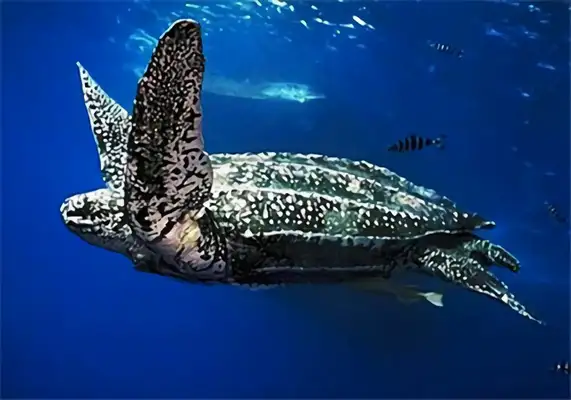
Leatherbacks are the largest species of turtles, living in the sea and travelling long distances only to lay eggs and breed. In recent years, they have been predicted to be completely extinct over the next 10 to 20 years, owing to the harsh living environment and the sharp decline in the number of leatherbacks.
Chinese literary name: leatherback turtle
Latin name: Dermochelys coriacea
English name: Leatherback Turtle
Don't call it a turtle, a turtle, a turtle, a turtle, a swallow turtle.
Context: Animals
Gate: Pipeline gate
Programme: reptiles
Tortoises.
C: Leather turtles
Yes: The leatherback
Castes: leatherback turtles
Distribution: In the warm waters of the Atlantic Ocean, the Indian Ocean and the Pacific Ocean, breeding grounds are essentially between latitude 30° N and latitude 20° S. From time to time, baited individuals can go up the current to Iceland near 70° N and down to Uruguay 35° S. Our South Sea, the East Sea and the Yellow Sea are all distributed, with records from Guangxi, Guangdong, Fujian, Taiwan, Zhejiang, Jiangsu, Shandong and Liaoning provinces.
Quantity: Not available, but significantly less than previously and with a potential for extinction within 10 years.
Eating: mainly with fish, shrimp, crab, squid, snails, clams, starfish, cucumbers, seaweeds and seaweeds, and even jellyfish with long toxic sting cells. It does not have teeth in its mouth, but it has large and sharp horny thorns in the oesophagus that can grind food and then digest it into the stomach and intestines. Prism turtle morphological characteristics
The skeletons of the leatherbacks are embedded in hundreds of small polygonal slabs, the largest of which form the vagueness of seven rules and are therefore known. These are transected at the back end of the body into a sharp hip, and the two sides of the body form an incoherent arc. The osteoporosis of the abdomen is not embedded in a small plate, and consists of five columns of small bones that are firmly embedded in a dense tissue, with one row of the centre breaking through the umbilical cord. Its mouth is a hook, its head is particularly large and cannot be indented into the crust. Prism turtle care knowledge
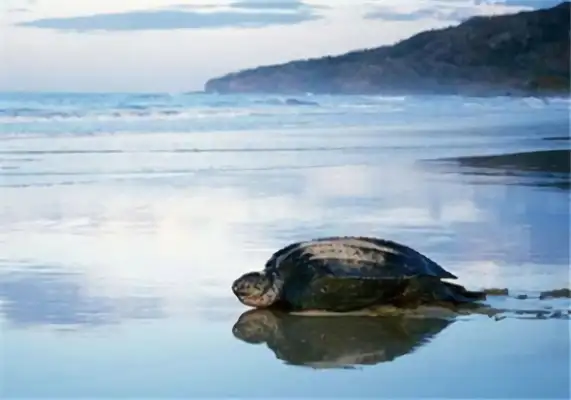
Leatherback turtles are elves in the ocean, a once large-scale return, but instantaneous numbers have fallen to extinction, and people are trying to protect this species, but because of the complexity of the coastline, protection requires concerted efforts by multinational Governments.
The number of leatherback turtles has fallen sharply.
As early as the 1960s, 10,000 leatherback turtles had settled in the Rantaa region on the eastern coast of the Malay Peninsula. So this is also the largest leatherback breeding ground in the world. According to the fisheries sector in Malaysia, only three leatherback turtles came in last year and none produced eggs. Professor Chang Eun-sheng (Sing), who led the Malaysian Sea Turtle Institute, said that the Pacific Ocean as a whole, in a very short period of time, would experience a decline in the number of leatherback turtles, as in the Rantaa region. It is painful to see this precious animal on the brink of extinction and to be powerless, according to a regular professor. The leatherback is usually as long as 2 metres. They fall victim to fishing vessels fishing for tuna and swordfish in the deep sea.
II. Reproduction of leatherback turtles
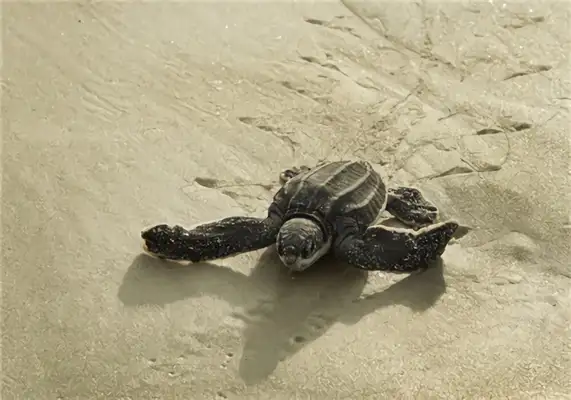
The leatherback is an egg that can produce 70 to 110 eggs at a time. Each year between May and June is the main spawning season for leatherback turtles, and females need to climb from the sea to the beach to dig for eggs. The laying of eggs is usually carried out at night, with great caution and immediate return to the sea if there is external interference. The laying of eggs is preceded by the digging of a pit on the beach with 90-150 eggs at a time, which can also be laid several times during reproduction, which is then covered with sand and hatched by natural temperature, but more than 10 in each nest are often unsuccessful. The size of the newly hatched larvae is about 5.8 to 6 centimetres, which instinctively climbs to the sea. Leatherback living environment
The leatherback cannot be artificially nourished, so people can only study its wild environment. Leatherbacks live in the sea, the largest turtle, with a wide area of the world and continuous cruises.
I. Large distribution of leatherback turtles
Leatherback turtles are mainly located in warm tropical and subtropical waters of the world, with breeding sites essentially located between latitude 30° N and latitude 20° S. From time to time, baited individuals can go up the current to Iceland near 70° N and down to Uruguay 35° S. China is spread over the East and South China Seas in the vicinity of Guangdong, Fujian, Zhejiang, Jiangsu, Shandong, Liaoning, Taiwan, Hainan, etc., as well as the sea off the Yangtze River in Shanghai.
II. The breeding of leatherback turtles cross the Pacific Ocean
Leatherbacks are known to travel over 6,000 miles from the west coast of the United States to produce eggs in Indonesia. Pacific leather turtles cross the Pacific during egg production and are the longest migratory organisms in nature. Due to the size of the leatherback limbs and their transformation into oars, they can swim in the ocean in a sustained and rapid manner, so they are called “swimming generals”. In 1970, a leatherback turtle was caught in the sea of the Yangtze River, and the markings on its body indicate that it was once caught in the British Atlantic Ocean, just as its swimming skills were high. Precious turtle breeding points
Leatherback turtles are fed mainly by seaweeds such as fish, shrimp, crab, squid, snails, clams, starfish, sea cucumbers, seaweeds and seaweeds, and even jellyfish with toxic sting cells. It does not have teeth in its mouth, but it has large and sharp horny thorns in the oesophagus that can grind food and then digest it into the stomach and intestines. The leatherback has bad eyesight. As a result, they often eat plastic bags floating on the sea or other garbage as jellyfish, causing intestinal blockage, resulting in the death of large numbers of leather turtles from human-made white garbage.