No.: PET1817
English name: Pacis Dwarf Cichlid
National origin: Nigro, Barcelona, Pure Particle
Vulnerability to diseases: albino disease, rotting tail disease
Life: 5-6 years brief on bi-banded shorts
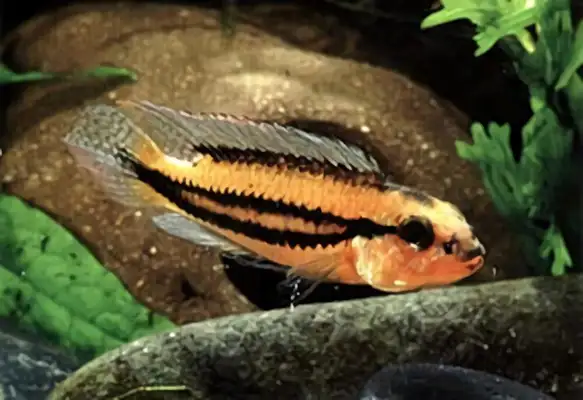
The bi-banded snails, which were known early as the blue lymphs, later became the name of the bi-banded snails based on translation from abroad. Males also have bright, light-eyed blue metal on their skins, which is very beautiful, but it is very difficult to raise and breed both.
School name: Apistograma paucisquamis
English name: Pacis Dwarf Cichlid
Distribution: Nigro, Barcelona, Pure Particle
Water temperature: 22-25 degrees
Quality of water: pH 6.5-7.2 bi-band short-chronic appearance
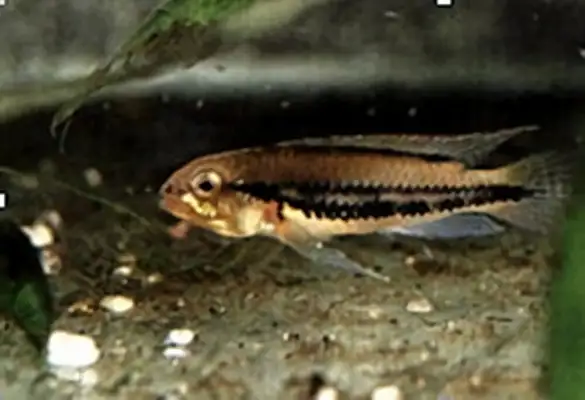
The name of the bi-banded bi-banded, also known as the blue-collar-tailed cylindrical cymbal, is gradually being accepted in Germany, where the name of the bi-banded cymbal is known to the public. It's also very beautiful, but it's more difficult to raise.
The mouths of the pairs are large, with two thick and visible black stripes on the side, the adult male fins are chords, and his fat fins are glamorous and beautiful; their surfaces are glittered with blue metal, so they are called blue tails. The most significant feature is the two black bands of the side of her body, which pass through the body and end on the tail, mainly with the rear of her eyes, which are long in shape, with the back fins free of tall hard thorns, with the smooth and smooth back fins rising backwards and extending backwards, and the colour mix, which is glamorous, mainly red-based, placed on the edges of the edges, with the metal blue, with the back fins as pink as gold, the tails of the piano, a circle of red and blue-phased web blossoms, like fanes.
The abdominal fins with a pair of short beaks are also super-normally long, stretching around the hips, with a larger mouth, with a slightly uncoherent shape, but that's her feature, with a slightly blue lid underneath her eyes. Bi-banded sorghum breeding environment
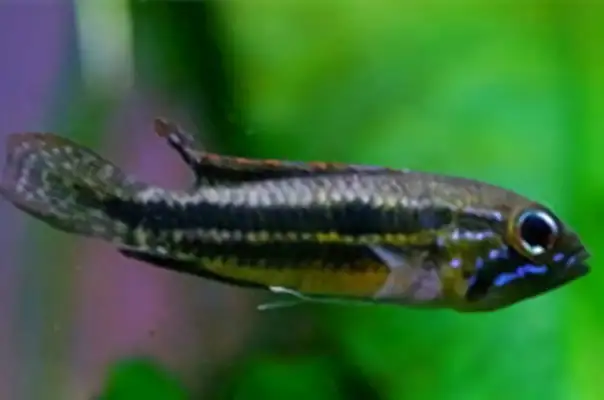
It is more difficult to raise and reproduce sorghum with two belts, so it is more advisable to raise fish friends with experience in breeding. The shape of the pairs is very beautiful, but due to their sensitivity to water quality, attention needs to be paid to all aspects of water quality in the breeding process.
The development of water quality with short beaks must be more stringent than that of other short beryllium species, with lower pH values, followed by lower hardness to meet its water quality standards, very slow water flow in the local wild environment and very close water colours, so that it can be modelled on the generally deeper water colour and slow-flow filtering system in the wild environment, with thick grass for her cover, and deep wood and stone caves being the best place to live, warm and shy. It is recommended that water temperature be 25-28°C and PH 4.5. Two-banded crotch.
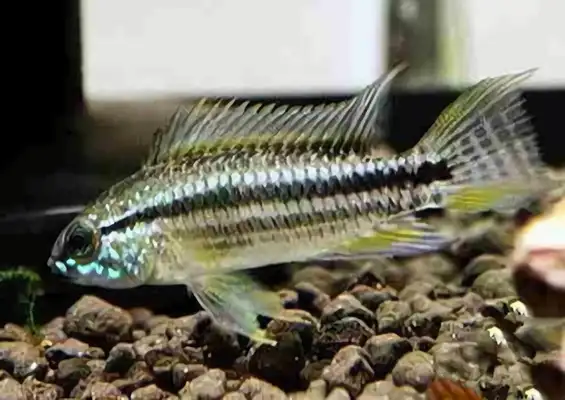
The difficulty of raising sorghum is not only a problem with the water quality environment, but also in feeding them. Double-banded shortseng is a groin fish, but there is a lack of food in the wake of environmental change, so it is necessary to feed short-banded shortseng with bait.
The most important aspect of day-to-day management is water quality stability. Even if water quality indicators are not ideal, as long as they remain stable, the bi-band can survive as long as the water is fixed. Many artificial fish have been multi-generationalized and adapted to the quality of piped water. In addition, maintaining a time-bound bait and a small number of meals would be beneficial for fish generation. There must be regular change of water, and every time there is a change of water, it is only necessary to keep changing regularly. Watch the heat in winter. With regard to baiting, it is possible to feed and feed, with thong shorts that are already used to artificial feed, with thong shorts to be trained.