No.: PET4237
English name: False Map Turtle
Country of origin: Overview of north-eastern United States map turtle species
Map turtles are not as common as turtles and turtles, and when they do, they are often individual and usually male (perhaps because they are smaller in size). Map turtles can live well under artificial rearing, but must be cared for in the right way. In most cases, their care is similar to the requirements for raising turtles and turtles. Map turtles are less resistant to poor water quality than other water turtles. For the health of turtles, clean water must be maintained. Northern map turtle morphological characteristics
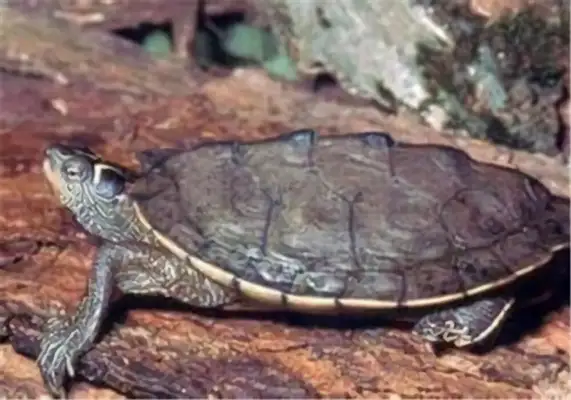
Map turtles are similar in size to the more common turtles and turtles. Unlike these turtles, however, the map turtle has a clear tatter in the middle of its back. In many types, this gust is more like a large puncture or tumour stretching up back.
This feature gives the map turtle another nickname: Sawbackturtle. Most map turtles also highlighted the back of their backs, making the backs of their backs visible sawn teeth. Some species have large head and jaws, which allow them to bite snails and other molluscs. At the end of the day, the most striking difference is the distinctive fine lines on their skins and shields, which are the origin of the name “map turtles”, because they look like the contours and road maps on the map. These fine web lines give map turtles a beautiful and elegant aerobics, which other turtles cannot access.
Within the map turtle, it is easier to distinguish between females and males. Like most other turtles, males have larger tails than females, and their excretion holes are located beyond the back of their backs. The male has extra claws on his front feet. The size of the body after adulthood can also be a distinguishing feature. For most turtles, the smallest female is also equal to or greater than the largest male.
For northern map turtles, there is nothing more special than the yellow one behind the ear, and the hysteria is not particularly visible and of light colour. Northern mapping turtle care knowledge
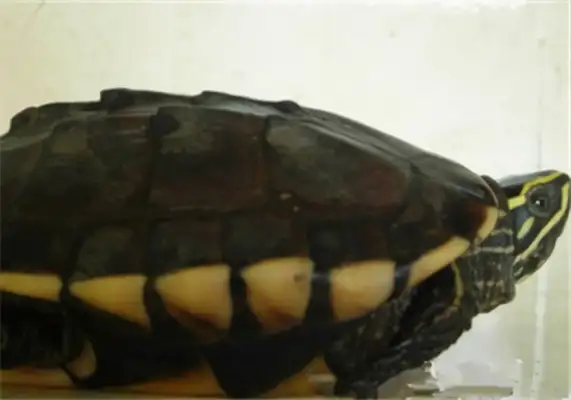
Due to the fact that northern map turtles are more neurotic than other turtles, heart selection is also applied to breeding sites. In busy areas, turtles may be under stress due to persistent mental stress. So northern mapping turtles need a relatively quiet growing environment.
I. INDIVIDUAL ELEMENTS
1. To start with a sense of “real” (weight);
2. Strong limbs;
3. Without disability;
4. No broken claws, no broken tails;
5. Physical homogeneity, no error (some individuals are ranked very symmetrically, but more valuable for adoption).
II. Selection of breeding containers
The material and size are not only taken into account. Individuals believe that better boxing, easier water exchange, and translucent materials also prevent sunlight and enhance turtle security. Sizes can be selected by their own senses, and there is no need to care about scientific data, such as rearing density, but it is important to note that too crowded is affecting the growth of turtles, which are not safe in space. The water can't be too deep, but it's enough for the turtles to come out of their noses.
III. Reproduction practices
Female map turtles routinely produce several eggs during a reproductive period. The number of eggs varies according to type. They need 60 to 75 days to hatch. When laying eggs, female turtles usually choose well-drained locations, such as sand beaches and open fields. For certain types of map turtle, the temperature at which the eggs are hatched affects their ultimate sex. At 25 degrees Celsius, most of the incubation occurs in males, while the eggs are kept at 30 to 35 degrees Celsius, while the female hatches. Northern map turtle living environment
Despite the fact that the northern map turtles are less demanding than water quality, you have to pay attention to their healthy growth! Chlorine gas in the piped water has an impact on turtles, especially in areas where water quality is different and chlorine levels vary. Fish friends know that when water is replaced, the body is filled with bubbles, “head-heavy”, followed by blood from the fish, so that the water goes through more than a day of “crawling water” before replacing the turtle. Northern map turtle breeding points
The north map turtles are impregnable and many of the information is presented in their recipes, and in practice the vegetarian diet is largely indifferent, except for fish, shrimp and meat. The north map turtles love shrimp as their staple food (must head off and avoid the “shrimp gun” stinging the turtle's oesophagus), which can increase the body erythmus of the turtles, as well as calcium, pre-opt, and feed small fish appropriately.