Designation: PET3668
English name: Green-cheeked Conure
Vulnerability: respiratory, digestive and parasitic diseases
Life: An overview of the species of parrots on the green cheek cones, 10-20
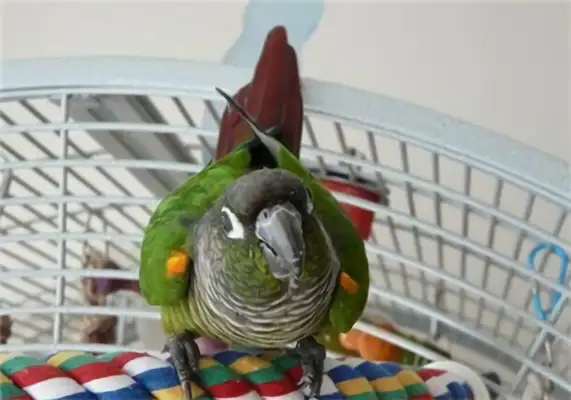
Green-cheeked Conure, known as the Green-cheeked Conure, is a typical climber of birds, whose feathers are more colourful, mainly in the eastern highlands of Bolivia.
The parrots are very young. It is inhabited by areas of various trees, swamps, forests filled with small trees, areas of secondary vegetation and areas of cloudy forest of 2900 metres. Food consists of seeds, berries, fruits, nuts, insects and their larvae. In Argentina, Brazil and Paraguay.
Chinese literary name: Green Cricket Parrot
A Chinese alias, "The Green-Skinned Man of the Sun."
English name: Green-cheeked Conure
Two words:
Area: Animal
Door: vertebrate door.
Platform: Birds
It's a parrot.
Section of parrots
Family: Conesian parrot
Asian: 5
Distribution: morphological characteristics of the highlands of the highlands of Bolivia
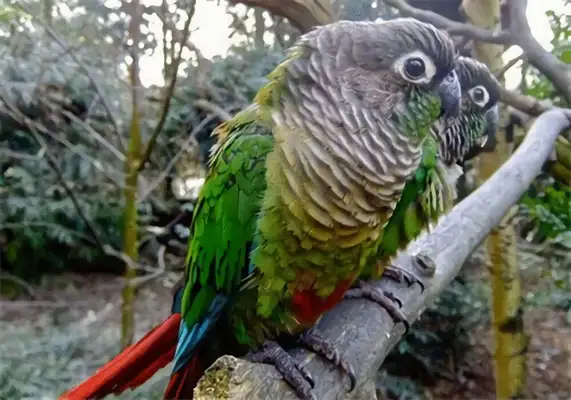
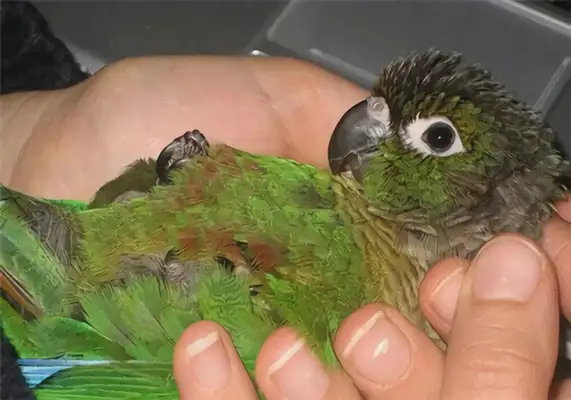
With five sub-species, the size of parrots varies from one sub-species to another, so that they have an adult body of about 24-26 cm and a weight of about 60-80 g. The chronology of young birds is roughly the same as that of adult birds. However, the overall plume is dim, the iris color is deep and the red brown feathers in the lower abdomen are scattered only sporadically.
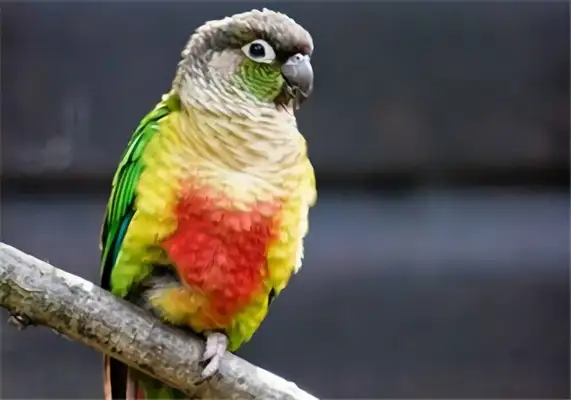
This parrot is green, with a narrow red brown feather distribution in front of the head; a small blue feather in the forehead, head, rear of head and ear feather; a little blue feather in the neck; brown green in the neck from brown to brown in the throat and upper in the chest; brown and yellow in each feather; yellow green feathers in both sides of the cheek; blue in the main and secondary flight feathers, with a red brown feather in the lower abdomen; blue in the tail and red brown in the tail and completely hidden in the back of the neck; and a white circle of nudity around the eyes, with grey beaks and rainbows. A parrot with a green cheek.
For those who really like green-skinned parrots, those who care about life in the human sense should consider raising them healthy and growing before you buy them: what are the names they want to name, what they want to feed them, where they come from, what their habits are, what are the conditions in which they come from? How's the climate? If you're familiar with these basic conditions, you can provide an environment close to where you come from, the faster the birds will be able to adapt safely to your home. It is then possible to live happily and to breed.
The macaws are mainly inhabited by areas of various trees, swamps, forests filled with small trees, areas where secondary vegetation is grown, and areas where 2900 metres of cloudy forest is scattered.
The turn of spring and summer in China and the fall are the hot season of bird breeding. Then the birds you raise must be careful to provide a near-climate environment. Over-humid weather must be indoor, over-cooled weather must be indoor, with essentially less than 10 degrees below temperatures not being outdoor, and the breeding birds must be careful not only that the temperature is not too low, but also that the temperature differential is too high. In spring, for example, daytime temperatures in Guangdong can reach more than 20 degrees Celsius, but only about 10 degrees in the evening, which is as high as 10 degrees in the day and night, although it is good compared to the North. Such temperatures are not relevant to parrots in general, and they pose a great threat to spawning birds. They are too hot, they are less adaptable, they are difficult to protect themselves, and they don't have to mention breeding. So, although the diet is good and the environment is quiet, the prodigy remains abandoned.
The environment is quiet. Too noisy an environment gives the bird a sense of insecurity, heated and restless, always on alert and unable to grow and reproduce well. Birds during reproduction are therefore particularly careful to keep the environment quiet, to place them in less disturbed places in their homes, where conditions are limited, to cover them slightly with dark-colored cloths or to cover them better with green plants.
They are quite fond of bathing, often keeping their feathers and skin in good condition, and many of the people who raise them will experience the habit of biting when they grow up, especially when they start to mature (about nine months old to one year old), but this problem is usually solved very quickly. Green-skinned parrots raising knowledge
When you're buying a green-skinned parrot, you're recommended by the general merchants to buy bird feed, which is produced according to what the birds need in their day-to-day diet. If you think about making your own food, you should be focused on the nutrients of the feed, and the diversity of the food is more favourable to the parrots, and only a diversified diet can be balanced and healthy.
Nautilus parrots are mainly fed by dried seeds, flowers, berries and nuts. To avoid feeding only seed feed on their diets, this would seriously compromise their health. Vegetables, fruits, bird biscuits, vitamins, etc., would have to be fed at their discretion.
In the wild, their breeding period begins in February and they seek mid-empty tree holes to nest. Artificially ploughed parrots are not very easy to breed and can reproduce for a full year with proper care, providing 30 *30 *60 cm thick wooden nest box. Three to seven eggs are produced at one time, usually more than five, with an incubation period of 24 days and young bird feathers of about 50 days.