Designation: PET5244
English name: Bells/Lowveld Hinge-back Tortoise
Origin: Countries south of Central Africa, with the exception of North Africa, spread throughout Africa and the African Sea Island
Vulnerability: gastrointestinal disease, white eye disease
Life: 30 to 50 years
Price: A brief description of the species of turtles with 50-2000 bells folded
Clocklines are the more common species of tortoises, usually living alone, preferring to live in dryer areas, and domestic pet markets are not very common, but can also be found, where breeding requirements are high and are not suitable for starters. They mainly live in savannahs, savannahs and sometimes in forests off the coast. Clock tattoos, back-to-back turtle morphology.
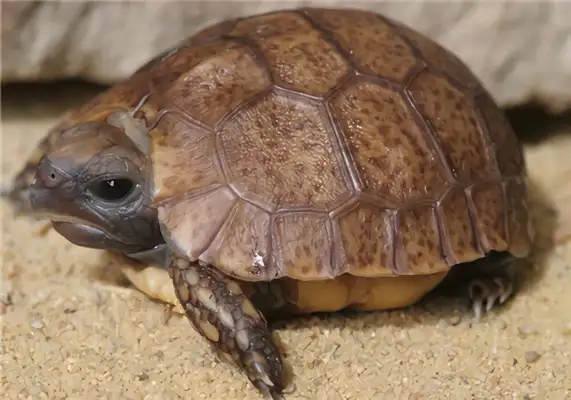
The bell folds the back tortoise, which is the largest and most representative species of the back tortoise, with three sub-species, with some differences in each sub-species, the appearance of the bell tortoise and the method of identifying the sub-species are described below.
I. Clock tattoos on the back of a turtle
The bell-marked tortoises can be 22 centimetres long, with one ass shield and one hook-to-tape, located on the African continent south of the Sahara desert and on the island of Madagascar, three of the sub-species, the widest and most numerous of the tortoises, with three sub-species of the bell-wield turtles, with separate areas.
II. Distinction of the bell-printed back-land turtles
Kinixys belliana belliana is known as the Eastern Sea turtle, spread over the Eastern African countries; Kinixys belliana nogueyi is known as the Western Seal turtle, spread over the Western African countries; Kinixys belliana zombensis is known as the Southern Sea turtle, spread over the Southern African countries and on Madagascar.
The three sub-species are the most common in the west. Although there is no overlap, it is sometimes difficult to distinguish: Kinixys belliana belliana Eastern Clock-Line Turtle: The front leg usually has five toes, the back nail shield is a dark border and has yellow brown stripes. Kinixys belliana nogueyi Western bell-marked turtles: the front toe is usually only four toes, the back nails are tan, the abrasion has a brown outer frame, and a little light coloured. Kinixys belliana zombensis Southern bell-marked turtles: the front toe is usually only four toes, the back nails are light yellow and are covered with large black radiation stripes. Clock tattoos to back turtle care knowledge
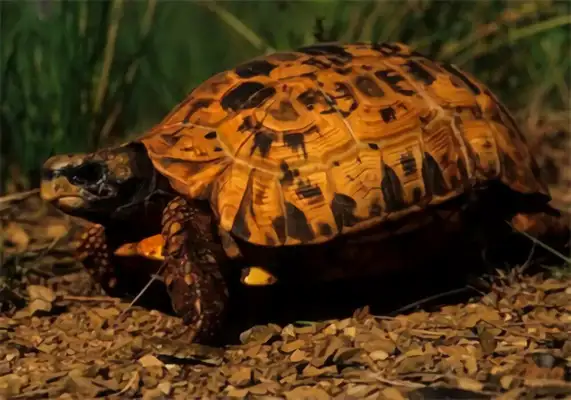
It is often difficult to raise a bell-laced tortoise, but that does not affect the people ' s preference for him. For some time, it has been forbidden to enter the mouth, but now some bell-laced tortoises have been found on the market and more people are trying to raise them.
I. Clockprinting knowledge of care for turtles
In 2001, the United States announced a ban on the import of wild Sukada, leopard turtles and bell-marked land turtles, as the three African turtles had a high percentage of lentils, which were also carriers of the animal water heart disease virus. Clock-lined land turtles belong to grassland-type land turtles, which also occur in bush areas and require higher humidity and water. The temperature also needs to be higher. However, the demands for the intensity of the light are not as high as those for African turtles in general, so there is no need to use too strong a light.
II. Reproduction point of the bell-printed back turtle
The difference between males and females is the same as between tails, male tails are thick, female is short and male abdominal abdomen are dentible. The male dimension of the bell-marked tortoise is stronger, so it would be preferable to have only one tortoise, otherwise there would be more intense confrontations during reproduction. Females can produce 4-8 eggs per child. At 30 degrees of incubation, about 90-120 days can be hatched. If fed enough, female turtles can produce twice a year. While the bell-marked turtle is not a dominant turtle species, long-lived individuals can still demonstrate good interaction and personality with feeders. Their merits are of course only felt by those who appreciate them. Clock tattoos folding back to the turtle's environment.
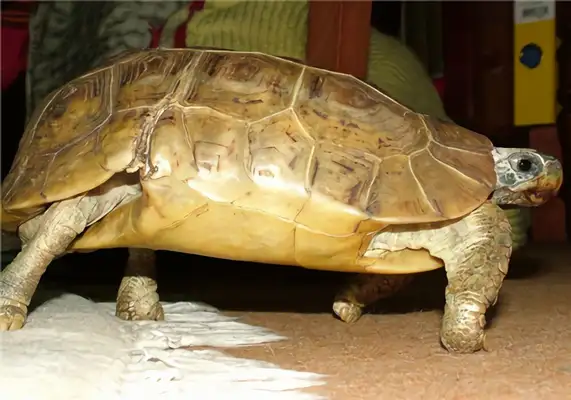
Clocklines are not particularly high for the environment, but temperature control is important. In general, they do not sleep in hibernation, but in hot summer, they are summer sleepers, so that too high or too low temperatures are inappropriate.
I. The temperature of bell tattoos on the back of a turtle
The most appropriate life temperature for a bell tattooed back to the turtle is 27-30°C. Wild individuals have a habit of sleeping, so the temperature is not too high, not more than 35°C or above, and can be reduced to 20°C at night, but a minimum of 27°C should be maintained before and after feeding to help digest food.
II. Adaptive humidity of bell tattoos
The most appropriate environmental humidity of the bell-printed back turtle is 60-85 per cent. They can be adapted to a wide range of moisture because of their wide distribution and the marked local tide season. Although bell-marked land turtles are not as wet as K. Erosa and K.homeana would require in terms of humidity, they seem to be more humid in terms of distribution, preferably 75-85 per cent relative humidity in the rearing box, and can also be added to the water dish to regulate only temperature.
The bells are most active when they start to rain, but when the weather is hot, they dig holes in dried-up water to hide themselves in order to save their lives and wait for another rain. In less hot weather, bell-marked turtles start searching for food at dawn and dusk. The point of the bell-tweed tortoise.
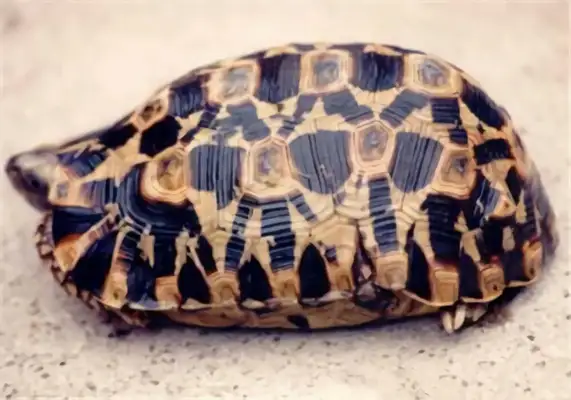
The bell folds are not too picky, and in general, the bell folds are absolute vegetarians, so that under artificial farming, as much meat as possible is avoided and dietary diversity and health is ensured.
The bell is folded tortoises in the wild, where they eat herbs, grass, leaves, flowers and fruits, but they also eat snails, bodies of small insects and animals, etc. The food to be provided under artificial farming includes:
Main feeding (>90%): plants with deep green leaves. For example: cabbage, mustard, horse teeth, dandelion, cargrass, sauerkraut, wild mustard, herbs, daisies, saloons, red flowers and leaves.
2. Medium-to-day feeding
3. No feed (0 per cent) shall be given: overjuicious vegetables, tomatoes, beryllium, lettuce, broccoli, broccoli, cabbage, cabbage, cucumbers, yellow, kale.
Clock tattoos require high fibres, calcium, low phosphorus and appropriate proteins. It would be very good to know the environment, but most of them are wild individuals, so there is an initial preference and even a refusal to eat.