Designation: PET4067
English name: Zhou`s Box Turkle
Origin: In China, mainly in Guangxi and Yunnan provinces.
Vulnerability to diseases: leukemia, rotting nails
Life: 30 to 50 years
Value: 10,000 for last week ' s closed-hull turtle species
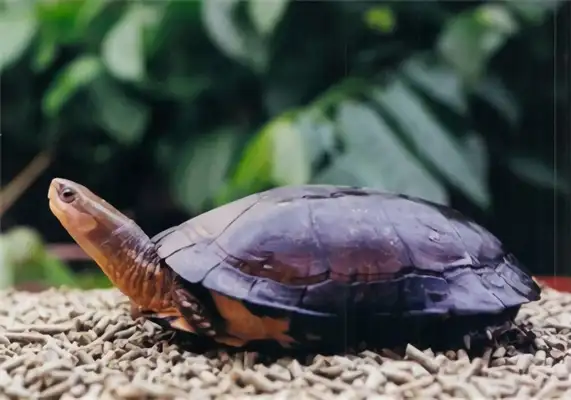
The small number of Zhou's closed-hull turtles, which are found only in Guangxi and Yunnan, are the most valuable species in the country, which are occasionally visible on the market, but wild resources are depleted and there is little research into the wildlife of this species, with only some information on the accumulated experience of man-made breeding.
Chinese literary name: Zhou's closed-hull turtle
Chinese alias: Black closed-hull turtle, Black turtle
English name: Zhou`s Box Turkle
Two words: Cuora zhoui
Context: Animals
Gate: Pipeline gate
Amen: vertebrate Amen.
Programme: climb
ACQUA: ACQUIPMENT
Tortoises.
Asia: Aside the neck turtle
C: Turtles
Aako: Ako, Fresh Water Turtle
Yes: Closed shell turtle
AIAN: CLOSED TERRORISM
Crop: Zhou's closed-hull turtle
Distribution: China, mainly in Guangxi and Yunnan provinces.
Appearance characteristics: black or tan on the back of the Zhou Dynamite closed-hull tortoise, cylindrical, central or non-argument, non-argument, and no sawn on the front edge of the back mantle.
Lifestyle: The lifestyle of wild Zhou Zhi closed-hull turtles is not yet documented. But in terms of its morphological characteristics, turtles live in mountains and mountain streams and rivers.
Reproduction practice: Zhou's closed-hull tortoise breeds by spawning.
Food: Wild Zhou closed-hull turtles are not yet recorded. Under artificially raised conditions, Zhou's closed-hull turtles eat thin pork, fish, poultry organs, small insects, etc. Zhou's closed-hull turtle morphological characteristics
Zhou's closed-hull tortoise head is pale gray, narrow in the head, flat on the top, smooth in the skin, sharp in the kiss, round in the tip; the upper beryllow hook, yellow in the iris, yellow in the drum, a yellow in the peri nostrils, a yellow stripe in the back of the head, a yellow stripe in the back of the head from the rear of the eye, an olive green line on the edge of the two stripes; the skin of the neck is covered with plasters, green in the back, side olives, light in the abdomen; the limbs are flat, green in the back, light in the abdomen, a yellow in the abdomen, with a thick on the back, a strong on the finger, a strong on the toe, a large on the front, a five claw on the back, a four claw on the back, and in the back. Zhou's closed-hull turtle care knowledge
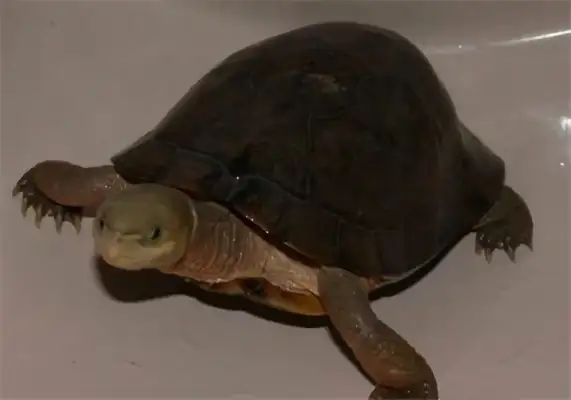
The method of raising Zhou's closed-hull turtles can be found in yellow rims, both in terms of setting the environment and food selection, and from the point of view of Zhou's closed-hull turtles, the method of raising Zhou closed-hull turtles is described below.
I. Zhou's closed-hull turtles need to be fed.
The fresh-shell turtle is so tender that it is not fit to go down the pool that it can first crawl freely on the sand, until the umbilical cord is dried out and the body is flatened from a curly to the ground, before it is placed in an indoor basin or in a vase. The first day or two does not require external nutrient intake because the egg yolk has not yet been absorbed. After two days, daphnia worms, decorated egg yolks were fed two to three times a day, every time they were saturated with no surplus at the next pitch, and after two days they were fed to fracked fish, shrimp, snails, larvae, etc. Change water every day, keep the basin clean.
II. Management of Zhou ' s closed shell turtles
After a few days of indoor resting, they can be transferred to the turtle pond. Before entering the pool, you have to disinfect it with drugs. Density of 50-80 per square metre. Feeding requires fine, fine, soft, fresh fish, mainly animal fish, shrimp, snails, cortex, larvae, etc., supported by plant-based melons, vegetables and wheat. The best conditional feed is artificial feed with protein content of around 40%. Feeding should be “four fixed”, time, location, quality and quantity. They are fed every morning and evening and once a day at lower temperatures. I'll change the water every day. Zhou's closed shell turtle living environment
Early in November of each year, as a result of declining temperatures, the Zhou Chong turtle gradually enters hibernation, at which point it is necessary to lay 7-8 centimetres of wet sand inside the rearing tank, which should be placed in the interior of the sun so that it can naturally hibernate. Late in March of the following year, when temperatures returned to about 18-19°C, Zhou closed-hull turtles began to eat, and their first feeding should be minimal, especially after feeding, with ambient temperatures of not less than 15°C, which would cause indigestion, etc. Zhou's closed-hull turtle feed point.
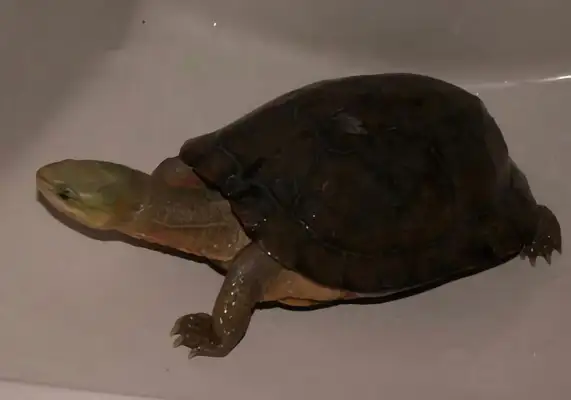
Zhou closed-hull turtles are grotesque, so when raising them, as much fresh, quality meat as possible, such as shrimp, skinny pork, and so on, they are rarely fed by turtles, but they can also be tried if they eat.
I. Feeding points for Zhou's closed-hull turtles
Animal baits are fed under artificially raised conditions in Zhou's closed shell. Food is regularly fed to thin pork, poultry, etc. When ambient temperatures are above 22 °C (considering whether the temperature can be 20 °C or above at night after feeding), feeding can be done once a day or every two days, the depth of the fall temperature is unstable and should be stopped early and at 20 °C, otherwise turtles are vulnerable to digestive disorders.
II. Day-to-day management of Zhou ' s closed-hull turtles
The quality of water is bad and has a direct impact on the health of turtles. The newly introduced tortoises are fed directly into fresh tap water, which should be released into the water, wells or rivers that have been sank before turtles can be replaced by running water. Water is exchanged within two to three hours after the spring and autumn feeding, and within one hour after the Shali feeding, to ensure clean water quality. Before hibernation, the health of the turtle must be checked, including physical condition, parasites and faeces. Healthy turtles sleep. In hibernation, turtles can be placed directly in water, but not above their backs. In the hibernation period, the water is changed 1 times a month and the turtles are regularly checked.