Bobby's a good kid, too, Bravo. Angel was also a good girl, and when he sat down, his hairy hips slid slightly on the tile floor, he lifted a claw to emphasize, as if he said, “My sharp nose smells this cotton ball and looks like a new crown virus”.
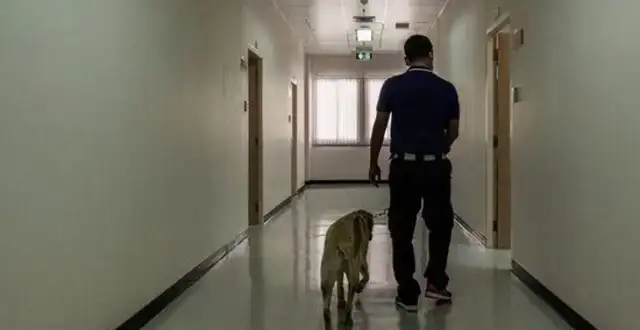
The United States New York Times reported on 31 May that the three Labrador dogs, who worked at a clinic at a university in Bangkok, were among the dogs trained globally to smell humans infected with the new crown virus. Preliminary studies conducted in several countries suggest that their accuracy may be greater than the rapid detection reagents frequently used at airports and other public places.
Dogs can be 96.2% accurate in controlled environments.
Dr. Cavaly Chadalon, Vice-President of the Faculty of Veterinary Science and Innovation, Chulalongkorn University, Bangkok, said, “For dogs, the smell is as clear as the roast we eat.”
It is hoped that the dogs can be deployed in crowded public spaces, such as stadiums or transportation hubs, to identify those carrying the virus. Their skills are applied in Thailand, the United States, France, the United Kingdom, Chile, Australia, Belgium and Germany. They patrol airports in Finland, Lebanon and the United Arab Emirates, and private enterprises use them in sports events in the United States.
Angel is the star of Chulalongkorn, has blond hair, has a young jaw and likes to chew plastic bottles. According to researchers at one university, as a group, the number of dogs trained in Thailand — Angel, Bobby, Bravo and three others, Apollo, Tiger and NASA — accurately detected the virus in a controlled environment was 96.2 per cent. In Germany and the United Arab Emirates, studies showed a lower accuracy rate, but still impressive.
The dog trainer at Chulalongkorn made the labradol sniff the sweat samples of the new crown patients.
It's faster, it's less expensive, it's easier to identify people with no symptoms.
Proponents of sniffer dogs testing the new coronary virus say that they work faster and at a much lower cost than the PCR test. Researchers said that their sensitive noses were sufficient to identify, within one second, volatile organic compounds from the fall of damaged cells of new crown patients.
“PCR tests do not produce immediate results and there is a false negative. But dogs can smell it in the early stages of the new coronary virus. She is an interdisciplinary health expert at the Academy of Animals and Veterinary Sciences at Adelaide University, Australia. She has been studying 15 new coronary virus sniffers for six months.
New Crown Sniffing Technology in Labrador, Thailand, is part of a joint research project between Chulalongkorn University and Chevron. The oil company had previously used dogs to test its maritime employees for illicit drug use. A Thai manager wondered whether those animals could do the same with the new coronary virus. In theory, the ability of a dog to smell a new crown virus is no different from its ability to detect drugs, explosives or Scooby snacks hidden in his pocket.
Train them to smell 600 times a day.
The six dogs were assigned to six dog trainers who exposed the dogs to the socks of the newly-positive individuals and to sweaty cotton balls.
In very few cases, pet cats and dogs, as well as other mammals, such as mink, in close contact with the infected, are tested positive. However, there is no evidence that family pets can transmit the virus to humans.
Cotton sampling supplies were cut in multiple sections to collect samples of sweat fluid from new crown patients.
After several months of training, these Thai sniffers sniff around 600 times a day and sit quietly whenever they smell a new crown virus on a cotton ball. Researchers placed cotton balls on a device similar to a carousel, at the height of their nose.
Some studies have shown that different types of dogs can be trained to smell diabetes, Parkinson's disease, malaria and certain cancers - through associated volatile organisms or body fluids.
The researchers hope that the Labrador dogs will be used to screen new coronal infections in gymnasiums, airports and other crowded places.
There's air conditioning in the room.
Labrados are one of the smartest varieties, according to the director of the Chevron canine project, Ratcha Shomlatanakul. And they're kind, and that makes them ideal dog scouts — focused and passionate.
Letcha stated that the Labrador dog was expensive, at approximately $2,000 per dog in Thailand. However, the price of cotton tags and other basic equipment used to sniff the New Crown Virus is 75 cents per sample. This is much cheaper than other types of rapid screening.
Three of Thailand ' s Labrador sniffers are stationed in the south of the country near the border with Malaysia. According to the Ministry of Public Health of Thailand, the dangerous variant of the new crown virus has entered Thailand. The other three were transferred only in recent weeks to the ninth floor of the Chulalong Veterinary Medical College building in Bangkok, where the former student dormitories were transformed into their places of residence.
There's a man on the roof, and the dogs play at the college football field every day. Their rooms have air conditioning.
In the mornings and afternoons, for a few hours, the sniffing dogs would turn around in one room. The room was equipped with metal arms and sweat samples. When they walk out of date, they suck their nose 10 times a second like a dog (humans usually only once a second). They then went back to their place of residence to take a nap and occasionally touched their stomachs.
"They live better than many." Angel's trainer, Tavace Prochott said. He was a supplier of Chevron and then turned to animal health screening.
According to Tavace, he grew up in the southern empty province of Simara with 12 dogs, with his pets sleeping in the garden and sleeping under the trees. They don't like air conditioning.
Helping to screen older people or bedless people
These sniffers, located in Bangkok, are working. Some do not have easy access to testing sites for nucleic acids, such as older persons or bedless people. The dog caretakers are working with the prison in Bangkok, where thousands of prisoners have been diagnosed with a new crown virus.
In the United States, dogs are used to screen new crown patients for a few private activities, including the screening of holders of the Miami Hot Team competition and the sweating feet of a wine and food-fester on the south beach. However, there are currently no national standards or government projects to use the dogs.
Cynthia Otto is the director of the Veterinary Dog Centre at the Faculty of Veterinary Medicine of the University of Pennsylvania, United States. She is concerned that this method will not be used unless there is better research to prove that dogs are more accurate in their real lives in sniffing new crown patients. “I don't want to leave out those who carry the new coronary virus, and I'm afraid that everyone will be safe by mistake.” She said.
Thailand is experiencing the worst outbreak since the new coronary pneumonia pandemic. In prisons, construction camps and other crowded places, the number of infected persons is on the rise. There is a shortage of vaccines, and less than 2 per cent of the population has been vaccinated.
Researchers at Chulalongkorn University have designed a mobile device that they plan to drive to potential new coronary virus hotspots so that dogs can determine through their smell which areas require large-scale nucleic acid testing.
There are still a lot of questions to be resolved.
There are many questions to be solved about dogs testing the new coronary virus: what does it smell like to be vaccinated? Is it easy to train a bunch of new coronary virus sniffers around the world? What if they don't sweat? What if they get a new coronary and lose their sense of smell?
Despite this, Letcha believes that testing the new coronary virus with sniffers is good news, especially in countries that do not have the resources to conduct more expensive tests.
"The new coronary virus will not disappear, and new varieties will emerge." Lettcha said, "Dogs want to help us, so we can ask them to help."
According to researchers, some dogs can smell diabetes, Parkinson's disease, malaria and some cancer.