In October 1957, the Soviet Union launched the first artificial satellite in the history of mankind outside the Earth, and, with the success of the satellite, the door to human exploration of the universe has been officially opened for more than half a century.
Following the launch of the first artificial satellite, the Soviet Union was preparing to launch a second artificial satellite one month later and hoped to board Earth organisms on it. Because of the problems encountered in the space environment and access to space at that time, the former Soviet Union did not have enough data to analyse, they decided to choose a puppy before sending people into space.
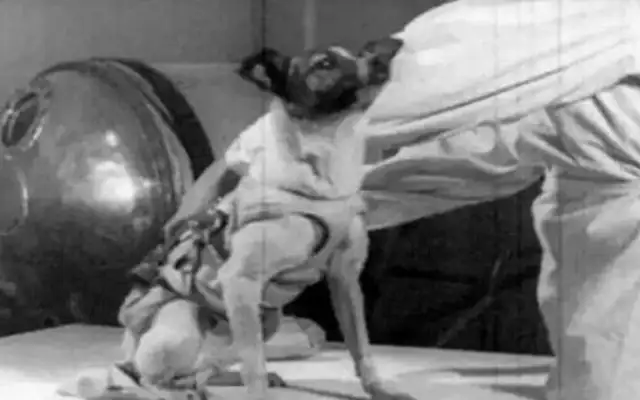
That's how the stray dog Lecca appeared in the eyes of scientists, who decided to make it the first life on Earth to fly into space, before they brought it back to the lab, where Lecca had been on the streets, where Lecca was so gentle, never biting, and so strong.
In November 1957, Lecca was sent to space on board the second artificial satellite of the former Soviet Union, after being fitted with sensors on the body surface. By that time, scientists had decided to let Lecca die in space before he could be successfully sent into space. And as a precaution, scientists did not even install a return device on the vehicle.
However, for humanitarian reasons, and in order not to allow Lecca to end up in a long space trip and die because of the loss of water and food, scientists pre-positioned drugs in dog food and decided to kill Lecca on the seventh day after he entered the universe.
While in the streets Lecca sometimes eats less than enough food and has no water to drink, at least Lecca is free, but after being locked in a vehicle into space, Lecca ' s freedom of movement is completely restricted, and a chain of irons holds it tight.
Scientists have prepared it with food, water and a device for producing oxygen, as well as an electric fan for cooling. When the rocket carrying Lecca had just left the ground, the heartbeat of Lecca almost tripled, and when the vehicle was completely out of control, the heartbeat of Lecca began to disappear.
While the former Soviet side had claimed that Lecca had died by euthanasia after a week of space travel, the truth was that Lecca had died in extreme pain. After the launch of the rocket, the temperature in the aircraft module began to rise sharply, and the small cooling fans prepared by scientists for Lecca did nothing.
So, almost five to seven hours after entering space, Lecca had no sign of life, and it could be said that Lecca had been suffocated by high temperature and high pressure, and until now, Lecca's body and aircraft carrying it were still floating around the planet. A total of nine dogs were selected for space training at the time, and only Lecca was on a journey to space without return. Lecca's death triggered a global debate on animal rights. Many believe that even her sacrifice in exchange for a major breakthrough in aviation will not make up for the fear and suffering she suffered before her death. Lecca's life and death have become an enduring artistic symbol in many works of art. There's a game named after her, Playstation's Lecca Planet. The Chicago Rock Band Kill Hannah also wrote a song called Lecca, which was like, "It's too far from home, I know your loneliness, especially when they pretend to remember you. Quickly come back... . . . . . . . . . . . . . . . . . . . . . . . . . . . . . . . . . . . . . . . . . . . . . . . . . . . . . . . . . . . . . . . . . . . . . . . . . . . . . . . . . . . . . . . . . . . . . . . . . . . . . . . . . . . . . . . . . . . . . . . . . . . . . The American cartoon novelist Nick Abadis drew a completely different ending in Lecca, which had superpowers, changed its name to a space dog, then returned to Earth and found revenge for the scientists who sent her to space. The Moon was undoubtedly the most successful event in human history, at the expense of many animals and human astronauts. Lecca may be a humble stray dog, but she also symbolizes many of the bitterness behind the great struggle of humankind. In 1997, 40 years of space flight in Leka, the Russian Institute of Space and Space Medicine on the outskirts of Moscow established a memorial for Leka. That was where it and the other nine dogs were trained, and Lecca was finally selected for a one-way, lonely space trip. Faced with vast space and vast universes, human pursuit has never stopped. But the path to space, to space, to space is a twist and sometimes a price of blood and tears. It is to be hoped that advances in science and technology will make it possible for us not to see any more of the casualties of life, such deplorable and fearful sacrifices, and not to repeat them.