Designation: PET1634
English name: Eclectus Parrot
Personality: relative, lively
National origin: Indonesia, New Guinea, Australia, etc.
Vulnerability: respiratory, digestive and parasitic diseases
Life: 8-10 years of compromise description of parrot species
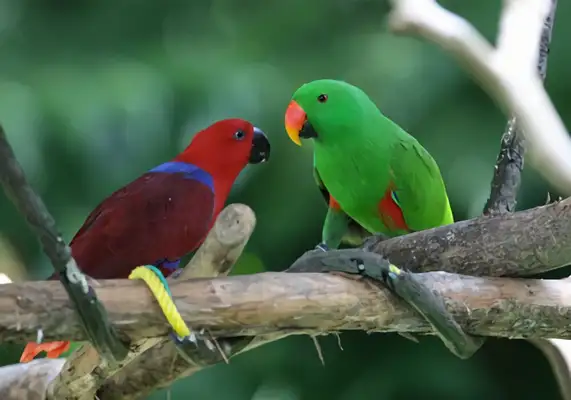
Parrots are distributed in many parts of the world and can be seen in Australia, Indonesia, New Guinea, etc. Concomitant parrots are non-hazardous species, and many breed them. Compromising parrots are quieter than some large parrots, but they are not always quiet, and occasionally you may hear their noises.
A very large feature of the conciliating parrots is that their female and male appearance is very different, and some may even think that they are two different species of birds when they first meet them. The male body is usually green, while the female body is dark red and blue purple in the abdomen.
Wild-state parrots tend to appear in tropical rainforests and low-lying forests, and, like many birds, they appear in pairs, although if they are breeding, they appear in groups, often male.
Chinese literary name: Compromise parrot
Two words:
Context: Animals
Gate: Pipeline gate
Amen: vertebrate Amen.
Programme: Birds
APA: Today ' s APA
Look: Parakeet.
Section: parrots
Acco: Acco parrot
Family: Margots
Yes: Compromise parrots
Species: Compromising parrots for parrot morphological characteristics
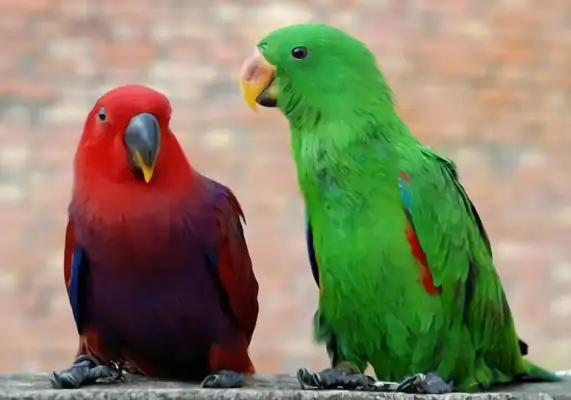
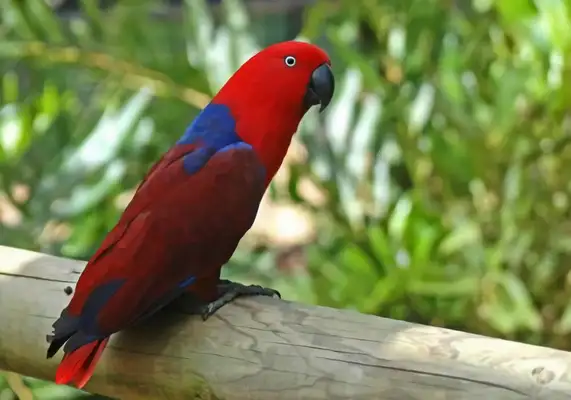
Concombining parrots, whose color varies greatly according to their sex, are male birds, although they are not all green, and there are other colours in certain particular parts, such as red nests, blue edges on bird wings, etc. The female colours are mainly deep red, but they are blue purple between the head and the chest, and the abdomen, and orange, etc.
Because parrots are birds climbing, their toes, like the rest of them, are two-toes forward, two-toes backward, and these toes are very good for climbing, so we can see that they can stand firmly on the branches.
There are 10 sub-species of parrots with different sub-species of birds of different sizes, such as the Australian parrots with a size of up to 40 cm, and the Solomon Islands parrots with a minimum size of 30 cm. Of course, different species of birds have different colours, such as those with purple abdomen, some with deep blue abdomen, and others with red abdomen.
Compromise parrot morphological characterization
Size: around 37cm.
Weight: around 430g.
Colour: The male is mainly green and the female is predominantly deep red. In general, the edges of the wings and wrists of the male bird are blue and the rest are red except for the black feathers on the bottom, in addition to which the sides and armpits are red, the tail ends are light yellow and some blue on the outer tail feathers. The female is blue and purple between the chest and the bottom of her wings, while the tail is orange.
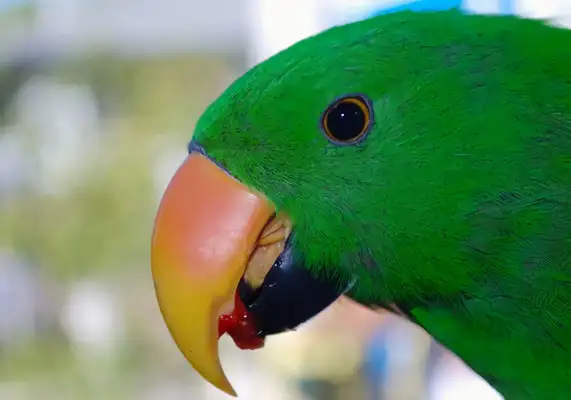
Oysterium: male is red, end yellow, female is black.
Ion membrane: The male is orange and the female is pale yellow. Compromise parrot living conditions
Compromise parrots are widely distributed on Earth and can live in many environments, and they can be found in tropical rainforests, grasslands and even crop areas. Areas above 1,900 metres above sea level are not the habitat they would choose. They are most often seen in forests and sea-dependent areas in Australia, Indonesia, etc. Compromising parrots would choose these places as habitats, in addition to adapting them to the climate environment, and the fact that they could provide them with the food they needed. Since they are also often found in crop areas, in some areas they are considered to be harmful.
Parrots, who are not captured by humans, tend to feed on trees, and if they are not reproductive, they often appear in pairs and sometimes only one bird. However, when it comes to reproduction, it is generally the males who appear in groups. Although the parrots have been quiet compared to many parrots, when they are gathered they are completely distraught and noisy. Concomitant parrots are also highly alert animals, and if they move, they immediately activate the defense system.
Concombining parrots is not small, so if they are caged, the master must prepare a large cage for them. It should be noted that an environment that is not suitable for reconciling the growth of parrots may lead to pecking of feathers (of course, feed problems, disease, psychological causes, etc. may also cause birds to peck each other). In order to avoid this situation, it would be preferable for the owner of the first-time bird to ask an experienced pet friend or expert about what kind of environment would be appropriate to accommodate the parrot’s life. Compromise the parrot feeding point.
Strictly speaking, it is not difficult to reconcile parrot feeding. Wild parrots eat mainly of plant seeds, nuts or fruits, so masters do not have to worry that they cannot feed themselves well. In order for the parrots to grow healthy, the masters may wish to feed the birds from the following points.
Water supply
The running water was not really suitable for the concubines, since the chlorine in the water was not good for their health, and it was better for the owners to drink pure water for the birds.
II. Importance of vitamin A and fibres
Anyone who knows anything about a parrot needs to know that a parrot needs a lot of vitamin A. And since the dichotomy of parrots is more digestive than other parrots, the master needs to provide them with more fibre-rich and beneficial food.
III. Not just seed feed
Some masters may find themselves struggling to create a quality living environment for birds. Why would they fall off? This is most likely due to long-term feed-only feed. Long-term feed-only feed not only leads to the fall of the bird, but even to the death of the bird. Fresh vegetables and vegetables can make parrots grow better, but they must be washed before they are fed, and the fruits better be cut into small pieces that are easy for them to eat. Concombining parrots may also have some of their special favorite vegetables and vegetables, and the owner can increase the supply appropriately.
IV. Quality protein availability
It is not difficult to live a high quality protein, which can be provided by crushing the cooked eggs (without stripping them). Apart from eggs, parrots can eat small quantities of fish. However, concombining parrots cannot eat food that contains spices such as salt and sugar, so be careful when cooking fish.
V. Food that can never be fed to a parrot.
Chocolates, avocados, pork, foods containing alcohol or various spices, etc., cannot be fed to them. If the owner is not sure whether the food will feed the birds, he must first consult a veterinarian or expert to avoid accidents. Compromise parrot care knowledge
There are two main sources of compromise parrots emerging in the pet trading market, one directly trapping from the field and the other feeding birds. As a general rule, wild parrots are not suitable for pet breeding, they are more vulnerable to disease and their mortality rates are very high than artificially grown birds, and although some traders sell them cheaply, it is difficult for their owners to feed them, so wild parrots are not recommended for purchase.
In addition to their high survival rates, artificially grown parrots can adapt more quickly to the new environment. It is important to note that the compromise parrots also have considerable differences in personality due to their gender, and that the male bird is a lively relative who can be acquainted with his master in a relatively short period of time, but the female bird is the opposite, because they belong to inward-looking birds, who may escape when they are raised at the beginning, but this will improve much when adapted to the new environment.
We all know that many parrots are loud, so masters usually consult their families and neighbours before raising them. Parrots are not the kind of parrots that argue about your headaches all the time. They're quieter than many parrots, and of course they're noisy. Those who want to raise them need to be prepared.
Concomitant parrots can also reproduce under artificial conditions, although there may also be problems in reproduction, such as eggs not fertilized, where the owner needs to identify the cause before “doping the disease”. While it may be possible to reconcile the ability of parrots to reproduce before the age of 5, in order to increase the chances of successful breeding and to ensure the quality of future generations, it is desirable for the master to allow them to reproduce after the age of 5.