Designation: PET1255
English name: Pained Terrapin
National origin: Malaysia, Indonesia.
Vulnerability to disease: Decay
Life: 50-60 salt cement colours Turtle
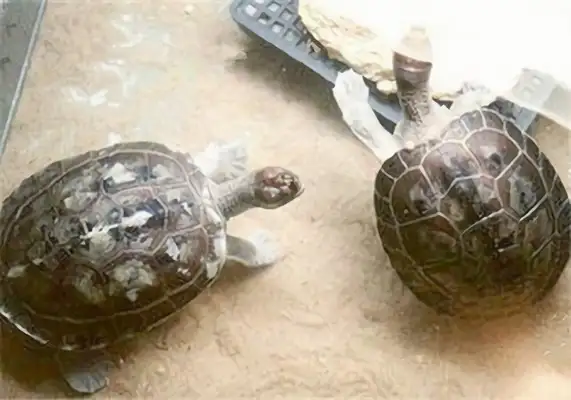
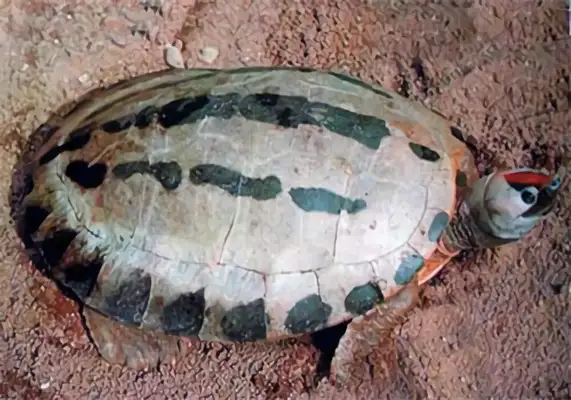
Salted cement turtles are a more characteristic type of tortoise, with their backs looking like a watermelon and their heads red enough to make them more attractive, distributed in areas such as Malaysia and Indonesia, and larger species of water turtles.
Chinese literary name: Salt cement turtle
Chinese aliases: turtles, turtles, triline turtles, watermelon turtles
English name: Pained Terrapin
Two names: Callaguur borneonesis
Context: Animals
Gate: Pipeline gate
Amen: vertebrate Amen.
Programme: climb
Tortoises.
C: Turtles
Yes: Tortoise
Crop: Salted cement turtle
Distribution: Malaysia, Indonesia.
Appearance characteristics: Rears can be as long as 76 cm, light gray or brown, the centre is elevated, the front is narrow and the front is elliptical.
Lifestyle: salty turtles belong to aquatic turtles. Tortoises live mainly in harbours, rivers and oceans. When planted, salty water turtles should live in less salty salted water, otherwise their skins may be white or suffer from aqueous disease. Long live in fresh water, turtles die.
Reproduction: Eggs. Each year, June-August is the breeding season for salt-water turtles. The salty turtle lays 12 eggs, 70 mm long and 40 mm wide.
Eating: Meat-eating, feeding on worms, snails, shrimps and small fish, and also on the leaves of plants. Salt cement turtle.
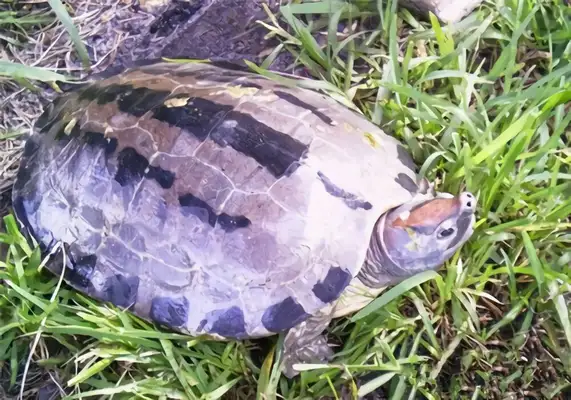
Salted cement turtles, also known as watermelon turtles, are called such lovely names because of the fact that their backnails have the most coloured species of watermelon. The salted cement turtles are the least visible species of turtles, but there will be some change in the reproductive period, with males showing little red on the head of the breeding period.
I. Look features of salted cement turtles
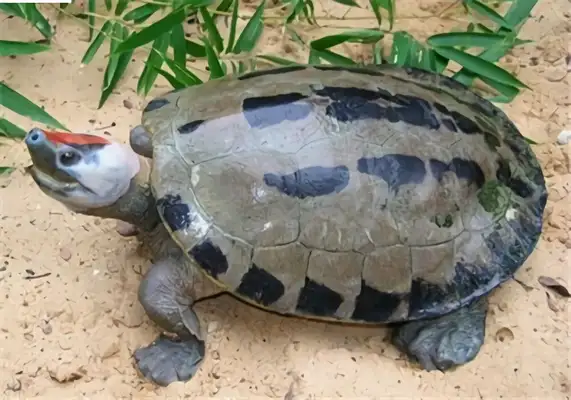
Salted cement turtles are the larger species of freshwater turtles. The vest can be up to 76 cm, more than 2.5 kg. Light gray or brown, with a high central rise, a narrow front wide and an elliptical shape. There are black rough stripes in the middle of the back nails, like watermelons, and large black spots on each shield. The back of the vests is in the form of sawn teeth. The abdominal acetal is light yellow, narrow and long.
Salted cement tortoise bridge light yellow, wider. The head is grey or brown, and there is a rough stripe in the centre, and the colour varies by sex. Eyes and faces are black, kisses are sharp, black. The neck is brown and gray, and the centre of the upper jaw is intact. Four-legged, black, toe-toe-toe. Short end.
Identification of females and males in salted cement turtles
Salted cement turtles may look different during the breeding season, with palm olives on their heads, brown stripes on their heads and short tails. He's got gray tops, red stripes, long tails. The head of the male turtle in the non-reproduction season is brown red and darker. Salt cement turtle.
The two most important aspects of the care of salted cement turtles are the setting of the environment and the provision of food. Generally speaking, salty cement turtles live in salt water, which, if provided only ordinary water, can cause irreversible decaying nails, while in food, salted cement turtles tend to eat meat.
I. Causes of salted cement tortoise decay
Salted cement turtles, which live in river-watered areas, are unable to live in fresh water for long periods of time. His incomprehensibleness over the next three weeks if only a simple tan treatment of the water was done, rather than his incomprehensible reaction, merely said that his skin disease would make you sick of the urgent decomposition that would cause serious decomposition if not salt, which would cause severe decomposition of the skin, which would normally result in severe decomposition if the water was removed and the water was not treated, but light decomposition would normally require only the incorporation of a proper amount of salt into the water, and the decomposition of the skin would result in the removal of the stove. It's enough to add Qinga cocin to the water.
II. Effort of salted cement turtles
Salted cement turtles tend to be predatory and can therefore feed more animal baits such as fish shrimp, beef, earthworms and red worms to meet their growth needs. Before they are fed, they shall be cut into appropriate small pieces so that the turtle may swallow. Some breeders consider that they prefer more sweet vegetables, such as rice, bananas and pears, and also try to feed a variety of aquatic plants, such as weeds, goldfish algae and chrysanthemum kelp, in order to balance nutrition. Salt cement turtle.
It is convenient to raise salted cement turtles outdoors, as they are not subject to man-made temperature control and moderateness, and the proper environment allows turtles to choose their own temperature regulation, which is more healthy and more natural for hibernation and safety over winter.
Salted cement tortoises can be raised in containers such as plastic basins, glass tanks, etc., with water depths slightly higher than turtle backs. A pool of water can be built on a scale, either indoor or outdoor. Tortoise ponds are built with concrete, brick structures, size-specific, 30-50 centimetre depth. The wall of the pool is above the surface of 50 cm. Paint smooth in case the turtle escapes. The pool is equipped with a concrete plate of appropriate size, which is tilted at a 30-degree dew level, both as a table and a sunscreen and as a cover for shades and turtles.
The size of the new tortoise pond is approximately 100 to 500 square metres, with water depths around 80 to 120 centimetres. The slope of the pond is 30 degrees in order to allow turtles to go to shore to rest and lay eggs. At a distance of 100 centimetres around the pool, a small wall of 50 centimetres high was built with bricks, 30 centimetres into the earth and 10 centimetres out of the upper mouth. The surrounding sites are used as sunback, rest and spawning grounds for turtles. The spawning grounds require 20 cm thick sand to allow females to lay eggs. Feeding density tends to feed 3.5 to 15 turtles per square metre, 10 to 15 turtles, 20 to 30 turtles and 50 to 100 turtles. Fish ponds mix 100-500 acres. Salt cement turtle.
Feeding can be based mainly on animal feed such as shrimp, snails, earthworms, animal organs, etc., which can be prepared with a small amount of vegetable feed such as grains and guacamole, and multivitamins and micronutrients. Depending on the size of the tortoise, clean and shredded, it can swallow. A turtle can feed directly. Vegetable grains should be pre-sampled. Daily feed is 5-10 per cent of turtle weight, with an appropriate increase in summer. From 8 to 9 a.m., and from 4 to 5 p.m., each feedes. Feeding points should be fixed on a permanent basis. The fish pond mix only increases fish feed and does not require additional feeding. The sick fish, the open pond fish are its good feed. At the same time, it has a preventive effect on combating the spread of fish disease.