Original by:
Raquel Trevail, DVD, DipECVN, MRCVS, graduated in 2004 from the Universalde de Trivers-os-Montes e Alto Douro, Villa Real, Portugal.
Distinguishing the type of epilepsy, developing a treatment plan tailored to each patient ' s needs and considering that quality of life is a key step in treating cat epilepsy
Epilepsy is a common neurological symptom of dogs and cats, which are estimated to affect up to 2 per cent of common cat animals (Stanciu et al., 2017). Like most diseases in cats, there is a intersection between cat and canine, but some differences must be considered.
Directory 1. What is cat epilepsy? How do we classify the types of epilepsy? 2.1. Complex series of epileptic epilepsy 2.2. Cats hearsay-reflective epilepsy 3. Diagnosis of cat epilepsy 3.1. History 3.2. Preliminary investigation 3.3.
Epilepsy is defined as more than one seizure. The classification of epilepsy is different, but according to the 2015 recommendations of the International Working Group on Veterinary Epilepsy for dogs, it is assumed that epilepsy can be classified as “specific” or “structural”.
Epidemic epilepsy refers to cases where the underlying causes and/or evidence of structural diseases have not been established. This therefore includes geneticity, suspected geneticity and unknown causes. Genetic epilepsy occurs when the genetic background is confirmed, and is suspected to be genetic epilepsy when the prevalence of the strain is high (more than 2 per cent) or when the number of epilepsy patients in the same family is high. Unlike canine patients who have been identified as having genetic tendencies, the genetic background of cat patients is often more complex. In most cases, therefore, the term epilepsy with unknown cause may be more appropriate.
Structural epilepsy, by definition, is an epilepsy caused by an identifiable structural brain condition. The pathology can be confirmed by diagnostic tests such as advanced imaging, CSF analysis, DNA testing or autopsy. How do we classify the types of epilepsy?
The type of epilepsy can be further broken down into general, general, general and non-ecstasy epileptic. Catal patients may have a special syndrome that dogs do not normally have.
It is important to describe the characteristics of the outbreak, which are usually associated with the origin of the seizure. For example, hippos are usually the cause of, or affected by, a complex part of a series of epilepsy. Complex plethora of epilepsy
Complex pockets of epilepsy are a syndrome that displays specific symptoms when cat faces are tired. These cases are usually characterized by salivation, facial convulsions, mouths, chewing, licking, dementia and behavioural change. In some cases, the outbreak may be universal. The results of complex pockets of epilepsy may be good and treatment should therefore be considered (Pakozdy et al., 2011). The main identifying diagnosis to be considered in these cases is cat-faced pain syndrome. Cat-hearing reflex epilepsy.
Another syndrome described in cat patients is cat-synthesis epilepsy. This is usually found among elderly patients, with a high incidence among Myanmar cats. Symptoms include muscle spasm epilepsy, which is usually followed by whole-body or dementia, usually triggered by high-frequency sound. In these cases, the treatment of the left arcitan is well received; however, the quality of life is usually affected by age distribution (Lowrie et al. 2017). Diagnosis of cat epileptic history
In recording clinical history, it is important to determine whether the outbreak contains different components. This is particularly important when the epilepsy is not a typical epilepsy and/or when there is a need to determine the most likely characteristics of the said outbreak.
The epilepsy can be divided into three stages: pre-prevalence, pre-prevalence and post-prevalence. In some cases, however, only one or two phases may exist, and the onset or onset itself is often the only stage of master description or identification. While pre- and post-prevalence periods may not be identifiable or present, describing them could be a valuable tool for clarifying the nature of atypical manifestations. The pre-incident refers to a change in behaviour prior to the onset; however, this stage is rarely detected and, if it exists, depending on the circumstances, the duration of the outbreak varies from seconds to days to the epilepsy itself, which, as noted above, varies from case to case. Autoneurological symptoms (e.g. saliva, urine or defecation) may occur at the same time as physical activity (e.g. pedaling and chewing) and may refer to behavioural changes at the final or post-prevalence stage, but after epilepsy. Behavioural changes may include orientation barriers, thirst or increased hunger. This stage also varies from person to person, and the duration of the preliminary investigation varies.
Once the nature of the outbreak has been determined (based on an identification diagnosis), an investigation is required. Basic haematological and biochemical blood tests should be conducted before more specific blood tests (e.g., gallic acid irritation tests and infectious disease tests) are considered, as these will depend on preliminary results and identification diagnosis. Blood pressure, urine analysis and chest / abdominal imaging should also be considered in the light of performance and diagnostics.
 A full video package for the Veterinary Examination [with downloading] + document material [with small stoves & Zeave video web lessons + mind guide + four colour notes + summary of the mouth + reality + practice]
Upon completion of the initial check, consideration should be given to conducting an advanced imaging check. There is evidence to suggest that structural pathologies are unlikely to be detected if your cat patient is under five years of age and there are no abnormalities in the nervous system (Raimundi et al. 2017). But if the patient is over five years old, the likelihood of finding a structural disease increases by 14% annually.
The detection of the nervous system revealed that anomalies should give rise to doubts about structural diseases. In these cases, advanced imaging and brain spinal fluid analysis may help to identify potential causes, which may or do not require more specific treatment based on anti-eclampsia drugs.
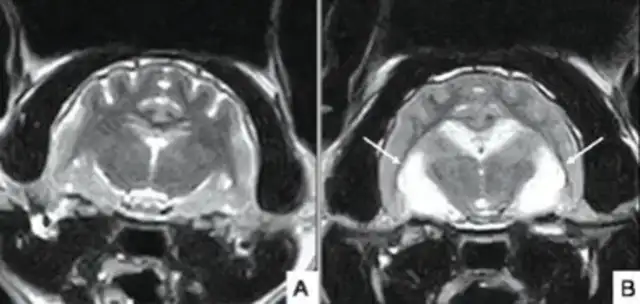
Normal cat (A) and suspected epilepsy caused brain damage to the head of the cat MRI scan [white arrow]. Cats (B) experience acute systemic epilepsy and behavioural changes, including offensive, salivating and lost direction.
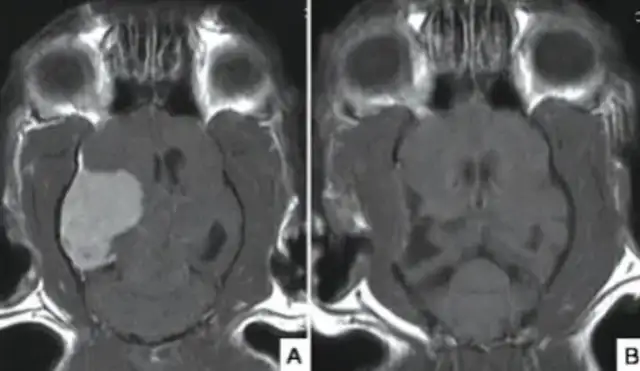
Brain tumors are a potential cause of epilepsy, especially for geriatric cats. Scan A shows the recent epilepsy of a large brain tumor in an 11-year-old cat (a benign tumour in the brain, an inner membrane in the brain) and spins to the left. This type of tumour can usually be removed by surgery and is very effective for most cats. The MRI scan (B) repeated two months after the surgery showed that the tumor had been completely removed. Cat epilepsy treatment.
There is no consensus on when to begin anti-eclampsia treatment for cat and canine patients. Some guidelines, however, suggest that treatment should be initiated if structural diseases are found and epilepsy continues or re-emerging epilepsy occurs (Berendt et al., 2015; Charalambous et al., 2018). Guidance is available on the occurrence of single outbreaks and the frequency at which drugs should be introduced, but tailored to specific circumstances.
The frequency, severity and subjectivity of epilepsy affect the decision-making process. In general, it is more difficult for cats to use medication, and if cats are often outdoors, the time spent on medication is difficult to grasp. Given the increasing challenges that can be faced by cat patients, it is important to understand which drugs are available and their doses, side effects, monitoring and costs.
The most common drugs used to treat cat epilepsy are phenylbarbitor, left Ethytan and Xenishamine. It can also be used for the treatment of cats and has good tolerance for healthy cats, but their efficacy remains to be proven (Engel et al. 2017). Potassium bromine is no longer used to treat cats because of the risk of acidic bronchitis and death. Oral diazine can cause liver death; therefore, it should not be considered as a first-line drug, even if it is not considered at all.
Finally, in selecting the right prescription for each case, it is important to consider the ability of the owner to deliver the drug and the frequency of delivery. The use of tablets or liquid formulations (both in phenylbarbitons, sometimes three times a day; in some cases in Zenazitan, three times a day; and in Zenishamine, one or two times a day) is still a liquid formulation (all liquid formulations are available in phenylbarbitons, left Zlatin and Xenishamine). It is important to bear in mind that it is difficult to judge how much the patient has taken when using liquid formulations, but in some cases this may be the only drug that requires blood testing (if the use of phenylbarbital is considered) the quality of life of an epilepsy cat: ethical dilemma
Increasingly, the owners of cats are beginning to emphasize their perception of quality of life, which is related to different conditions, both patients and themselves. In epilepsy cases, more in-depth research has been carried out on dogs; however, a recent study has provided a detailed assessment of the perceptions of cat owners of quality of life and the burden of care (Szelecsenyi et al., 2017).
As part of the study, researchers assessed the questionnaires filled out by the owners of cats from 22 countries. The control of epilepsy, the absence of side effects and the early onset of the disease (under five years of age) are associated with a significant improvement in the quality of life. When it comes to age (the older owner is better off), epilepsy lasts longer than eight years, epilepsy is controlled, and when the owner feels veterinary support, the burden of care is lower. The latter highlighted the influence and importance of veterinary professionals in the management, dependence and support of cat epilepsy cases. In addition, the better the relationship between the owner and the lighter the burden of care, the higher the quality of life. Advance
Unidentified epilepsy cases are usually forecasted well. One study shows that epilepsy symptoms and epilepsy types appear to be unrelated to survival rates, treatment responses and prognosis (Szelecsenyi et al., 2017). In this study, diagnostic and mitigation times are highly relevant to positive results. However, the length of diagnosis is difficult to explain, as the earlier the diagnosis, the shorter the duration of survival, may be explained by the ageing itself. However, mitigation has indeed produced better results.
Interestingly, different studies show that cat epilepsy overall results are better than dogs.