Designation: PET2691
English name: Fluttened Musk Turtle
Origin: usually upstream and downstream of the Black Warrior River water system
Vulnerability to disease: Decay
Life: Overview of musk turtle species aged 30 to 40
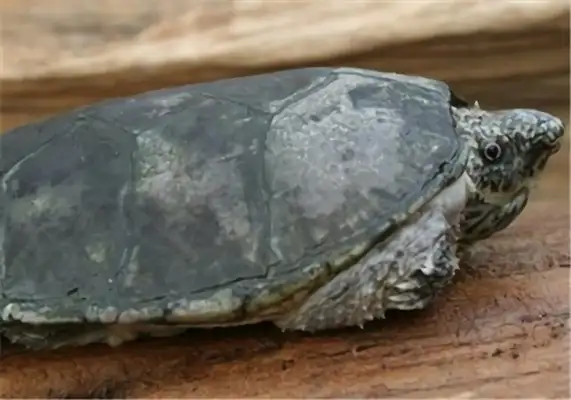
The musk turtles are smaller in size, they are small in size, they like to live in a variety of small water-flow basins, they are traded occasionally in the pet market, they are small, expensive and difficult to buy in the country, and they are popular with players.
Chinese literary name: Skeleton Turtle
Latin literary name: Sternotherus depressus
English name: Flattened Musk Turtle
Context: Animals
Gate: Pipeline gate
Programme: climb
APA: Aerobics
Tortoises.
Subtitles: Curvature turtle
Section: chest tortoises
Jako: Cartoon Ako.
It's a musk turtle.
Specs: Skeleton Turtle
Distribution: Usually in the upper and downstream parts of the Black Warrior River water system, places such as Jefferson, Marshall, Lawrence and Walker, as well as small, medium-sized rivers and large streams and even dams, are ideal habitats.
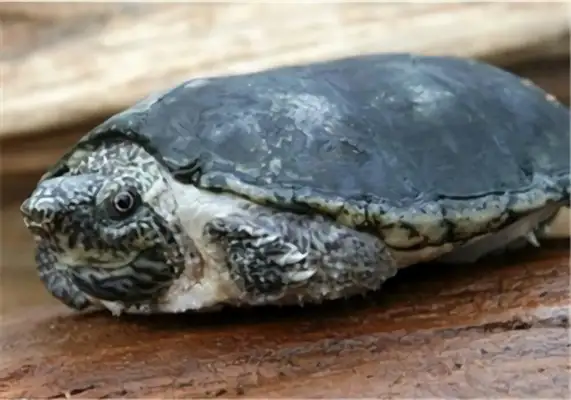
Appearance characteristics: The flatback musk turtle is a small turtle with a shell of about 7.5 ~10.0 cm (3.0 ~ 3.9 inches) and the largest record is 11.4 cm (4.5 inches). As its commonly used name and species add, its backs are flatter than other species of small musk turtles.
Living environment: Rocky streams at the bottom and water accumulation around them.
Life habits: Little sun tan, preference for the faint sun and movement at night, especially in the middle of summer. It is clear that larvae are better active during the day, with a greater range of male than female activities, and within a season and within an area, a greater range of adult, male and female turtle activities remain mainly within 20-30 metres. The shape of the flatback musk turtle.
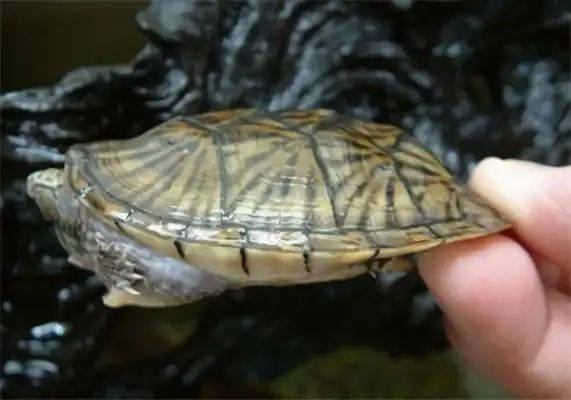
The main reason why flatback turtles are more characteristic turtles in small musk turtles, which are known as egg turtles, is that backbacks are a shell of an egg, but flatback turtles have less visible radians and flat.
The flatback musk is a small freshwater turtle with very flat backs and slopes on both sides form an angle greater than 100 degrees. In larvae, the angle-to-heavy ratio is about 9.5:1. There is a relatively blunt, less visible spine in the center of the back. The edge shield on both sides of the front end of the back armour is slightly serrated, each vertebrate shield overlaps with the front end of the rear shield, the length of the first vertebrate shield is never in contact with the second vertebrate shield, and the width of the other four vertebras is greater than their own length, while the fifth is extended backwards. The backslids are coloured in brown and coffee, accompanied by black or coffee-coloured spots and stripes.
The size of the head is moderate, with an upper jaw that is not exactly like a hook, and in the back of the olive head is the perfect black web stripes and spots, with a moderate expansion after the body has matured. There are yellow stripes on the back of certain forms, from the nostrils to the eyes, vertical stripes on the neck, which are narrower and less visible than the musk of the tiger. The jaws have a pair of tentacles, the limbs have ankles, the male tail is thick and long, and the colour is usually brown. The knowledge of skinhead turtle care
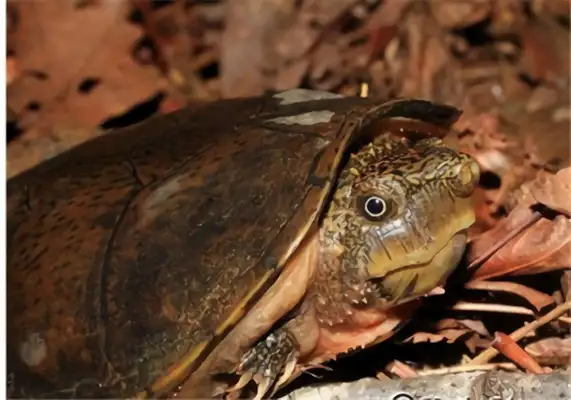
As a relatively rare tortoise tortoise, with a small number of wild populations and a temporary absence of successful cases of artificial reproduction and a rare price, people have been admiring this species for some time, hoping to have one.
I. Flowing of musk turtles
The flatback musk turtles are mixed with the tiger-edged musk turtles, and some consider them a subgenerous species. It takes four to eight years for flatback musk turtles to reach sexual maturity, usually producing only one to two eggs in one year and one to three eggs per nest. Historically, flatback musk has been reported and found to be living in the Black, Wally River in unknown numbers, and in the current circumstances, only about 15 per cent of the habitat retains these healthy, reproductive turtles, which are slowly declining because of natural and man-made factors that seriously threaten their long-term survival.
ii. Baldback musk turtle conservation
The other members in the relative group are flat on their backs, with dead leaves, black stripes or stripes, pink or white abdominal nails, with individual chain joints, but it is not obvious that the head has black spots. When flatbacked musk turtles are young, they are often preyed upon by water-related birds or by predatory fish, and Procyon lotor is the main predator for adults. Large crocodile turtles (also known as “small crocodile turtles”) are also predators of flatback larvae and adult turtles. Life expectancy in the wild is around 40 years. A flatback tortoise living environment.
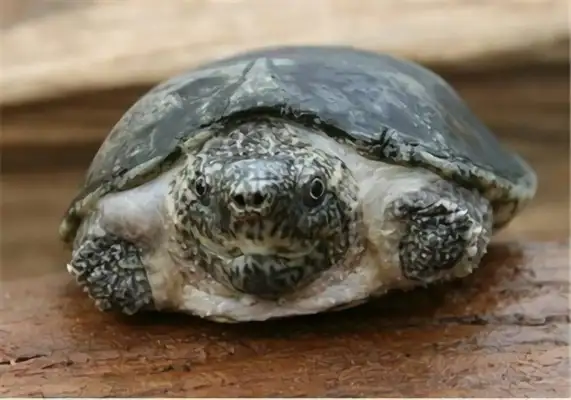
The flatback turtles inhabit water, a very vulnerable group of individuals whose quality changes could cause them to fall ill or even die. In recent years, as a result of the deteriorating environment, some rivers have inevitably been affected by sewage, which has also led to a steady decline in the number of flatback turtles and rising international transaction prices.
The flatback turtles are used to live in small, medium-sized rivers and large streams, even dams, as ideal habitats, although the flatback turtles can live in different circumstances in streams and lakes, where their habitat is more suitable for free-flowing streams and rivers, with about 2 inches of aquatic vegetation. Rocks on the surface of the river are rich in molluscs, shallow sludges and piles, medium nutrients and appropriate bacterial quantities, appropriate water temperature, low pollution, and a constant accumulation of sand without harm.
The shy musk turtles, whose mysterious backs are rarely sunburned, prefer the faint sun to the evenings and come out at night, especially during the summer season. In the daytime larvae are better active than adult, and males have a greater range of activities than females. Within a season and within an area, the range of male and female turtle activity remains largely within 20-30 metres. I'm gonna need some of that musk turtle.
The flatback turtle prefers to eat some molluscs, which is a more difficult problem in breeding, since there are no snails for a given season, so that it is as adapted as possible to some other meat to facilitate it.
I. Food choices for musk turtles
Insects and worms are also at times eaten by molluscs. For active individuals, snails and clams and clams are the main foods. Young children eat small snails, but apparently rely mainly on insects to a lesser extent. A strong correlation is the abundance of food and the density of populations in one place.
II. ELEMENTS FOR THE RESPONSIBILITY OF THE BIRTHING TORTURE
In breeding, flatback tortoise turtles are fed only two to three times a week, and on a fast growing basis, every day or every two days. In many markets, special commercial turtle food is good for musk turtles. Because they hunt at the bottom and most of the special foods float on water, it takes some time to make them realize that they are food. As a result of this adaptation process, food should be sunk and at the bottom for some time before washing.