Designation: PET5405
English name: Northern Black-Humped Map Turtle
Origin: South Alabama, USA
Price: An overview of the species of the northern melanoma map turtle around $500-800.
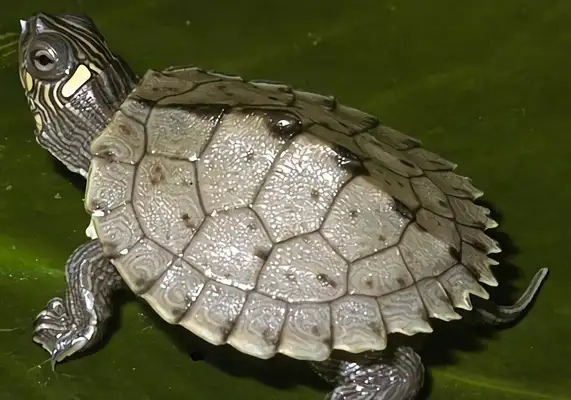
The northern melanoma map tortoise wild individuals, mainly located in the United States of America, Alabama and Mississippi, are now seen in markets around the world as relatively common species of turtles, and are more likely to breed because of their relatively cheap prices, the difficulty of raising them, and their peculiar features.
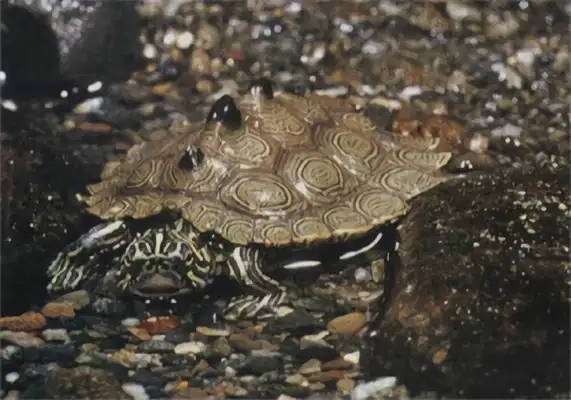
The northern melanoma map turtle is 19.1 cm long, with visible black tumour surges on the front edge of the front vertebrae and yellow stripes on its back. The yellow spots in the rear of the eye are spread backwards and present a Y font after the flow of both sides. In addition, the rear edge of the back armour was clearly sawned. The diet is dominated by insects and shells.
School name: Graptemys nigrinoda nigrinoda
English: Northern Black-Humped Map Turtle
Chinese: Map turtle of the northern melanoma
Classification: vertebrate doors, reptiles, turtles, swamp turtles, swamp turtles, map turtles, northern melanoma maps Turtle
Distribution: South Alabama, USA.
Ace long: 12-18cm
Custom: The temperature is 22-30°C and the feed is insect, snail, shrimp, fish, chicken, animal liver.
Price: Relatively cheap, $100-300
Difficulty of raising: simple northern map tortoise characteristics
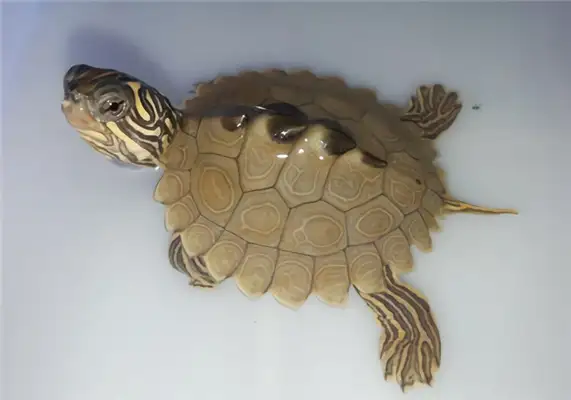
The northern melanoma map turtle looks like all the map turtles and has a map pattern, but the northern melanoma map turtle is easily identifiable because of the thorny mammoth on his back, which is his most visible sign.
The northern melanoma map is 19.1 centimetres long. The front edge of the front vertebrae is marked by a black tumour and yellow stripes on the back of the vest. The yellow spots in the rear of the eye are spread backwards and present a Y font after the flow of both sides. In addition, the rear edge of the back armour was clearly sawned. The small size of the young man's back is lighter, and the colour grows deeper with age.
The vortex is not visible, the vortex is visible, and the sudden tumours are visible, and the difference between the adult stripes and the subchromatography is clear, so it would appear more obvious. The head marks correspond to the pattern on the body, creating a good protective colour, the greatest feature being the yellow stripes behind the eye, different from those in other positions, and forming a very good y-shaped shape on the head.
The vests are broadly rounded, but the edges are serene, it is clear that the tortoises are smaller, and a circle of the edges suddenly disappears like paper cutting, without growth patterns based on the shape. Northern melanoma map turtle care knowledge
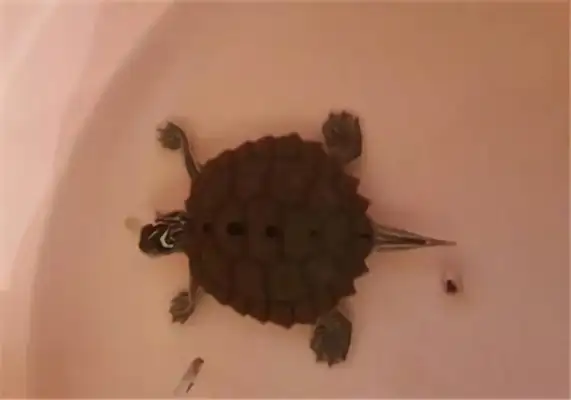
Under normal circumstances, the conservation method for artificially raising the northern mammoth map turtle is simple, and, relatively, the maintenance of the back mammoth map turtle is simpler than that of the turtle, and with the right method, we can see this lovely little creature.
Out of panic, turtles often leap into water from sunbacks, causing stressful damage to crustal edges, leading to infection and possibly death. Thus, when the construction of turtle farms begins, attention is paid, both indoors and outdoors, to the neurality of the map turtle.
The size and number of turtles usually determine the characteristics of the breeding site. Large baths or reservoirs may be the best type if they are larger female turtles, or if they have several turtles, because they have multiple sizes and shapes. In most areas, map turtles can be raised outdoors, provided they are adequately protected from animal flight and adequately prepared for winter animals.
Outside the house, a cell or reservoir of glass fibre can be buried under the ground around fences or walls to prevent turtles from escaping and to protect them from predators. Outdoor breeding sites are closest to natural conditions, which will facilitate artificial reproduction. Indoor sites may also be used, but because of the size of the animal, the site must be large to ensure sufficient space. Northern melanoma map turtle living environment
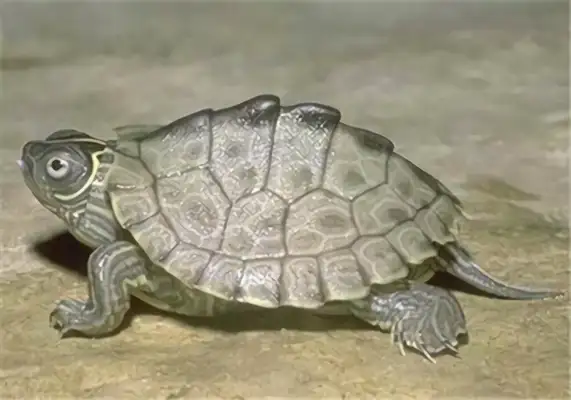
The health of turtles is strongly affected by the good and bad breeding environment, particularly the good water quality, the temperature of the environment and the setting of environmental conditions. The northern melanoma turtles in artificially ploughed conditions are not very demanding for the habitat, so raising is not difficult.
I. RESOURCES IN ENFORCEMENT
The northern melanoma turtles are very fond of suntans, so they need a suntan, a UVB lamp above the suntan, and a hot bubble. If the water is too low, it is recommended that you use water-sink heaters. They're all swimmers, so the water should be as deep as possible in the breeding grounds. In the case of pet turtles, use transparent aquariums as much as possible so that they can be readily appreciated in the water of the back mammoth map.
II. Recommended breeding environment
For an adult sole, if a male turtle, we suggest at least 30 gallons of aquariums, and for a female, at least 75 gallons of aquariums (more than 90 gallons). This would provide sufficient swimming areas and would allow filters to maintain good water quality. If you want to raise more, I recommend that you add at least 20 gallons of water tank space for every male, and at least 40 gallons for every female. The northern map of blackoma.
Back mammoth map turtles are carnivore-based turtles, but they are not many when they reach adulthood, and such foods do not attract their appetite, so they are given selective feeding in the rearing process, and some turtle foods are not as selective as possible, and chronic consumption can lead to malnutrition.
I. Map turtles of melanoma in wild environments
In wild environments, the northern melanoma tortoises are based on aquatic herbs and snails, so the teeth are so hard that they can bite the crust. In a wild environment, there is usually no choice between eating some grass and sometimes some shrimp. In combination, care must also be taken that they bite the tail or neck of other mild turtles. It's more appropriate to mix with North American turtles.
Maps of melanoma in the context of artificial feeding Turtle
In an artificial environment, where any food is eaten and is well fed and growing fast, some turtle food can be chosen, but the amount of turtle food is as small as possible. After all, the northern mammoth map turtle is carving, providing as little fish, shrimp, pig meat as possible, so that he can eat and be healthy. The female and male identify as Brazilian turtles. The same is true for spawning and breeding. It's just that it's less adaptive to the environment, and it's less imported. So not so much as Brazilian turtles do.