Designation: PET5877
English name: Loggerhe adturtle
Origin: Temperature waters in the Pacific and Indian Ocean
Vulnerability to disease: decomposition
Life: 100-year Pacific turtle species profile
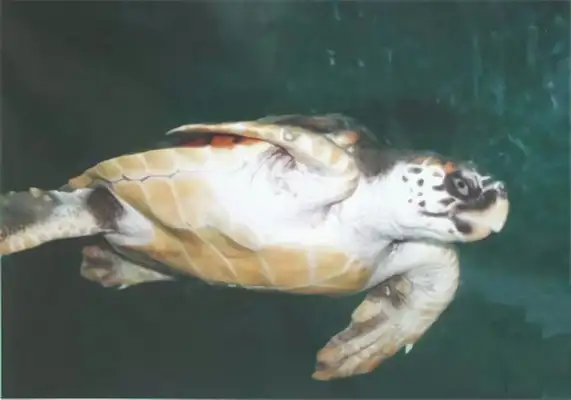
Pacific turtles are endangered and protected species, one of the marine organisms, with only beaches that occur each year during the spawning season. The rest of the time is usually roaming the sea, with rapid body metabolism and constant feeding, which is occasionally seen in our waters and where the main spawning sites are located in Japan.
Chinese literary name: Pacific turtle
Chinese alias: Red Tortoise, Red Sea Turtle, Psychic Tortoise, Psychic Turtle
English name: Loggerhe adturtle
Two words: Caretta Caretta
Context: Animals
Gate: Pipeline gate
Amen: vertebrate Amen.
Programme: climb
Tortoises.
KO: Sea turtles
Yes: Tortoise
Plant: Pacific turtle
Distribution: Temperature waters in the Pacific and Indian Ocean. The South China Sea and the East Sea have Pacific turtles.
(b) The manner of reproduction: spawning, in May-July of each year, lays eggs at 60 to 150 at a time, white, spherical and approximately 38 to 40 mm in size, on the beach. Under natural conditions, turtles hatch for 60 days.
Appearance characteristics: Large body sizes of up to 1 m long and typically weighing about 100 kg. It's big, red brown with red backs and orange abdomen.
Lifestyle: In the Western Pacific, the main spawning sites are the coastal beaches of Japan, Kagoshima and Okinawa.
Eating: Eating from fish, shrimp, crabs, molluscs and algae.
Protection status: CITES at risk: Appendix I; IUCN at risk: at risk; Chinese endangered animals at red paper level: at risk; national priority protection level: Level II. Pacific turtle morphological characteristics
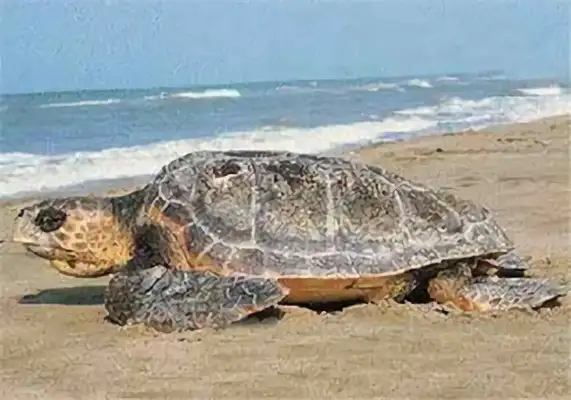
Pacific turtles have a similar appearance to Atlantic turtles, with a fluided back, large head, short necks, broad necks, and slurry limbs, and a physical shape that is conducive to sliding through the sea, where the Pacific turtles are elves in small numbers and in need of protection.
Pacific turtles have a larger size of up to 1 metre and typically weigh about 100 kg. Large body size leads to a backnail curve length of 745-1025 mm (n=16). Red brown back, abdominal orange. The head is wide and has a very strong hook beak. Head back symmetry, 2 for forehead, 1 for green turtle. The vest is heart-shaped, with narrow and high hips. The scales are flat. The neck shield is short, the vertebrate shield is 5-6, the rib shield is usually 5 pairs, the first pair corresponds to the neck shield, the first pair is 13 pairs, and the third pair is lower. Four-legged maggots, four-legged oars, large front limbs, small back limbs, one to two claws each, suitable for swimming and short tails.
There are two types of turtles, divided according to their distribution into Atlantic turtles and Pacific turtles, which are mainly located in warmer seas in the Pacific Ocean and the Indian Ocean, and who do not wander without purpose. According to scientists, Pacific turtles can clearly find their own path, but the reasons are unclear. Pacific Turtle Care Knowledge
The Pacific turtles, mainly in warm waters, especially along the continental shelf, can even enter the bays, estuaries, brackish lakes, etc., and are the most north and southerly species of sea turtles. Fish, crustaceans and molluscs are the main foods, especially headfoots. In May-July of each year, during the reproductive period, female intercourse is followed by the laying of eggs at night on the beach, with 60-150 eggs, white eggs, spherical shapes and approximately 38-40 mm ovulations. Pacific Turtle Living Environment
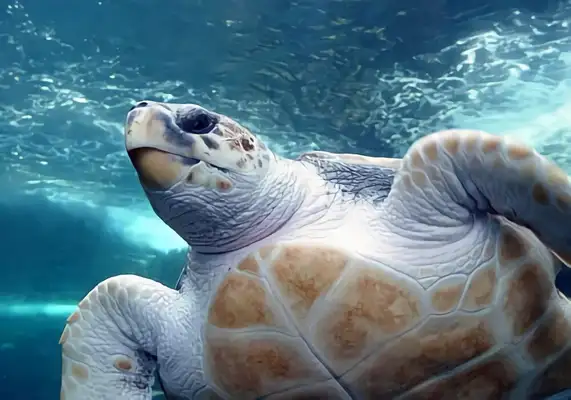
The Pacific turtle lives in a vast ocean with a wide distribution of turtles, which can be found on a beach on every continent, and is a sub-species of turtles, mainly found in a warm sea in the Pacific and Indian oceans, where the annual spawning and the Pacific turtles find spawning positions precisely with amazing persistence and direction.
The Pacific turtles are located abroad in the south-eastern Asian seas and in the Indian Ocean, along the coasts of Guangdong, Guangxi, Taiwan, Fujian, Zhejiang, Jiangsu and Shandong, as well as in the open waters of the Yangtze River in Shanghai and even in the Yangtze River. S.S. Frazier et al. (1988) reported on surveys in Fujian and Guangdong in our country, with the observation of Turtle 16. According to the authors, most of our turtle records are in Fujian (81 per cent), more than half of them from the coast of Pyramu Island. The Pacific turtles, mainly in warm waters, especially along the continental shelf, can even enter the bays, estuaries, brackish lakes, etc., and are the most north and southerly species of sea turtles. The main spawning sites in the western Pacific Ocean are the coastal beaches of Japan, Kagoshima and Okinawa. And while we can find traces of them on our beaches, recent hunting has led to “zero” spawning, so it does not count as a suitable spawning ground. The point of Pacific turtle breeding.
The main habitat of turtles is warm waters, especially along the continental shelf, and even into the bays, estuaries, brackish lakes, etc., which are the most distributed north and southerly categories of sea turtles. Fish, crustaceans and molluscs are the main foods, especially headfoots. Between May and July, reproduction occurred, with males and females usually mating between coastal reefs at spawning sites. After sexual intercourse, the female digs and lays eggs on the beach at night, laying 130-150 eggs at a time, and after a break of 2-3 weeks between rocks, she can also lay another egg.