Title: PET3907
English name: Indian Star Tortoise
Origin: India, Pakistan, Sri Lanka, etc.
Vulnerability to disease: sudden death. Pneumonia. Rock
Life, 30-40-year overview of star turtle species in India
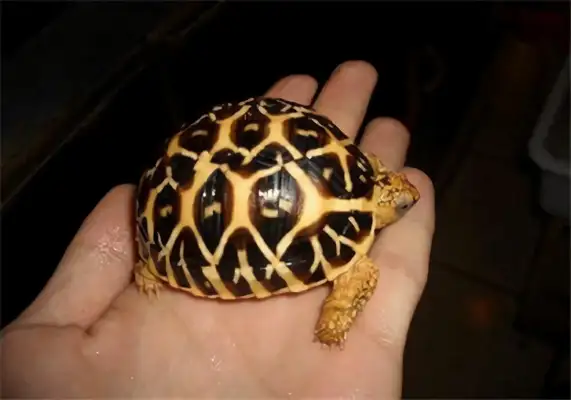
Indian tortoises are more environmentally friendly species of turtles, but it is a more difficult turtle to raise, not because Indian tortoises are sick, but because they usually die of death, and we can treat them slowly, but we can't do anything about it.
Chinese literary name: Indian star turtle
Chinese alias: Indian starland turtles
Two words: Geochelone elegans
English name: Indian Star Tortoise
Context: Animals
Gate: Pipeline gate
Programme: climb
Tortoises.
Subtitles: Curvature turtle
Section: Marine turtles
It's a turtle.
species: Indian star turtles
Distribution: India, Pakistan, Sri Lanka, etc.
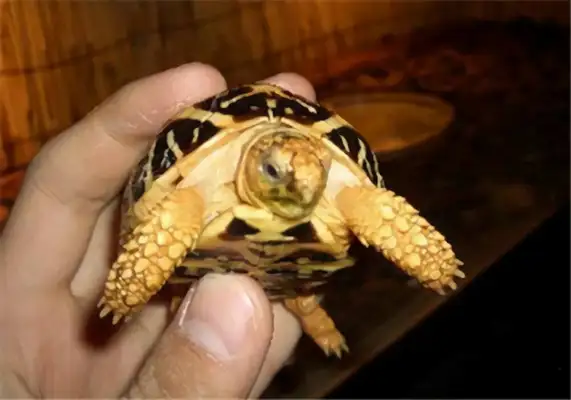
Appearance characteristics: Radiation-shaped star tattoos appear on the back armour shield plates. There are more than eight lines in one shield plate, but the number is smaller in the larvae and the same pattern in the abdomen.
Lifestyle: In the wild, Indian star turtles tend to operate in the early morning hours, and environmental differences can create different ecologys due to their wide distribution in India and Pakistan, from deserts and grasslands to falling forests.
Reproduction characteristics: Female turtles excavate a water bottle-like lair about 15 cm deep with their back feet. If the soil is too dry or too hard, it wets and digs it with urine. And then it'll produce 1-6 eggs in the nest.
Eating: They like fruit, stingy cactus, fat-leaved plants and truffles. Home-grown Indian star turtles, for example, have adverse effects if they are overfed with juicy plants, such as beryllium, lettuce, tomatoes and juicy fruit. Indian star turtle morphological characteristics
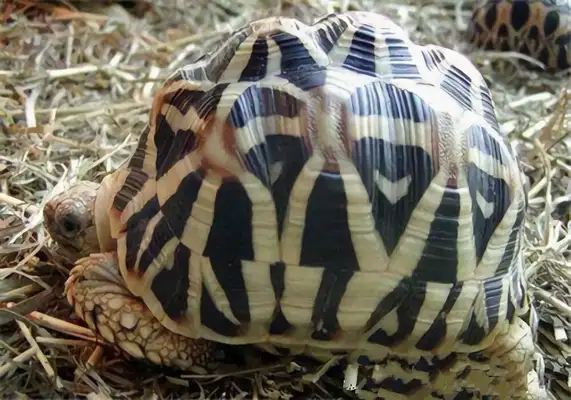
The Indian star turtle's vests are very distinctive, and the seemingly non-characterized radiation print does distinguish the focus of the turtle, and Indian star turtles often experience back-sliding phenomena that make them look more peculiar, but this is also what the breeders try to avoid.
Star turtles are the smallest species in elephants. The thinness of the thread can be divided into Indian and Sri Lankan star turtles. The former are relatively thin and have the same thick tails; the latter are thick and magnified at the end. It is a protected colour of origin, and it is difficult for predators to find it in star turtles in dry grass. Its name is given by a star on every nail on its back. There are more than eight lines in one shield plate, but the number is smaller in the larvae and the same pattern in the abdomen. Its rodged limbs are typical of the limbs of the ground turtles, which allow considerable time to climb and dig.
The normal hierarchies of turtlebacks are visible and slightly different from the general back. Star turtles are also the species in undergraduates that need more moisture. So it's best for the turtles to take a bath every day and have regular suns. Length 30-38 centimeters. This female is much bigger than the male. Females are easily identified, they are smaller in size and small in size, and they have a significant cavity in the abdomen; they are wide and flat in the abdomen. The male has a large tail, while the female has a short tail. Indian star turtle care knowledge
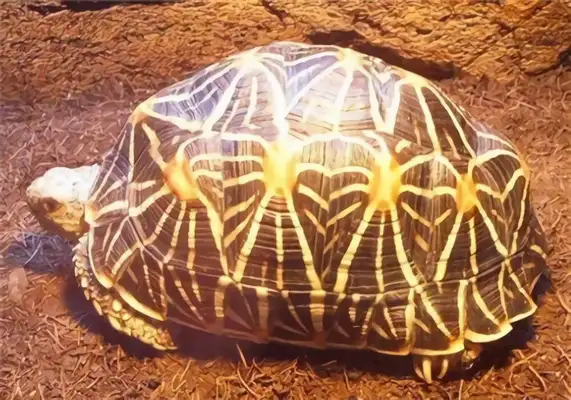
India ' s star turtles are difficult to feed, and the chances of success are to start with the selection, to choose the most robust individuals, and to pay attention to temperature and humidity in the breeding. Temperature and humidity change are the main causes of their death, and lastly, to tan their backs and ensure their health.
I. Selection of star turtles in India
The choice of the size of the individual to be bought is important, and there are basically two types of individuals to be sold on the general market, three to four centimetres of ping-pong, and a slightly larger group of six to eight centimetres, who are recommended to start raising about eight centimetres for the first time. This large group of individuals is much stronger in body and adaptability than the ping-pong star, and when they are picked, they are the second most important ones. The eyes are the most important ones, the eyes are the gods, the limbs are strong, the limbs are too heavy, the body is too heavy to choose, and they may be the ones who do not eat.
II. High rearing temperatures
Star turtles are mainly produced in northern and southern India and throughout Sri Lanka. It's always high, so when we raise it, we don't have to be below 25 degrees, we don't have to have too much temperature change in the morning and night, and we can basically stay at 28 degrees. Because of the dry and rainy seasons of origin, star turtles are not very sensitive to humidity, and they can endure it as long as they are not too wet.
III. Indian star turtles in sun
Although the turtles lack UVB lamps, they should not rely entirely on them, but should enjoy the sun bath when conditions so warrant. But to avoid the sun, there must be a cool place for them to regulate. Although the Indian star turtle is “deceptive”, it is not difficult to keep it well, as long as more attention is paid to these points. Indian star turtle living environment
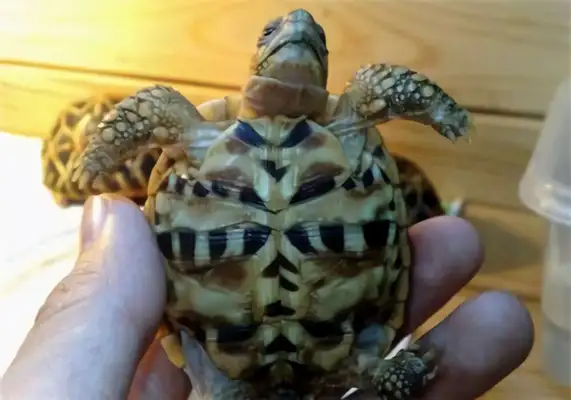
The soundness of the living environment of Indian star turtles is the most important factor in their healthy growth. Indian star turtles are particularly sensitive to changes in temperature and humidity, and unreasonable regulation is likely to lead to pneumonia or stones.
I. Temperature control for raising Indian star turtles
The base temperature is over 28 degrees, the BEST is 30-35 degrees, creating a small area of 35-38 degrees under the lamp. Of course, if you take into account the abdominal cold, you'll need a warmer pad. Tortoises, most of them like sunbaths, so they can improve body temperature and stability. In a wild environment, the bottom does not need to be warmed, and in an artificial environment, the issue needs to be considered. The bottom of the tank is cold, which prevents food from digesting and metabolism.
II. Indian star turtle sun
Almost all the turtles can be called sons of the sun. Calcium, based on vitamin D, is normally absorbed by turtles, forming shells, bones and eggs during spawning periods. Ultraviolet is the raw material for the production of vitamin D and is therefore the most essential requirement. There are many UV lamps on the market, but none of them are longer than the 290-320NM produced by the Sun. If possible, wish turtles to let them enjoy the natural sun.
III. Indian star turtle feeding facilities
If it's managed, boxes, glass and steel, wooden boxes, etc., can be used. The glass steel of 90*45*45*45 sold at the test site can be raised for life. If you want to reproduce, the male and the mother bear separately before breeding. It's an increase in their reproductive activity. The Institute has many, most basic, winter shelters and summer breeding sites. However, the Institute has a larger number of star turtles, so that many of the breeding sites that are prepared for them can be temporarily isolated from small areas, while at the same time paying attention to different types of management. The point of Indian star turtle breeding
Indian star turtles are absolute vegan turtles and prefer to eat plants with less water. High-water plants cause diarrhea in Indian star turtles, so be careful to choose the type of food. The food options for Indian star turtles are described below.
When raising land turtles, the best possible end is to feed. But this is the most important place for attention. In the long term, star turtles can change food, which is their biological need, sometimes not their appetite. This is mainly true of food, and young tortoises in their first months of life can participate in reproductive activities within a year and a half. In a wild environment, they do not have so much oil and fruit to eat, that is to say, in a wild environment, where the star turtles have wild grass and wild vegetables as their main food, unlike in India, they must be fed with more attention and must never be given to stimulating food.
When you're feeding, it's best to have more food of all kinds. Occasional changes are made to make staple and by-catch. The hardest thing to do is to prepare a variety of foods. Indian turtles, staple foods, can be oily, some stars, come and eat as soon as you feed them, some of them timid, and they won't eat for half a day. This is a time for both a permanent bait. Permanent baits are baits that are not as easily decomposed as staple foods at high temperatures. Such food, which is less caloric and more fibrous, can be planted for weeds, plants such as sauna, radish leaves, pastures, sunflower sprouts, etc.