Designation: PET2843
English name: An introduction to the HornedLark Cape.
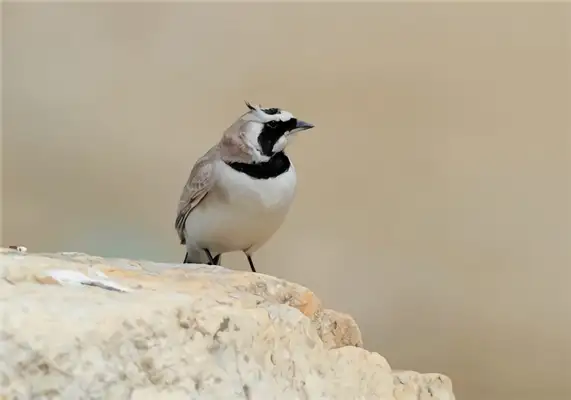
Hormed lark has a somewhat similar shape to a sparrow, especially with dark gray feathers. The Cape Fleur, which has been one of the country ' s famous cagebirds, lives in groups during the non-reproduction period.
In China, each of the sub-species is a winter bird, the others breed in China and stay for the rest of the year. It is now mainly located in Iran, Afghanistan, Pakistan, the former Soviet Union and Xinjiang on mainland China.
The Chinese literary name:
Other Organiser
Two words:
Area: Animal
Gate: Phylum Chordata
Amen: Vertebrata
Aves
♪ The world's most beautiful world ♪
(a) Passerformes
Section: Alaudidae, Encyclopedia
Eremophila
Angry Hollow
Distribution: Gradually morphological characteristics of Iran, Afghanistan, Pakistan, the former Soviet Union and Xinjiang, mainland China
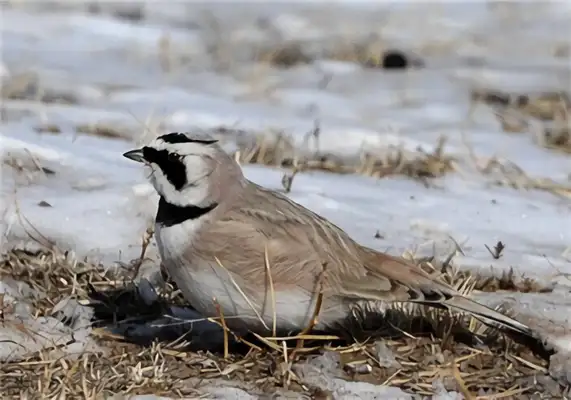
The length of the horn-breed ideal should be around 16 cm, the desired weight should be between 33 and 45 g, and the ideal wing should be around 33 cm. There are currently 42 sub-species. The female and the male are broadly similar, but there is a clear distinction between them.
The horned male bird has a white forehead or light yellow, with a wide black band, with two or three black feathers at each end stretching behind his head, as two horns. First eyes, cheeks, ear feathers and mouth-based black, white or light yellow, linked to the forehead white. The back, back, brown, brown or gray, with dark brown stripes and sand or brown feathers. The tails are covered in brown or brown, the central tail is brown, the feathers are brown, the outer tails are slightly white, the outer side of the tails is a few whites, the second side of the tails is white only, or the outer side has only one wedge. Blank brown, white on the outer side of the first primary flying feather, white narrow edge of the remaining primary flying feathers and white end marks of the secondary flying feathers. Lower white, a black belt.
The female and male feathers are broadly similar, but the crowns are short or not visible, and the breast strips are smaller.
Ion or tan, black beak, black or black. It's all about life.
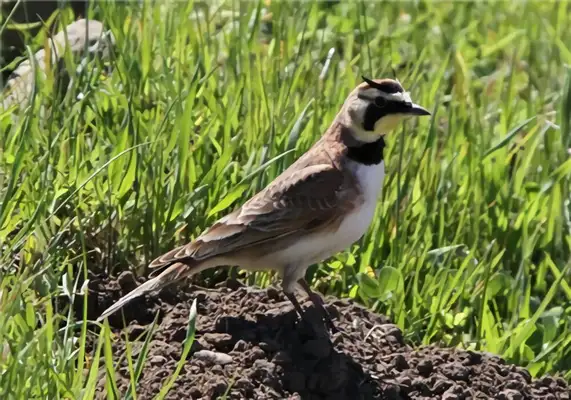
Angglomeration is a typical larvae bird, fed mainly by vegetable foods and occasionally by animal foods such as insects, with cyanide, plant fragments, locusts, larvae and beetles.
In China, each of the sub-species is a winter bird, the others breed in China and stay for the rest of the year. There are often separate or twin activities, sometimes in small groups of 3-5, especially during migration seasons, non-reproductive periods and winters. Mainly on the ground, it is generally low or far. It is good to run at short distances on the ground, and in case of disturbance, to stand up, look up and fly at short distances when the danger approaches. Singing, especially early in the morning and evening, softly and often in the air. The sound of flying sounds is sit-di dit. The sound from the habitat or during flight is a simple high-sounding hissing, or a light tu-a-li, tioli-ti or similar sound. Angry-breeding knowledge
Angryl is one of the most common caged birds in the country, and if it is to be raised as a pet bird, it is important to distinguish the male from the female before you buy it. The period of reproduction is usually in May-August of each year, but it is also earlier if it is in a warmer area at lower altitude. Angglomeration usually starts laying in mid-May of each year. It's a long way to go. In winter, they reach lower elevations to shorter grasslands and lake banks. The camp is nested on the ground or in the bushes.