Designation: PET3549
English name: Indo-chinese Box Turkle
Nature: timidity
National origin: China, Viet Nam
Vulnerability to disease: decomposition
Life: A brief description of the species of yellow shell turtles for about 50 years
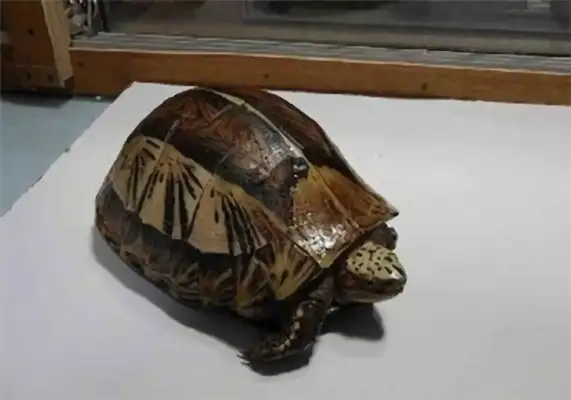
As we all know, closed-hull turtles are unique to our country, and yellow-hull turtles are an accident, because they are also spread across Vietnam, and they are called yellow-hull turtles, which are more difficult to raise, are environmentally demanding, are prone to disease and death, or do not eat at all, so they are not easy to try to raise.
Chinese literary name: Yellow closed-hull turtle
Chinese alias: yellow box turtle
English name: Indo-chinese Box Turkle
Latin name: Ciscomys galbinifrons
Context: Animals
Programme: climb
Tortoises.
Section: Freshwater turtles
Yes: A box of turtles
Castes: yellow box turtles
Distribution: Domesticly in Guangdong, Guangxi, Hainan Maung Shui County, Ludong County, overseas in Viet Nam.
Lifestyle: Living in mountain streams. Yellow box turtles are scattered only in dry tropical areas and live in hilly mountains and shallow water areas.
Food requirements: mainly meat bait. High environmental temperature requirements, low adaptive capacity, environmental changes, and turtles generally do not eat.
Reproduction practice: 6 cm long and 12 g long, with white eggs, 3 cm long and 3 cm long.
Level of Protection: Appendix II to the CITES Convention on International Trade. List of “three”. Yellow closed-hull turtle morphological characteristics
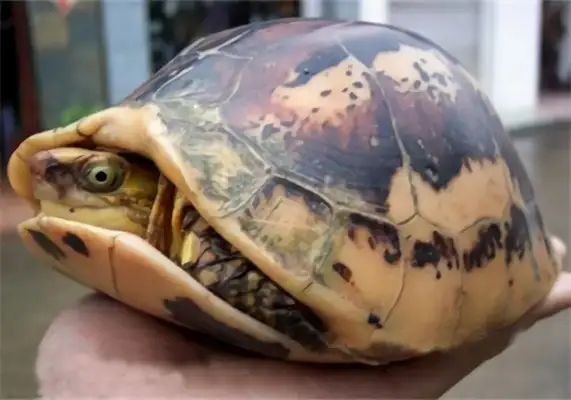
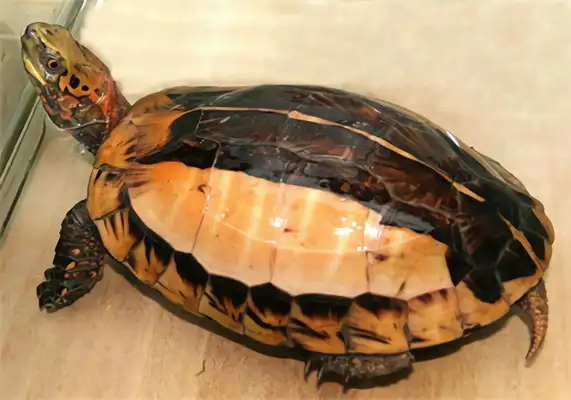
The yellow-hulled turtle's back is flat and has beautiful raisins, but the raisins are not visible, and yellow-hull turtles are known as yellow-shell turtles, which can narrow the whole body inside the shell and close the abdomen.
The yellow box turtle is a beautiful and distinct turtle. The pattern on their backs may be very colourful, but most of it is in brown areas at the vertebrae, with creamed threads from the centre down. The ribs are light tea colours that are bright and may bear a stubble pattern. The shield is a strong contrast to the dark brown. The abdomen are mostly black or dark brown.
High in the back, one half of the size of the shell, with obvious ambiguity. And the abdomen shall be large and flat, round and round, and there shall be no dimples. Anal shield single, no ditch. The abdomen are connected to the back and the back and the back of the abdomen, and the abdominal bile is completely closed up to the back. Toes and toes are half-tied. The tail is short.
The head is light (milk, yellow, green or gray) and may have black narrow stripes on both sides. Light yellow under the jaw and neck. The difference between females and males is not significant, but generally the tail of the male turtle is slightly thicker. Shells 10-18cm or so. Medium head, smooth top, flat top jaw. Knowledge of Yellow Cyclops Care
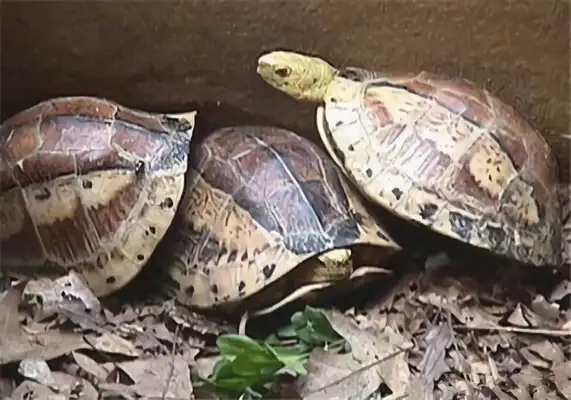
Yellow-covered turtles are more difficult to raise, a very demanding turtle with high environmental and food requirements, and the amount of yellow in a field habitat is not so good, but artificially raised yellow-covered turtles are more timid, so it is more difficult to eat.
I. HYDRA CLOSE TORTURE CONTEXT
Yellow closed-hull turtles are located only in the tropics and live in hill hills and shallow water areas, dominated by meat baits. High environmental temperature requirements, low adaptive capacity, environmental changes, and turtles generally do not eat.
II. Management of yellow closed-hull turtle breeding
Households need first to keep warm, with a temperature range of 24-30°C. Temperature is as much the same as the temperature of turtles, and three or four days later, inducing food is dominated by locusts, earthworms, fish, shrimp, pork, and, in the case of mice, under conditions.
Be patient when inducing, and guard the turtle. Daily feeding of meat, small insects with apples, tomatoes and cabbage. It's mostly carnal. They eat some fruit and vegetables, but prefer earthworms, crickets and mice.
Live bait can induce them to eat. A small amount of cat food is also acceptable to these meat-eating turtles, and this is usually the first food to be eaten by a rejected turtle. When one of the breeders fed mushrooms, her yellow sheathed turtles opened. Calcium is added to the food once a week to meet the needs of turtles, and squid bones should be placed in the breeding grounds for turtles to bite.
The yellow-covered turtles tend to feed much later, but most of the inexperienced feed them before they do, probably because of frequent disturbance, which leads to discomfort in the environment, so when raising the yellow, do not disturb easily and keep the environment quiet. Yellow closed-hull turtle living environment
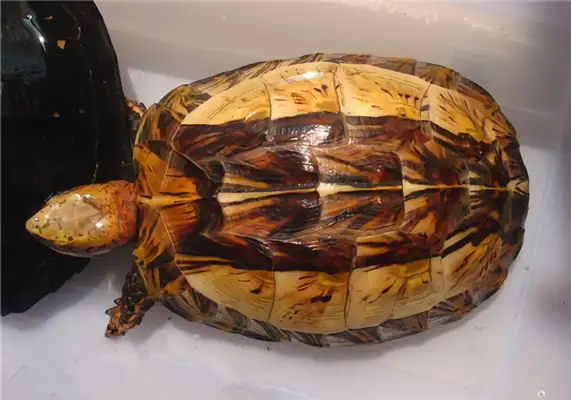
Yellow closed-hull turtles require higher environmental humidity, and while both are semi-aquatic turtles that prefer to stay on land, yellow closed-hull turtles require higher environmental humidity so that some mosses can be placed in the environment.
I. ELECTRONIC RECOMMENDMENT FOR Yellow CLASS
Yellow closed-hull turtles are usually timid and difficult to raise. Insistence is prevalent among yellow-rich closed-hull turtles caught in the wild. Creating an environment as comfortable as possible would help to address this problem. It is also important to keep these high-pressure turtles away from busy areas.
Yellow closed-hull turtles are semi-water-dwelling turtles, and the breeding environment must be surfaced and not be deeper than two thirds of the height of their back armour, or turtles should not float in water. Turtles can also be raised in shallow water at a depth of 5 cm, with the advantage that they are smell-free, disinfectable and clean.
Prepare a large breeding site with moss or leaves and bark. The moist moisture of moss should be maintained, as yellow-covered turtles require a high-humid environment. Some breeders report that they are happy to grow plants in breeding grounds, and that individual breeders grow grass in rearing boxes and turtles are well adapted. Plants also contribute to increased humidity. There should be small ponds for drinking and bathing, which are warmer to the environment. There should be both cool shades and warm areas where sunlight shines. The use of a full spectrum reptile lamp is recommended, as it contributes to the physical and mental health of reptiles.
II. Temperature control of yellow shell turtles
Yellow closed-hull turtles are starting to starve at around 17 degrees, and the temperature of hibernation should not be below 15 degrees. Small amounts of food and creeping around 22 degrees and 28 degrees are the best feeding temperatures. Therefore, good day-to-day management and temperature management are key. Particular attention is paid to the actual changes in temperature during rearing. In particular, during seasonal exchanges, temperatures must not differ by more than five degrees, otherwise they are prone to disease. In areas with a mild climate, it would be preferable to choose a fenced outdoor breeding site if the appropriate temperature was maintained. Yellow closed-hull turtle breeding point
Yellow seal turtles are hard to eat, mainly because the environment is not satisfactory for the turtles, and generally, as long as the environment is well-placed, yellow shell turtles are more likely to eat faster and be more successful.
I. METHODOLOGY OF CLOSE CLOSING HOLDERS
When you've set the temperature of the environment, you can feed a variety of foods every day, because every turtle tastes differently, believing that there's always one that lures it, and it's usually normal not to eat for two months, and they can carry it, but water must not be scarce, hunger is hard to starve, but dehydration is fatal.
It could be done by trying to cut the tomatoes straight into strips, pick up the turtle's 45-degree angle, rub them gently under the turtle's nose, put them in after their mouths, and some yellow amounts will bite themselves. If it does not work, it may be necessary to fill up the tortoise, to touch its nostrils with hard matter, to open its mouth in anger, to grab the time and put its finger in its mouth so that it bites it, and then slowly injects the ketchup in the syringe or puts the ketchup in its mouth, and then feed the tortoise several times.
ii. What do you eat?
The yellow diet consists mainly of insects, beef, tropical fruits, fodder, tomatoes, rats and so on, feeding on the principle of “a small variety”, in which earthworms and snails are good foods that match their diets in their original state, while earthworms are good for turtles in terms of feces and respiratory systems, while fresh snails contain large amounts of glue protein, which are good for turtle growth.