Designation: PET6443
English name: Bog Turtle
Origin: Southwest Vermont, United States
Vulnerability to disease: decomposition
Life: A brief description of the species of fish turtles for about 50 years
The turtles are smaller in size, tend to move in hot summers, spend their time in the mud in winter, in smaller quantities and not easily discovered, and are classified as protected animals, like sunbacks and warm environments. From April until mid-October, they have often been tanned on sun-filled grass in spring. In hot times, they bury themselves in mud or plant debris, exposing only a fraction of their backs to sunlight. By winter, they bury themselves deep in the water sludge. Today, in most cantons, they are protected if distributed. Characteristics of the morphological pattern of the poaching turtle
The heavier weighs approximately 84 ~140 g, with an average length of 8.9 ~ 9.4 cm, with larger males and only 2.7 cm long. They have brown head and yellow, orange or red stripes on both sides of their head and neck. Their bodies are dark, orange red on the inside of their feet. Tortoise shells are round arched with ringed marks on the shield. Some older individuals, or who often hide in rough places, will be smoother. The shells are usually black, and each shield is radiated in chestnut. The bra has white and black stripes. The male tortoises are dim, and the female is flat. Knowledge of management of sea turtles
In late April and early June, the tortoises breed after hibernation. They nest in grass or water. Most of the spring is mating, with two or five eggs at a time. They produce the eggs where the grass is not covered, and they hatch themselves. The incubation period is 7-8 weeks, and it may take a cold season to hatch. The turtles are only 2.7 cm long and often become prey for birds and mammals. When you're 5-8 years old, you'll have sexual maturity. Their life expectancy is unknown, but is believed to be 30 to 40 years old. Living environment of a sea turtle
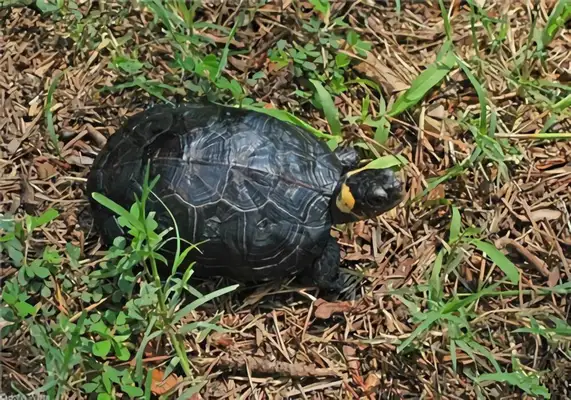
They live in the same environment as most of the turtles, and they sleep in the same way as other species have accidents during hibernation, and they are likely to die during hibernation.
Leaning turtles are found in limey wetlands, such as water shrubs, wet grasses and lawns. They are located in the south-west of Vermont, the north-west of New York and north-east of Ohio in the United States, to the Appalachian Mountains in Georgia and South Carolina. They require abundant grass or moss cover and high humidity to survive. They're going to get warmer by tanning the sun in a place that's wide and bright. They go to the 6-18 inches of mud in the swamp water. The turtles don't hibernate, they don't sleep until they're 2-3 years old.
The habitat is usually swamped shallows and moist grasslands with a maximum water depth of 4 feet. Peek-in turtles are active during the three seasons of spring and summer and fall, and sleep in the field in winter. Although they are often hidden under dense wetland vegetation in the summer, they are often seen in the sun in the clear. In order to sleep or avoid the heat of summer, the enemy usually burys themselves deep at the bottom of the mud pond, and it turns out that they often spend half their lives burying themselves in the dirt. It's the point of feeding a fish turtle.
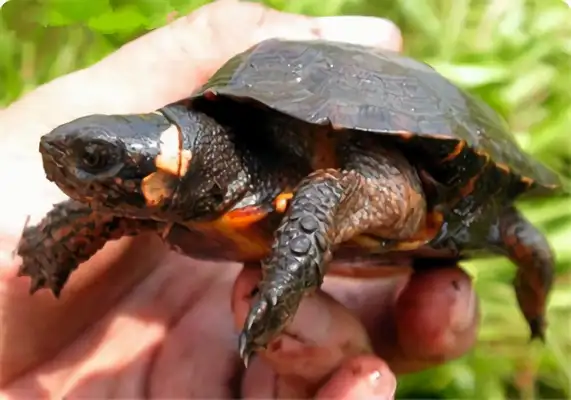
It is very important to eat in an environment that is less daring, where the first switch to feed is to turn on food, and sometimes if the turtle does not.
I. ELECTIVENESS OF TORTURE
Aphid turtle is a groin, usually fed in the wild by berries, beaks, insects and animal carcasses, and is found in the daytime, but not active at the hottest times. They eat mainly seeds, strawberries, insects, pickles, worms and freshwater lobsters. It is also a more land-based tortoise that can feed on land in water.
II. ELECTRONIC TOOXY
When eating, the shrimp/fish (which can be replaced by fresh shrimp)/past chicken can be caught in hand or in a small clamp and stopped in front of the head of the turtle. It would be better to do so in the water, while the tortoises put their heads in the water. However, there is generally no immediate response, so there is a need for patience and long periods of enticing. If you can't do it for 30 minutes, kill the shrimp, put it in the water, and the master can walk away. If they do not eat in a few hours, they insist on inducing them every day and dropping them into their new home with an adaptation period, which is likely to prevent them from eating.