Designation: PET5127
English name: AsianLeaf Turkle
National origin: Overview of the species of turtles by the tooth of the southward Malay peninsula, Indonesia to Bali, Borneo, Philippines and mainland China
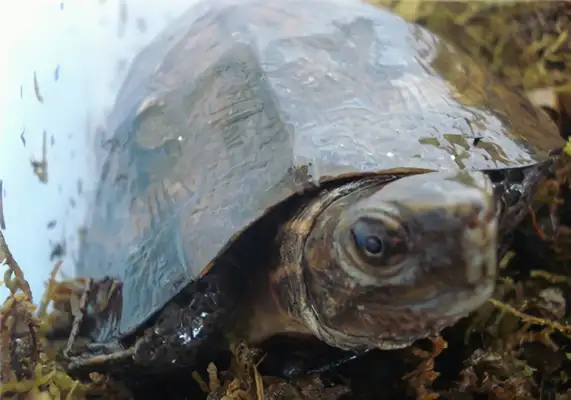
The biggest problem with the tooth turtle, which is a relatively common half-water turtle, is that it does not choose the right species, and the tooth turtle is very well suited to new hands and has a strong personality and interaction with humans, both in terms of price and difficulty.
The rodents are reptiles. In Yunnan and Guangxi, located from India to Indochina, to the Malay Peninsula southward, Indonesia to Bali, Borneo, the Philippines and mainland China, live in mountain streams. Its maximum altitude is 1,300 metres. The species is modelled in India, Bangladesh and Java, Indonesia.
Latin literary name: Cyclemysdentata.
English name: AsianLeafTurtle
Classified: reptiles, turtles, fresh water turtles Section
Practising: Discovered in mountains and plains, but mainly in low altitudes, such turtles appear in small rivers and ponds. The larvae are more hydrogenic than the adult form, which is more like a foot-crawler than a true swimmer. It is believed that the back of the leaves and colours help this turtle to hide in forest cover. Like many turtles, they excrete when caught.
Subspecies: At present, there are four subspecies for the toothfish:
1. Beautiful turtles Cyclemysatripons (IVERSON & MCCORD 1997)
Cyclemysdentata (initially described as Emysdhor, GRAY 1831)
Cyclemysoldhami (GRAY 1863)
Cyclemystcheponis (initial name: Geomydatcheponsis, BOURRET 1939)
Artificial stock-raising: The tooth-causing turtles are carcasses and eat mainly fish, shrimp and meat. Teetheds for turtle morphology
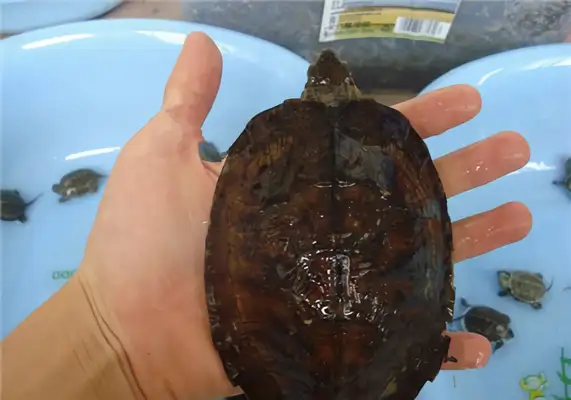
It is difficult to identify the rodent turtle because he has four sub-species, and each sub-species has some differences in appearance, the main difference being the radiant form of some along the back and neck tracks, some of which are radiant, some of which have no visible characteristics.
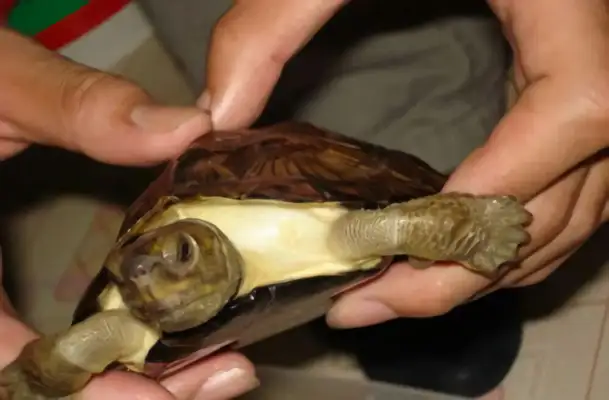
It's 20-24 cm long. The back is flat, the larvae is about the same size, and the larvae grow into a wide body; the larvae of the back centre are very visible, not as they grow with age; and the larvae are particularly visible after the larvae. The abdomen are narrower, the front end is flat or rounded out, and the back end is three dents: the longest fragrance, the shortest hysteria or larynx; the shorter and visible size of the bridge; and the development of the fratrical cord between the abdomen and the lower plate.
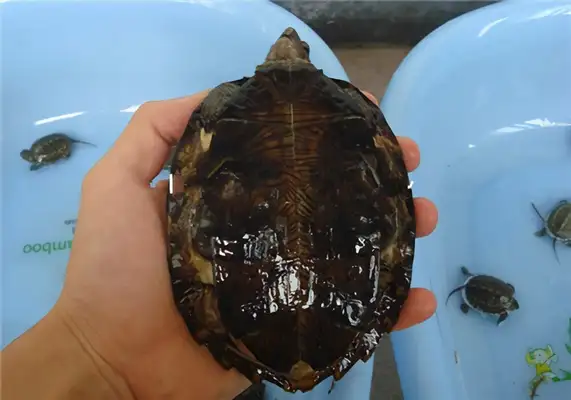
Teethy turtles have three well-developed prisms. Overall, they are brown in colour, ranging from tea to red brown, and very much brown. The abdomen are also tea or brown, and there may be brown and black spots on each shield. As a box turtle, it has an abdominal joint that can be closed. There are small but visible bridges on both sides of the body, linking the back and abdomen. The turtles are quite flat, similar to Asian leaf turtles, but the size of the turtles is relatively high.
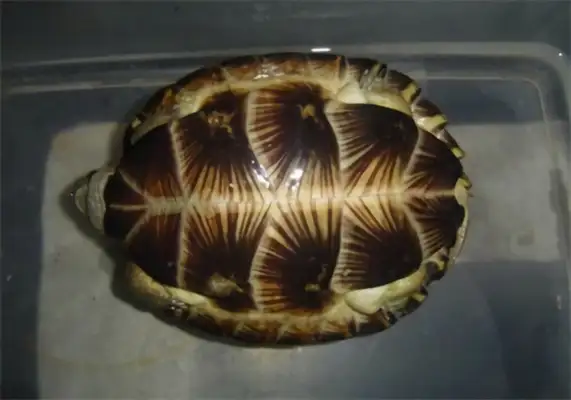
The colour of the rodent turtle is highly variable, typically tan on the back of the abdomen, with a black radiation line on each shield of the abdominal aperture, and often with ill-defined traces of the back aorta. The knowledge of dental turtle care
Teether turtles are easier to feed, and as semi-water turtles, they are easy to feed, but even so, we still have to pay attention to a lot of problems, or even the more easily rearing turtles are prone to disease and death.
I. OXYL VIOLENCE
Living at low altitude, larvae are highly aquatic and fully terrestrial. Eat both animal and plant food. Two to four eggs each, 6 cm long and 3 cm wide. Presumptuous animal bait, with the artificial raising of shrimp and skinny pork. Temperature 25 °C is optimal, 17 °C enters hibernation. Teether turtles are semi-water-dwelling, but they are the most land-based, semi-water turtles, many of whose friends are placed in a general semi-water habitat, and which can easily lead to decaying nails, and who prefer to live in wet mud rather than in water. So, when setting the environment, it can be made of wet soil and sand, and it is best to plant green leaves like green tatters, or to lay some dead leaves. It is possible to imagine the climate in the mountains of Guangxi, Hainan and try to create a similar environment.
II. NORMAL TORTURE RESPONSIBILITY
Teether turtles are aquatic turtles, and the rearing vessels can be watered up at a height of 40 cm or more (20 cm for larvae) with some shredded or pebbles in the vessels for the turtle to climb, if not to the point where there is unconditional water; they can also be placed in wooden boxes with 5 cm thick sand on the bottom of the boxes and equipped with a larger shallow basin for turtle water and bathing. The living environment of the turtles with teeth.
Teether turtles are semi-water turtles, but their breeding is different from turtles, which require more terrestrial environments, and the depth of water is high, and they are not swimmers, and they cannot grow well if they simply go into water and swim harder.
I. THE BABY ENVIRONMENT
In the case of larvae, we recommend the provision of water at depths of 5-10 cm and the provision of dry tan sites with a stone on one end. For a turtle, the right size aquarium is about 20 gallons: 75 cm * 30 cm. As turtles grow, breeding grounds should also grow. Water quality is important. Many of the problems with turtles can be avoided if it takes time and money to design and purchase suitable filters. In many cases, it is difficult to provide a good filtration system for juvenile turtles because of the shallowness of the water, in which case the provision of a diving filter or a sufficiently strong filtration device, as well as the exchange of additional water, is a royal route. At the tip of the breeding environment, a reflecting light should be installed above the tan site to provide an artificial tan environment. The set-up tan site should be about 32 degrees Celsius under the focus light. They should also be equipped with spectral lamps to provide UVBs and UVAs. UVB is necessary for synthetic vitamin D3 (ccalcium metabolism). It would be preferable to provide such a source of light by using silver vapour lamps to meet both thermal and UV needs. The placement of living or plastic aquatic plants to provide refuge for turtles increases their sense of security.
II. TORTURE ENVIRONMENT
For adult individuals, at least 50 per cent of the area of recommended breeding grounds should be on land. The depth of the water should make it easier for the tortoise to reach the surface and breathe. Outdoor breeding sites - Outdoor breeding sites that ensure that they are not harassed by predators during warm seasons have many advantages over indoor breeding sites and deserve serious consideration. A fenced swimming pool for children is a reliable outdoor breeding site. A big pond with good filtering is a good breeding ground for your leaf turtles. The point of the rodent tortoise.
The demand for food by the rodent turtle is low, and it is a typical groceries turtle, which you think can be supplied with foods that are good for your health, but whose stomach is fragile, so pay attention to his feeding frequency.
I. The eating nature of the toothline turtle
Food — tooth turtles are completely unscathed, and wild turtle foods include figs, fruit, rotting meat, fish and crustaceans. Similar food can be provided in the case of artificial rearing. Be careful not to eat too much tortoise. Obesity is a common problem. Adult turtles can be fed two to three times a week, one per day or the following day for fast-growing turtles. They will soon accept the commercial production of turtle food that is available on the market.
II. Frequency of feed-feeding by tooth-dry turtles
Teether turtles have a narrower distribution and are relatively less adaptable. The daily daily feeding rate is 2 to 3 times a week, at 10 per cent of the turtle ' s body weight per feeding time is appropriate at noon, with four to five hours after feeding. When changing water in late autumn, the water should be warmer than the original water in order to prevent intestines on the turtle. Every day, in addition to feeding and changing water, it should be observed on an on-the-job basis that, if a sick tortoise is found, it will be kept isolated. Teether turtles are more sensitive to temperature changes, with a small diet at 20°C, 17°C in hibernation, and 35°C in “hypnotic sleep”, without moving. As a result, water temperature is regularly measured and temperature changes observed in day-to-day maintenance, with a view to taking appropriate measures.
It's difficult to feed the rodent turtles, and friends in the new hands don't try it easily, and “absolute death” is often associated with them. The choice of healthy individual purchases is crucial, followed by control of their environmental configuration, which is too dry and can explode in the head. If it's bubbled, it's perishable. And don't forget the calcium.