Designation: PET3963
English
Nature: timidity
National origin: North-East Laos, Viet Nam and the south-east and south-east of mainland China.
Vulnerability to disease: Decay
Life Life: An overview of four-eyed turtle species for about 50 years
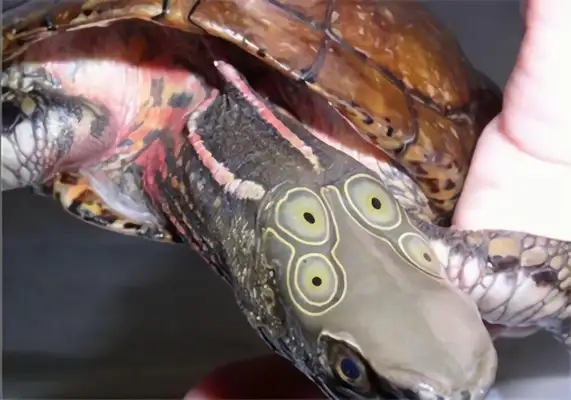
The four-eyed turtles are not uncommon, and for a long time the wild four-eyed turtles have been small in number, expensive and difficult to raise, so they belong to the more precious species of water turtles, who are timid and usually do not interact with their owners when raising them.
Chinese literary name: Sea turtles with four eyes
Chinese alias: six-eye turtle, four-eye turtle
Two words: Sacalia quadriocellata
English
Context: Animals
Gate: Pipeline gate
Programme: climb
Tortoises.
K: Zetoru
It's the eye of a turtle.
Castes: Sea turtles with four eyes
Distribution: North-East Laos, Viet Nam and the south-east, south-east, south-east of mainland China.
Food: communion. There are also small amounts of red carrots, cucumbers and mixed feed for animal baits, such as skinny pork, small fish, liver, etc., under artificial rearing conditions. There are no cabbage, potatoes, platinum; thin pork is immersed in water for longer and white is not.
Lifestyle: the timidity of the four-eyed turtle. The general preference lies in the darkness of the water floor, such as under rocks and around the corner. Repeated nostrils are exposed to the surface for about 15-20 minutes, when they are breathing.
Reproduction: spawning, mid-May-June. One or two eggs at a time and in batches. The length of the egg is 43 mm by 22 mm and weighs about 15 g.
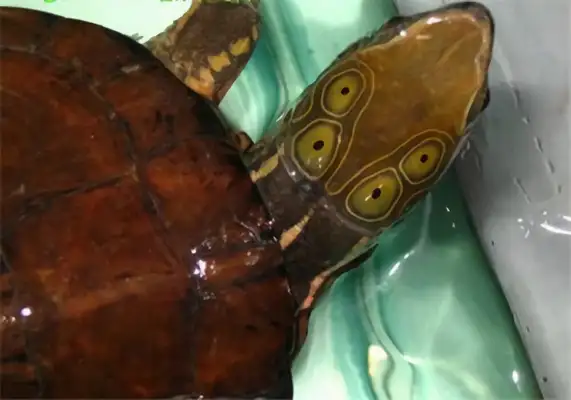
Appearance characteristics: medium-sized. The skin on the head is smooth, the beaks are not hooked, and there are two pairs of eyes on the back of the head, each with a black spot and a stripe on the neck.
Preciousness: The species has been included in the List of Land-based Wildlife for National Conservation or of Significant Economic and Scientific Research Values, published by the State Forestry Administration of China on 1 August 2000. Four-eyed water turtle morphological characteristics
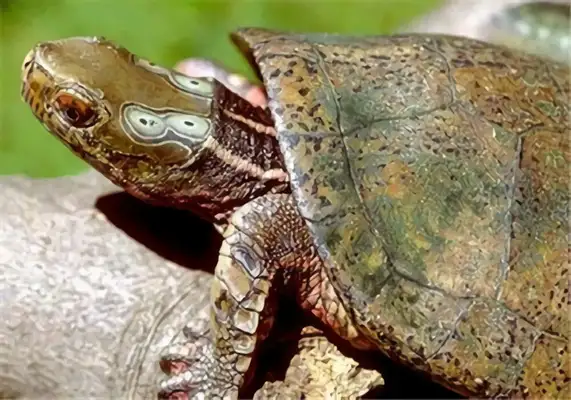
The four-eyed water turtle has obvious features that tell you it's a four-eyed turtle, because it has four landmark rings on its head, like eyes, and because it looks like six pairs of eyes, it is also called a six-eyed turtle.
I. The appearance of four-eyed water turtles
The four-eyed water turtles are in the right shape. The skin on the head is smooth, the beaks are not hooked, and there are two pairs of eyes on the back of the head, each with a black spot and a stripe on the neck. It has a brown back and a raisin, with no sawn teeth or slightly sawn teeth. The diarrhea is yellow, and each shield has a black-sized spot, which is connected to a bone stitch between the back and the abdomen. Fingers, toes, thongs.
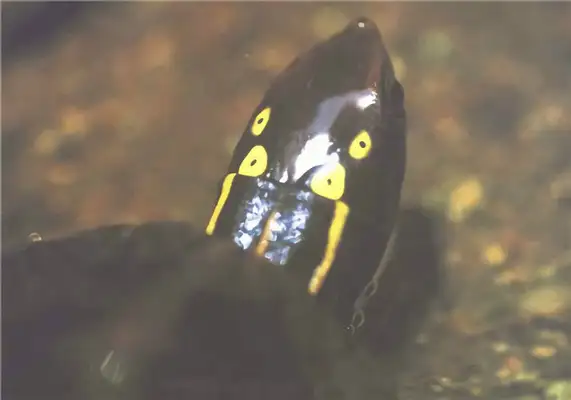
There are dark vertical stripes on the upper and lower beaks of the four-eyed water turtles, like many wrinkles on the mouth. There are three yellow or orange stripes to the top of the neck. In the larvae, there are radiation marks on the back, which fades when they grow up. And they grow small, dark spots, but not as thick as the insect-shaped shape of the eye-eyed water turtle. The insorption of insect tattoos is more or less related to the individual differences of turtles, where the insect tattoos are found only around the abdomen.
II. Precious characteristics of four-eyed water turtles and identification of male and female
The larvae are rounded, strangulated, with the central prism rising high, like a ridge, and the edges are slightly gnawed. An elliptical abdomen, with a shallow missing triangle in the back. The limbs are flat, long and small, with 3-4 overlapping scales on the outside of the front limb. The toes are gills, long and sharp, with moderate tails, with yellow brown or dark olives on the back of the turtle, and slightly dark on the back of the neck. The back color of the body is dark brown or deep olive. There are two pairs of eyes on the pillows on the head, and the front is small.
The colour of the eyes, which is considered by most experts to be determined by sex, is yellow for females and olive for males. The difference between males and females is relatively large, so it has been thought for a long time that these are two turtles. Four-eyed water turtle care knowledge
The four-eyed turtles, which are timid turtles, are more difficult to raise in the early stages of breeding. Often, the four-eyed turtles refuse to eat because they are not adapted to the environment, and the four-eyed turtles that refuse to eat are only able to sustain their lives by filling, generally in a suitable environment, and if the turtles themselves are not sick, they feed themselves soon.
i. Knowledge of care of four-eyed water turtles
After selecting the four-eyed turtles that are satisfied, do not immediately feed them, putting them in clean water (with two to three days of tan, otherwise turtles will change to rotting nails), at about 25°C, at water depths below half of the turtle's backnails, in a dark, relatively quiet environment, two days in exchange for water, one week in which they begin to feed, mainly live fish and insects, as fresh baits stimulate four-eyed water turtles to catch their food instincts, feed them for one month in a row until they are fully healthy, and then feed fresh dead fish for three days, without needing to worry, because turtles, after all, are species that continue through nature's way of survival, will gradually take the initiative to catch dead fish. In addition, four-eyed water turtles love vegetables and can feed them before they are fed.
II. The method of feeding four-eyed water turtles
Of course, for four-eyed sea turtles with poor adaptive capacity who may not have eaten for a long time, it is necessary to check whether the turtle has changed disease, if there are anomalies, if isolated in time, and if treated with medication or a comprehensive method. If the turtle is normal, the bait must be artificially fed: the fish must be caught with a hammer, the turtle's mouth opened with an opener, the fish must be thrown deep into its esophagus, the turtle must be put back into the water and the turtle must swallow itself (some will throw the fish back out, and for such a turtle it will need to be fed repeatedly). The turtle usually eats on its own initiative, feeding about three fish at a time, once a day for two weeks. The four-eyed water turtles live in an environment.
The four-eyed turtles are timid. The general preference lies in the darkness of the water floor, such as under rocks and around the corner. The nostrils can be exposed to the surface for about 15 to 20 minutes after repeated exposure. A small amount of activity is observed at 15°C at water temperature and can be seen in water at about 18°C at the beginning of April-May each year. During the months of June to September, as temperatures rose, turtles increased their range of activity, stretching their limbs to the shore at noon. After the October frost fell, it entered hibernation. In November, at water temperature of 13°C, turtles enter hibernation and react slowly to touch, vibration and irritation. In January of the following year, at temperatures below 10°C, turtles entered deep hibernation without excretion. The point of four-eyed water turtle breeding.
Four-eyed water turtles are groceries, but in an artificially raised environment, four-eyed water turtles prefer meat-based foods and provide better nutrition during reproduction. To ensure the health of four-eyed water turtles, attention needs to be paid to the methods and concerns of raising them.
I. ELEMENTS FOR RESPONSIBILITY OF THE THREE-EYED HOLDER
Four-eyed water turtles prefer animal bait. Under the conditions of artificial rearing, there is a particular preference for skinny pork, shrimp, fish, yellow powder insects. Artificial mixed feed may also be fed, but there is a feeding process. The first is to feed fresh bait crumbs into mixed feed (new bait versus mixed feed 1:2) for a continuous period of one to two weeks to adapt the turtle. After the turtle adapts, the ratio of fresh to mixed feed is adjusted to 1:4 and then gradually reduced to no fresh bait. The number of daily feedings varies from season to season, usually from May to September, when the feeding takes place once in the morning and at 3 to 5 per cent of the turtle ' s body weight. Nutritional drugs such as vitamins are added monthly. Vitamin E is added to the feed of the tortoises. After October, the quantity of turtles is reduced as temperatures decrease, and turtles stop eating when temperatures are below 18-19°C.
II. The feed of four-eyed water turtles
Four-eyed water turtles are aquatic turtles. Good and bad water quality directly affects the health of turtles. In day-to-day feeding, two jobs are required: to change water, and to work. In the early spring, as the food intake of turtles is unstable, the baits fed are often surplus, and after three hours of feeding, the residue is recovered in time. Water is exchanged once a week, usually two to three days after feeding, and injected at a temperature that is not much different from that of the original water, usually not exceeding 5 to 6°C, otherwise the turtle is prone to gastrointestinal disorders, etc.; in summer, three to five hours after feeding; in autumn, water is exchanged at noon, so that early and late temperatures do not affect the health of the turtle; and in winter, turtles stop eating and change water once a month. Every change of water, regardless of the season, needs to be disinfected and disinfectant drugs should be replaced on a regular basis in order to avoid drug resistance.