Designation: PET2894
English name: Summary of Hundred-paceviper kisses
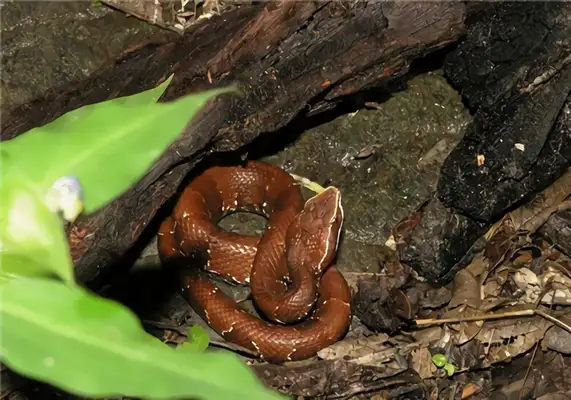
Hundred-paceviper is a toxic snake that likes to be found on the slopes, a typical night-crawler, mostly at night. It is a well-known snake species in the Asian and South-East Asian regions, especially in Taiwan and South-East China, and it is a category that has received much attention since time immemorial. No sub-species have been identified.
Chinese literary name: Point kiss.
Chinese aliases: white flower snakes, 100-step snakes, 5-step snakes, ploughback snakes, money white flower snakes, white flower snakes, 100-velvet snakes, Snake.
English name: Hundred-paceviper
Two words: Deinagkistrodon
Area: Animal
Door: vertebrate door.
Scramble
I've got eyes.
Cobra.
It's a kiss.
Kind of a kiss.
Distribution: Precinct kiss patterns in the provinces of Anhui (South), Chongqing, Jiangxi, Zhejiang, Fujian (North), Hunan, Hubei, Guangxi (North), Guizhou, Guangdong (North)
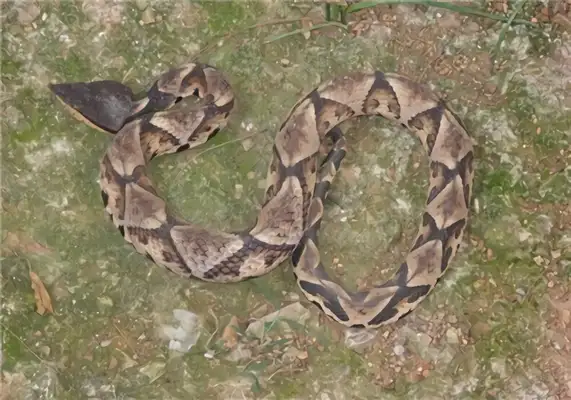
Script kisses are known as seven-step snakes, 100-step snakes, or five-step snakes, which, by definition, are bitten by such snakes, are bound to poison to death within a hundred paces, to show that the bites of the screech are ferocious; because of the difference in terms from one place to another, there are places called screech kisses as “five-step snakes”, further exaggerating the power of their toxins.
The head of the tip of the kiss is bigger, it's triangleed, and the kiss ends with a short, sharp spike from the kisses and nostrils. He had black and brown heads, symmetrical scales, cheek nests. The back is dark brown and brown, with a row of 15-21+2-6 large square blocks on the back. White on the abdomen, staggered black and brown. Short, longest male 1335+66 mm, female 1238+165 mm. Lines 21(23) - 21(23) - 17(19), with only very small flints in the outermost rows of 1-3, with the rest being coarse and coarse; males 152 - 169 and females 162 - 171. Anal table complete. Males 51-61 and females 48-63, mostly in both lines. The tail is flat and long, commonly known as the "false nails". It's like a kiss in a living environment.
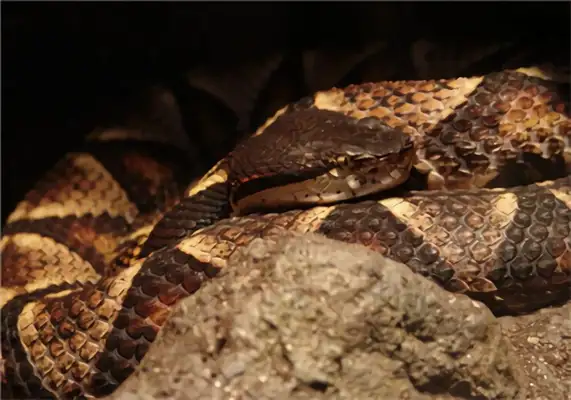
Pointy-kissing is a highly poisonous snake that usually bites a human being to death, so it is highly dangerous not to recommend family breeding, let alone new breeders. The snake prefers to live in a breeding environment of more than 25°C, with humidity between 60 and 80. The reproductive period is different from the usual breeding environment.
Viper farms should be built in areas of ventilation, towards the sun, with water sources, far from residential areas, with a certain natural slope, easy drainage, and long grasses, and walls around them are generally suitable at a height of 1.6 to 2 metres. In addition, the inner wall is radiant and the corner of the wall is arc. In order to prevent the rat from entering the hole and cause the snake to flee, the walls should be deep between 0.5 and 1 metre, and the walls should be filled with concrete slurry and then built on the walls. At the same time, the interior wall surface can be coloured with cement and should not be painted white in order to avoid over-reflection of the sun in the summer and autumn, increasing the temperature in the field. Small shrubs that are not easy to grow can be planted. that the snakes may climb and shade.
The tangles of the reproductive period tend to be at temperatures of 19.2 - 32°C and 17.5 - 31°C, with a relative humidity of 51 - 94%. If the hatching temperature of the eggs requires a range of 25-30°C, the relative humidity requires a range of 51% to 95%. I don't know.
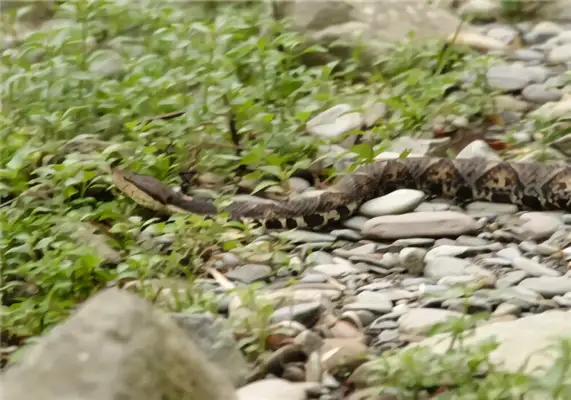
Pointy kisses belong to the wide-eat snakes, and they will not be rejected as long as they have access to food. The digestive system of these snakes is not developed at all, and it usually begins to digest and excrete after five days of diet, so it doesn't matter if they don't eat in a week. Artificial kisses are usually quieter when eating.
A five-step snake is generally afraid of high heat, exceeding the usual diet below 8°C at 28°C, and feed is generally associated directly with the temperature in accordance with the geographical environment. At low temperatures, it can be fed at more than 15°C at noon. At high temperatures, it is chosen to feed at night, with severe fear of light when fed, with a high level of food, which is not less than one third of its own body weight.
Its food consists of frogs, clams, lizards, birds and rats, with the highest frequency of eating rats. Viper is an egg-bearing, rare and slow-growing animal. The difference between farmed and wild five-step snakes is not significant and, as a result of the nutritional adequacy of the stockbreeding, the body is slightly obese and milder. Wild five-step snakes are slightly dark and thin.