Of the country's 13 cat animals, the snow leopards are species living in high altitude areas, which are permanently active in permanent snow mountains or in bare rock areas of summer mountains. They are cat animals scattered near the snowlines, known as “the snow leopards”.
The snow leopards are members of the cat panthers, who are close to the tigers in relation to their kinship, and who, when they reach full age, weigh 22-55 kg, a few male individuals can grow to more than 75 kg, and they are properly one of the cats, so the leopards also have the name “The King of the Snow Mountain” and feed on the rock sheep, lasagna, and otters.
It is well known that cold and oxygen-deplete conditions prevail in the Tibetan plateau and that it is difficult for living organisms to maintain normal activity in conditions of oxygen-depletion. The leopards, which are constantly operating at altitudes of 3,000 to 5,000 metres, are able to adapt in the long term because, over time, they have evolved into a highland adaptation mechanism.
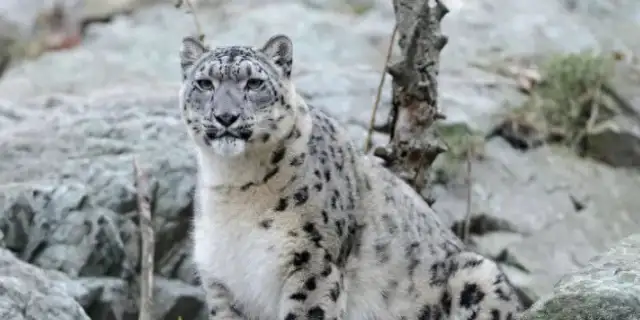
Snow leopards have a larger nasal cavity that allows them to enter more air at once, while they have highly developed skills in distribution of blood, regulation of breathing, etc., and are extremely sensitive to changes in oxygen.
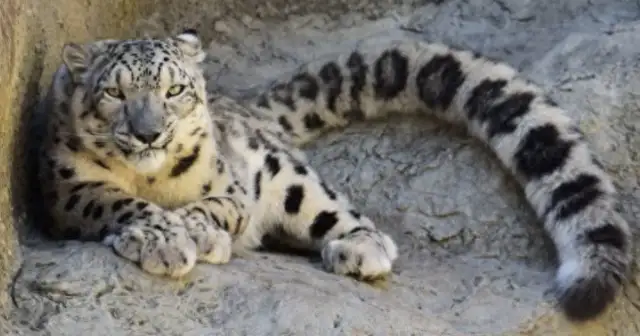
In addition, in response to cold weather, there have been a number of adaptive changes to the skin of the leopards, such as hair becoming thicker, having a large tail, which can be kept warm at the mouth and nose while resting.
Like most cats, snow leopards live alone, often in ambushes, and feed on hoofed animals such as northern goats, rock goats and herds, which have a strong ability to climb and to do the same in rocky areas between mountains.
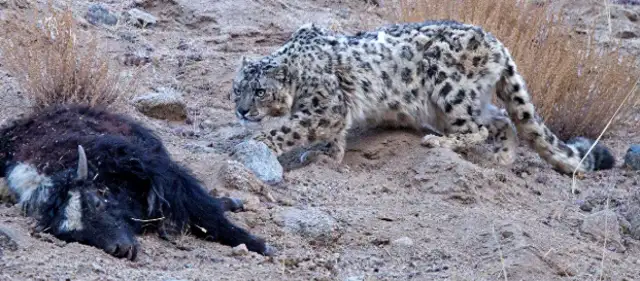
In addition to wildlife, snow leopards occasionally go down the mountains to feed livestock such as cattle and sheep, and this phenomenon has become more frequent as the number of leopards has increased in recent decades.
For example, in the vicinity of the village of Ulanbruck in the Bahingbrook savannah of Xinjiang, Xinjiang, snow leopards have repeatedly infiltrated the pastoralists' spring pastures and are skilled in hunting cattle and sheep.
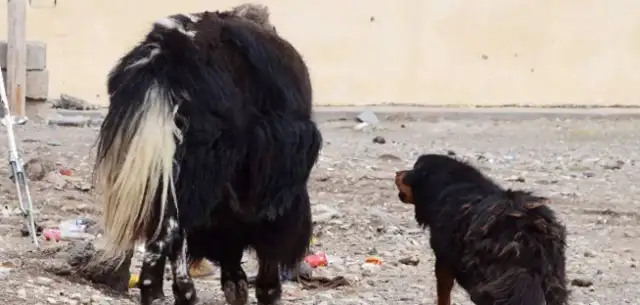
The conflict between a snow leopard and a dog.
In the past, for reasons of geography, nomadic life was prevalent in the Tibetan highlands, with livestock such as cattle and sheep being their most important asset and a year's livelihood. In order to better protect cattle and sheep, and to facilitate grazing management, pastoralists tend to keep some sheep and sheep dogs, a practice that has also been maintained to date.
On the high plateau, the snow leopards and the sheepdogs are an enemy to each other, and the snow leopards hunt cattle and sheep in order to survive, and their main task is to protect them. So they meet each other as enemies, so that they see each other in the outer eye. In particular, when snow leopards go down the mountain for food, when they find out, the sheepdogs try to stop them.
Recently, a snow leopard went down to the mountains to feed and was driven away by a shepherd dog at a grazing site in the northern hill village of the village of Ag. The herder Nur Ali Ali Ayafati visited the herd as usual and found the cheetah.
It came from the mountains, was stopped by six shepherds at the entrance to the village, and the two sides remained deadlocked for almost three minutes, ending the confrontation with a snow leopard who turned his back on the hill.
Similarly, despite the increasing technological development and the increased sophistication of pastoralist methods of animal feeding, the traditional way of raising sheep dogs, which in many rural areas are still the mainstay of pastoralist resistance to beasts and the protection of cattle and sheep, continues to play an important role.
Since the “hidden heat” subsided, many of the owners abandoned large amounts of the stash that could not be sold on the Tibetan plateau, which has led to a growing number of stray dogs on the plateau, which have gradually grown to a certain scale. These vagrants, with increasing wildness, eventually became a major force in the snow highlands, under the leadership of Wang.
Initially, the stray dogs picked up garbage near the village, or secretly caught some poultry, and later developed into deep into the field to compete with animals such as the snow leopards, exacerbating the conflict between the snow leopards and the dogs, while the grouping of stray dogs, which transcended the snow leopards and the pack of wolves, became the most powerful of the beasts in the plateau.
Did you win the snow leopards by hiding the sting?
In the Tibetan plateau, there is no better-known shepherd dog than a hideaway. This type of dog, Tibetan, began with the early migration of the highlands and was brought by humans from low altitudes into the Tibetan highlands.
The dogs were also low-altitude species and difficult to adapt to life on the highlands. But later, as the number of dogs grew, some began to mate with the ancient local wolves, giving some offspring the genes from the wolves, one of the key genes, which gave them the resilience of the highlands.
This critical gene, known as the EPAS1 gene, has been successfully detected by scientists in a wide range of highland species, including snow leopards, coyotes and hideers, but not in low-altitude species, such as grey wolves, dogs and goldbacks.
Since ancient times, they have been raised in large numbers by pastoralists as “means” to fight beasts and protect cattle and sheep.
There's a rumor in the neighborhood that "The Three Wolves in a Battle", so that the cheetah wins? To be honest, if it were one-sided, it would not be a match for a snow leopard, which, after all, as the top hunter in the highland ecology, is not comparable, either in terms of confluence or speed flexibility.
Once a struggle has been waged, there is little chance that the hidden cheetah will win, and there are few examples of snow leopards going down to die. However, it rarely appears alone, and if it is a group of Tibetans against the previous snow leopard, the ending is different.
Dogs are born in groups and have a strong territorial consciousness. In one village, all dogs spontaneously form a group and are dominated by one of the strongest dogs. Once a dog finds out about the enemy, it quickly summons its nearby partner to fight against the enemy, and the snow leopards, even if they are strong, are hard to beat.
In 2016, scholars in Beijing filmed the vagrant flocks hunting for rock sheep and fighting for food with snow leopards on the highlands. Four of them stole food from the Panthers and six of them forced a Tibetan brown bear back.
The fact that the snow leopards live alone only for a short period of time with the pairing of females during their period of onset means that they are taboo, because if they are injured, they affect hunting, so most of the top predators are more cautious than the dogs.
As a result, it may not be possible to match the cheetahs alone, but many of them are made up of cheetahs, with whom the cheetahs are afraid to clash.