Designation: PET6309
English name: Golden-headed Box Turkle
National origin: China
Vulnerability to disease: decomposition
Life: 50-60 years
Price: A brief description of the type of gold-shell tortoise sold by Cheng
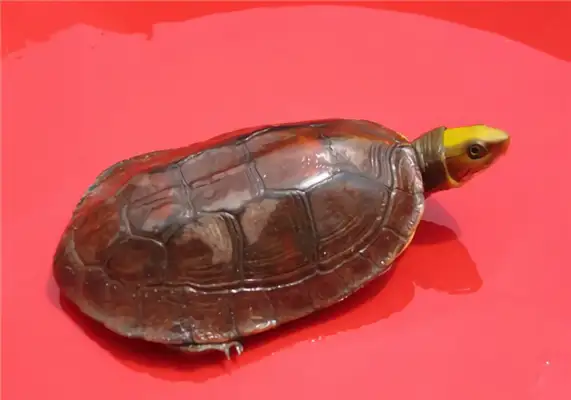
The golden-hulled turtle is a unique, beautiful but rare species in the country, and efforts are under way to study the best way to raise the species in order to expand the population and give more people the opportunity to witness the windfall of the gold-hulled turtle.
Chinese literary name: Golden Clock Turtle
Latin name: Cuora aurocapitata
Anonyms: Golden Turtle, Plug-in Turtle, cedar Turtle
English name: Golden-headed Box Turkle
Context: Animals
Gate: Pipeline gate
Amen: vertebrate Amen.
Programme: climb
ACQUA: ACQUIPMENT
Tortoises.
Asia: Aside the neck turtle
C: Turtles
Aako: Ako, Fresh Water Turtle
Yes: Closed shell turtle
AIAN: CLOSED TERRORISM
Cast: Goldhead closed-hull turtle
Level of protection: CITES Appendix II
Distribution: We have specific species. It is now known that only the districts of Anhui-Nam, Guangde and Shuan-Nang are located.
Characteristics: black and brown backs, rises and flats in the spines, with a clear elasticity. It has a large black spot of basic symmetry, which is connected to the front and back of the armour with a tenor and which can be completely closed to the back. The head is golden, the head is slightly brown and has two black threads. It's our own kind.
Practising: In trenches or ponds with relatively clear water quality in hilly areas, where animal food is the main food staple, with small amounts of plants. The spawning period runs from the end of July to the beginning of August, with two outputs each. Someone uses it to raise green turtles.
Protection: Golden Cyclops are a rare turtle specialty in my country, named in 1998 by Robita and Zongbai on the basis of the Anhui Southern Hills logo, currently known only for a few areas in Anhui province. The tortoise is colorful, gentle and popular with turtle lovers, yet, because of its small number and narrow distribution, it is threatened with extinction by long-term piracy and smuggling. Gold closed-hull turtle morphological characteristics
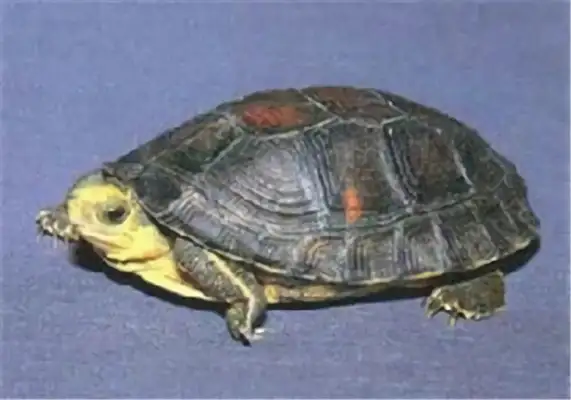
The gold closed-hull turtle looks very similar to the three-line closed-hull turtle, the biggest difference being that the gold closed-hull turtle has no visible graft on his back, and the three-line closed-hull vest has a word like "swain."
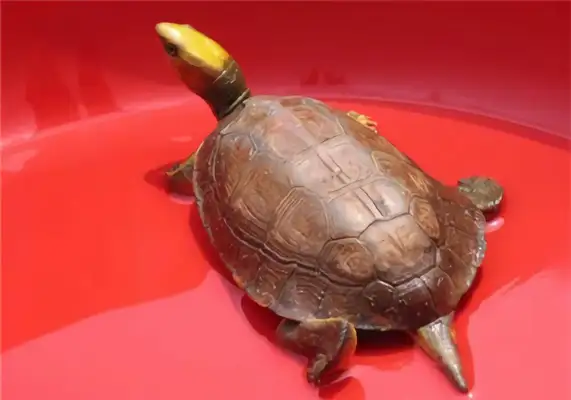
Goldhead closed-hull turtles with black and brown backs, uplifting and flattened ridges, with clear lids, 78 ~ 127 mm long (male), 109 ~ 152 mm long (female). It has a large black spot of basic symmetry, which is connected to the front and back of the armour with a tenor and which can be completely closed to the back. The head is golden, the head is slightly brown and has two black threads. For Chinese species.
The gold-hulled tortoise is large, the front end is rounded out and the back end is thin, with ligatures attached to the back armour, with ligature between the chest and the abdominal shield, which can be completely closed to the back of the abdomen in two and a half, with the longest acoustic gland, and the shortest giraffe. The head size is moderate, the back is smooth, the kiss is slightly more than the upper beak, the upper beak is fine, the lower beak is shorter than the upper beak.
Goldhead closed-hull turtles have weak limbs and are covered on the back, with five claws for the front limbs, four claws for the back limbs, and developed between toes. It's a short tail, a cone, and it's turned into a pair of scales, and it's in a ditch. The back is black and brown, the gutter and its surroundings are dark, and the turtles have a small brown and red spot on the edge of the second pair of ribs, and the adult form has a light spot on the corresponding part, and the abdominal yellow has a few symmetrical black spots. The head is yellow, the head is a little brown, and there are three black stripes. Gold closed-hull turtle care knowledge
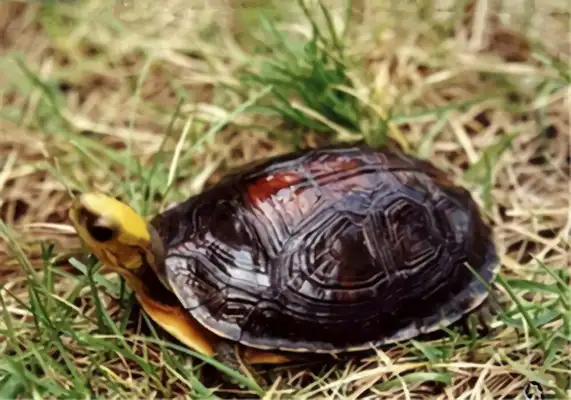
In the field, gold-closed turtles eat meat, but in the process of artificial breeding, some feel that some plants are to be fed, which is also true, as long as they are able to eat enough to feed some plant-based food to ensure full nutritional balance.
Food choices
Daily feeding is provided for shrimp, fish, pork, breadworms, earthworms, locusts, etc. The spring and autumn festivals are fed 3-4 times a week, usually in the morning and evening, while the early and late autumn festivals are better served at noon. Gold-head closed-hull turtles are best served at ambient temperature of 25°C, occasionally eat less at 15°C and sleep less than 10°C; at 35°C, they have a state of hibernation, irritation and stoppage, and begin to enter “sharping”. In day-to-day breeding, therefore, attention should be paid to observing changes in ambient temperature, and it would be useful to have a stockkeeping log to accumulate information on the living patterns of turtles and the requirements for temperature and bait.
II. Environmental requirements
For water exchange in the early spring and late autumn, it should be noted that the temperature differential is generally not higher than 3-4°C and that the change is best made before feeding. Early in November of each year, due to a decline in temperature, turtles gradually enter hibernation, at which point 7-8 centimetres of wet sand should be laid inside the rearing cask, which should be placed in the interior of the sun, allowing them to sleep naturally. In late March of the following year, when the temperature rises back to about 18-19°C, the turtle begins to eat, and the first feeding should be minimal, especially after feeding, and the ambient temperature must not be lower than 15°C, which would cause indigestion, etc. As the temperature increases and stabilizes, the number of baits dropped can be increased and some antibiotic drugs are regularly fed, and a small amount of calcium should also be fed up to 50 grams to prevent osteoporosis. Gold closed-hull turtle living environment
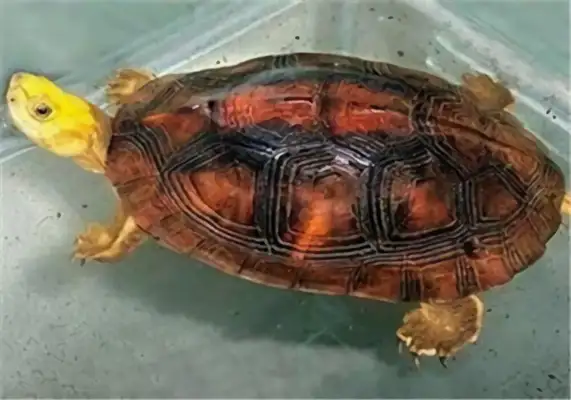
Gold-closed-hull turtles are very watery water turtles, and in the wild, gold-hull turtles like to prey on small organisms in some water, and in an artificially raised environment, they can provide a deep-water environment for gold-hull turtles and ensure a suitable temperature.
I. GROUND CLOSER TORTURE MATERIAL EQUIPMENT
Gold-hulled turtles are sea turtles, which are rich enough to live in deep waters, where they must distribute unsurfaced stones for their rest, and stockhouses must be placed in a “surface” form, with no need to build land at depths of 20 centimetres, such as land above 20 centimetres, in order to prevent turtles from suffocating for long periods without breathing.
II. rearing management of gold closed-hull turtles
It is generally easy to feed on the basis of gold-closed-hull turtle habits and temperature, bait requirements. At about 15 °C there is a stoppage or less, up to 10 °C in hibernation and normal feeding at 20 °C. Under artificial rearing conditions, fresh fish meat is used to lure food into the first place, and it is used gradually to feed itself. In addition to meat baits such as fish and shrimp, a few plant baits should be regularly fed. Feeding once a day. In spring, summer and autumn, more or more feeding can be done. Particular attention should be paid to temperature during the early spring and late autumn, especially when the temperature difference in water exchange is not too different. The winter water temperature should be above 0°C, otherwise there is a risk of freezing. Gold closed-hull turtles.
The price of the gold-cracked turtles is more expensive, so the number of people who actually buy to play is a small number, and most of them are used to breed, so at this point attention is to be paid to the question of what is most reasonable for a turtle to eat when it breeds in close nutrition.
Eating is a heavy part to allow turtles to breed. The most important aspect of food in the current domestic ecological environment is not diversification, but security. It is especially important to raise closed-hull turtles in cities, where most of the riverways are now heavily contaminated and where small fish caught are no longer able to feed them. Fish in these waters, such as mosquito-eating fish, are alive, but already carry large amounts of pathogenic bacteria or excess heavy metals. The deaths of turtles due to the consumption of these small fish are not rare. Artificial feed can be used to ensure food safety while providing the various nutrients needed by turtles. Ingestion by adult turtles directly affects the number of eggs produced in the second year, and therefore a time-qualified feeding process is implemented to ensure a stable appetite and absorption.
On food, it is also recommended that artificial feed be used as the staple food, such as groceries and larvae. The greatest advantage of doing so is to avoid gastrointestinal problems caused by bacterial infections of various living foods and to increase survival rates and reduce morbidity. The various nutrients in today ' s artificial feed are calibrated to make it easier for turtle seedlings to absorb full nutrition.