No.: PET1207
Name: Yellow-crowned Parrot ' s Pancreatic Parrot.
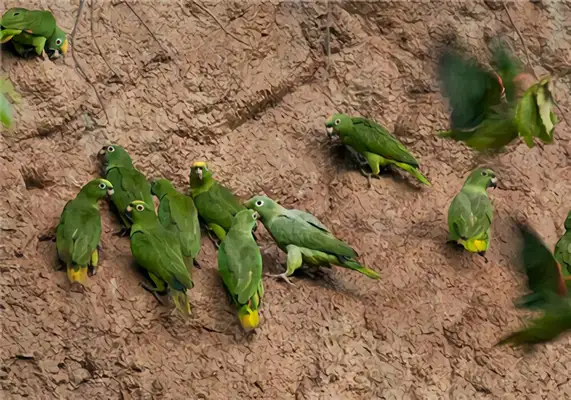
The Yellow-Crowned Parrot is a very smart Amazon parrot, currently comprising four subgeneric species. Such parrots are generally cheaper, but the parrots are excellent in their mythology, with artificial breeding birds not afraid of human beings and often interacting with feeders, but often wild birds are seen on the market.
Chinese literary name: "The Amazon parrot."
Chinese aliases:
English name: Yellow-crowned Parrot
Two words:
Area: Animal
Door: vertebrate door.
Amen.
Platform: Birds
Today's bird's
It's a parrot.
Section of parrots
It's a parrot.
Asian: 4
Distribution: Characteristics of the Amazonian parrot in Central America
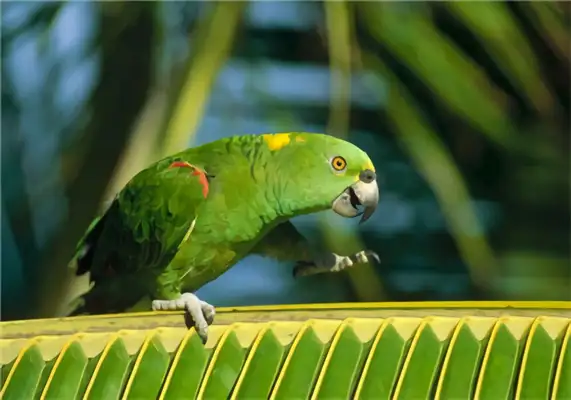
The macaws have the same size as the macaws, but not as beautiful as the macaws. The size of the adult macaw should be around 35 cm and the ideal weight should be between 380 and 500 g.
Most of the feathers of the macaws are green. Their eye iris are orange, their mouth is black, their yellow is spread over their crowns, and the yellow on their heads is called the "hat". There are a few red dots at the turn of the wings, and the edge of the feathers is yellow and green. Their wings are primarily blue, and subflying feathers are blue and blue, scattered in the petals and wings. A macaw with a yellow crown.
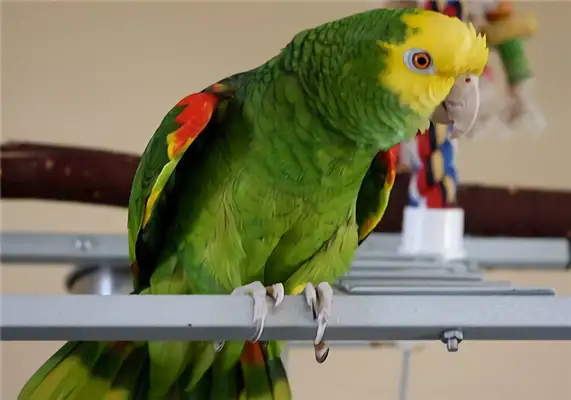
The beauty and openness of the macaws in the yellow canopy have attracted the love of many bird lovers, and the wisdom that they like to learn the language of the human race, a virtue that fascinated more newcomers. How, then, should the parrots set the breeding environment for them?
Bird cages are best Quadrilateral or rectangular, and round cages are not suitable because of the opportunity to twist the head of a parrot. It must be strong enough to keep the parrots from biting. The cage door is bigger so that parrots can get in and out. These parrots can easily learn to open cage doors and may therefore need to be locked.
Select the cage according to the size of the macaw. If your birds don't leave the cage, the cage will grow. The spacing of the cage should be at least 7/8 inches to 1 inch, but to ensure that the head of the bird does not cross the interval. Since birds often crawl around cages, it is important to ensure that the contents of cages are free of lead and toxicity.
Parrots all have the nature of water baths, which not only wash dirt to make birds' feathers more beautiful, but also wash bacteria from their bodies and act as disease prevention. The cold seasons should reduce the number of baths, usually indoors above 20 degrees, but be careful about room temperature and water temperature to avoid parrot cold. Bathtubs can be replaced by rounded ashtrays. The parrot shall be taken out of the water, even if it is in warm water, so that it does not wash again and again. Girls, sick birds should not bathe. In winter, when room temperature is high, parrots can be sprayed with small sprayers with flowers, but not with large quantities of water. One or two minutes on it. Apart from water baths, parrots can be given sand baths. Make a sandpad for birds to wash sand twice a week. New sand will be replaced for some time. A macaw with a yellow crown.
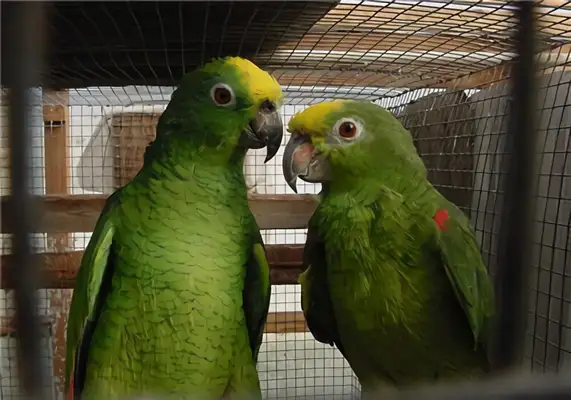
The macaws are more active, liveable, adapt quickly to the new environment, prefer to chew and bath, provide fresh branches, and feed with other Amazon parrots during the reproductive period, but they are ideal.
The yellow-coloured macaws are not as expensive as many Amazon parrots, as pet birds are a good choice, and young birds have good speech skills. They are as high in human interaction as most Amazon parrots. Unfortunately, there are few artificial breeding birds, so young birds are not common on the market, whether they be made or imported.
The effects are better in terms of reproduction, usually in April, during which the male is aggressive, especially in order to protect his nest, is aggressive when approached, and even attacks the mother or young bird when angry, avoiding unnecessary disturbance, with a nest of about two to four eggs, with an incubation period of about 26 to 28 days, two months later.