No.: PET5085
English name: Foureye Butterflyfish
Origin: Coral reef areas in the Western Pacific
Vulnerability to disease: end-of-life disease
Life: 5-6 years profile of four-eye butterfly species
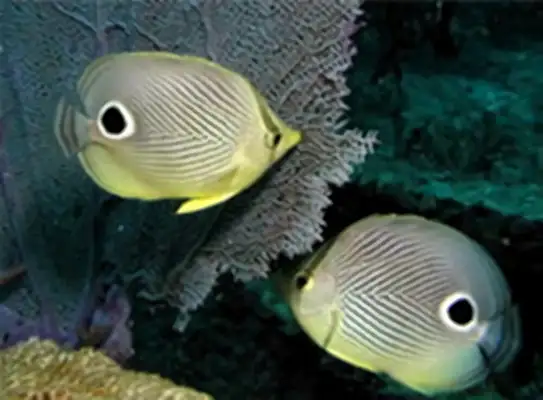
The four-eye butterfly fish, also known as the four-bone butterflies, are mainly located in the western Atlantic Ocean, and from the pictures of the four-eye butterflies, we can see that the look of the four-eye butterflies is very special. The four-eye butterflies in a wild environment prefer to live in shallow coral reef areas, usually living alone or in pairs.
English name: Foureye Butterflyfish
Type: butterfly fish, tropical seawater fish
Origin: Coral reef areas in the Western Pacific
Reproduction: Eggs
Water quality: pH: 8.1-8.4; weight: 1.020-1.025
Difficulties in raising livestock: difficulties
Fit for water temperature: The normal seawater fish has a suitable water temperature of 24°C ~ 27°C in the shape of a four-eye butterfly
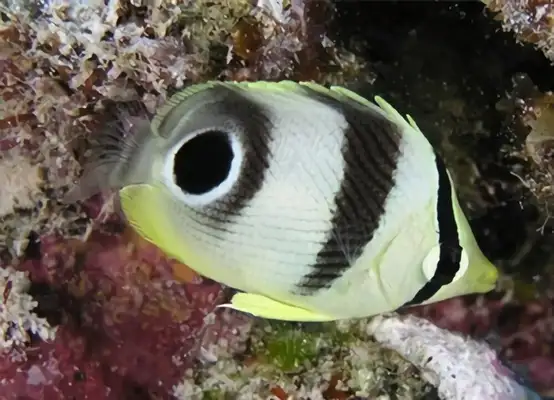
The shape of the four eyeflies is very special, but the four eyeflies are also very difficult to raise, so it is recommended to fish friends with some experience in raising them. What's so special about the shape of the four-eyed butterfly? Chief here to introduce you.
Four-eyed butterflies are 7.5 cm long, high and ovulating, with a flat contours above their heads. The kiss is sharp, but it does not extend to a tube, with a nostril in front of the nose. The front lids are fine-cut, the gills are connected to the canyons, and the two gills are fine and tight. The body is covered by medium-sized scales, and the sideline rises upwards to the lower side of the back fin 9-10 thorn and falls to the lower side of the bottom of the back fin base, where the back fin is single. The four-eyed butterflies are identically gray and blue, with yellow on the head, abdominal ass fin and lower side. The upper and lower sides of the body, each with 17-20 grey black slashes extending to the end of the back fin and the end of the hip, meet at the centre of the side and form an arrow pattern pointing to the head. The Four-Eyed Fluttershy Environment
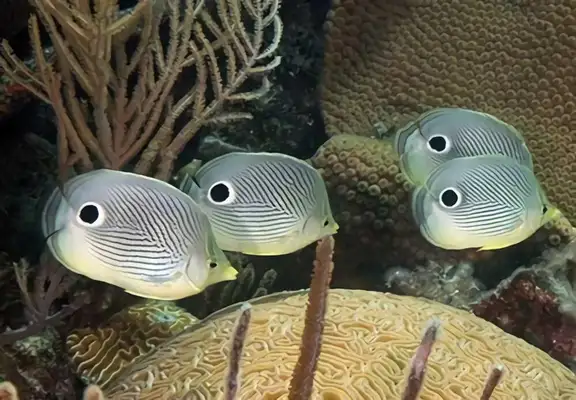
Artificial rearing of four-eye butterflies is more difficult and, as they are seawater fish, they need to be fed in a water-quality environment similar to that of seawater. PH values of 8.1-8.4 are recommended for four-eye butterflies, 1.020-1.025 for water and 24-27°C for water temperature.
The blue and white body of the four-eyed butterflies carries a "<" black stripe and a black eye spot at the end of the body, which is used to seduce predators. It is recommended that more than 250 litres of aquariums be used for breeding, mixed with moderate fish, which can feed in pairs and fight for the same sex. It is important to note that four-eye butterflies are not suitable for placement in coral casks and can eat stone and soft corals. And the four eyeflies are somewhat toxic, so care is taken not to get hurt when raising the four eyeflies. All four-eyed butterflies.
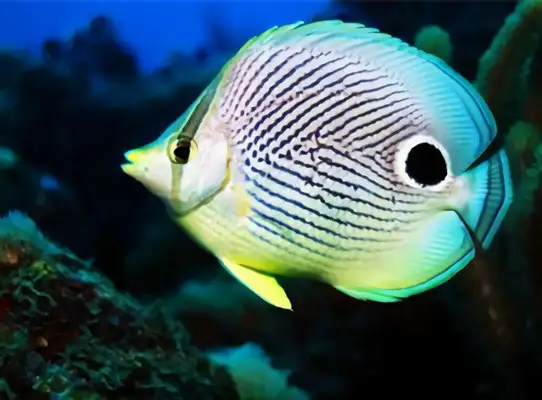
It is more difficult to feed four-eyed butterflies, because they are seawater fish, and they require attention to the allocation of water quality and food problems. The difficulty of feeding is greater because of the difficulty of feeding the four-eyes.
Four-eye butterflies are meat-eating fish, which is hard to talk about. Live shrimp, shellfish and mysid shrimp can be used to induce openings and can then feed various animal baits and frozen baits. It's recommended three times a day. The four-eye butterflies in a wild environment eat mainly six corals, polychaetes, willow corals and cysts. It should be noted that the eyeflies have some toxicity, so care should also be taken when raising them.