Designation: PET2964
English name: Orange-socket Surgeonfish
Origin: Indian-Western Pacific
Vulnerability to diseases: fish plague, white cloud disease, skin disease, rotting tail disease, etc.
Life: An overview of orange-grained species 3-5 years
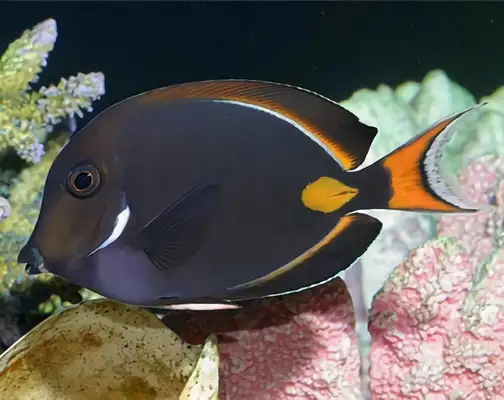
Orange thorns are tropics with a maximum size of 35 centimetres and a preference to dwell between 3 and 20 metres deep in shallow outer reefs. Orange thorned fish like to live in groups and enjoy fish for algae-eating tropics.
Chinese name: Orange thorn
English name: Orange-socket Surgeonfish
Latin name: Acanthurus auranticavus
Geographical distribution: coral reef areas in the India-Western Pacific Ocean, covering Seychelles, the Philippines, Indonesia and the Great Barrier Reef. Recent reports indicate that it is available in Maldives, Malaysia and Samoa (Samoa, South Pacific).
Climate zone: tropical
Endangered: Not in IUCN Red Book
Reproduction pattern: group-layed orange-grained externals
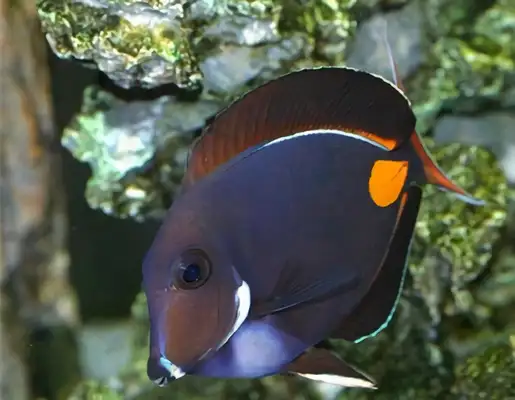
The total number of oranges is nine, the total number of back fins is 25-26, the total number of hips is three and the number of hips is 23-24. The maximum length of adult orange strangulation can be 35 cm and reproduction can normally occur once in a month, but due to individual differences there is also a time lag.
Orange thorned fish are elliptical and flat, their heads are small, and the contours of their backs rise as they grow. The mouth is small, the end is flat, the upper and lower jaws are flat, the teeth are fixed, the teeth are etched. The back fins and the fins of the hips are sharp and do not lengthen the fins; the chest fins are near triangles; and the tail fins are beamed with an extended upper and lower leaf as they grow. Fish are brown and brown, each with an orange spot on its pupils and a part of orange brown below the base of its chest fin. The tail thorns are fresh orange, and are therefore called “Orange thorn hanging”. A black tail, near the tail handle and a white belt of top and bottom lobes. Orange-stringing environment
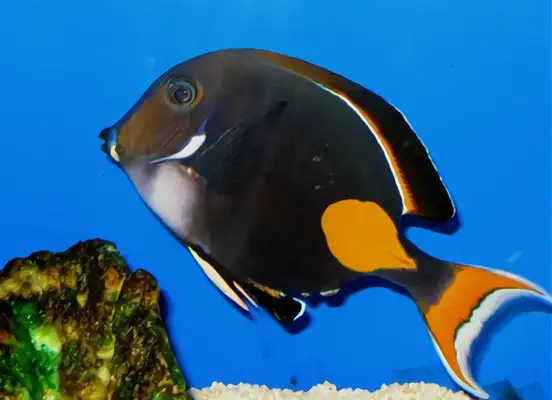
Orange roughing belongs to tropical fish, so it is more important to provide them with a living environment similar to nature when raising orange roughy. The difficulty of raising orange thorns is moderate. How can they be equipped with a suitable living environment?
The appropriate pH values are 8.1 - 8.4 in the water quality suitable for orange thorns; 1.020 - 1.025 in the appropriate weight; and 24 - 27°C in the suitable water temperature for orange thorns. Orange thorns prefer to live between 3 and 20 metres deep in shallow lakes and outer reefs, where fish are usually in herds, and juvenile fish are mostly alone in a layer of approximately 2 metres in a soft coral-crowded lake. I'll feed you.
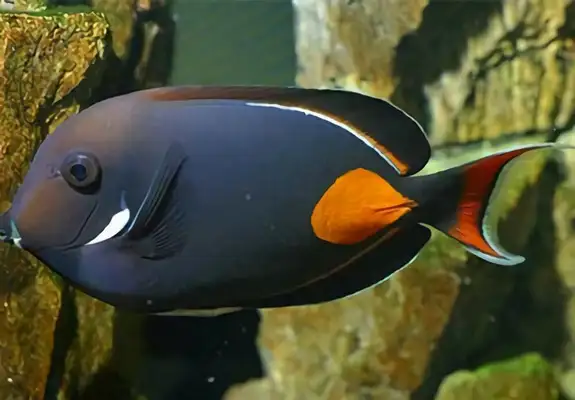
Orange-graining, while as good as many slinglings can feed animal feed, needs to be raised with care to provide orange-grassing with sufficient vegetable feed, such as seaweed and seagrass.
The provision of vegetable feed to orange thorns enhances their body immunity, reduces attacks and improves their overall health. Dry seagrass can also be attached to stones to feed and recommended three times a day. Or some artificial plant bait. It's easier. Orange thorns tend to live between 3-20 metres deep in shallow lakes and outer reefs, where fish are usually in herds, and juvenile fish are mostly living alone in a water layer of about 2 metres in a soft coral-created lake. Algae are the main foods.