When it comes to hiding, it is possible that the words that appear in the minds of most people are “loyalty, the Lord, the Three Tigers of War”. Such an “excellent” type of dog, whose price is naturally not bad, was placed at 3.9 million in September 2007, and four years later, in 2011 the “New King” renewed the perception of Tibetan prices at 30 million. Not only is the value of the Zhuang King very good, but even the ordinary treasured calves have been sold for tens of thousands of dollars, but at the beginning of 2000 it was also 2000 yuan, and by the end of the year it rose to 50,000 yuan. In order to promote the well-known treasures of the caches, in 2010 a Tibetan was arranged by a seller in Henan for a Mercedes, a BMW and 30 Audi. And the food that is kept is corn made of beef, chicken racks, broth and yolk.
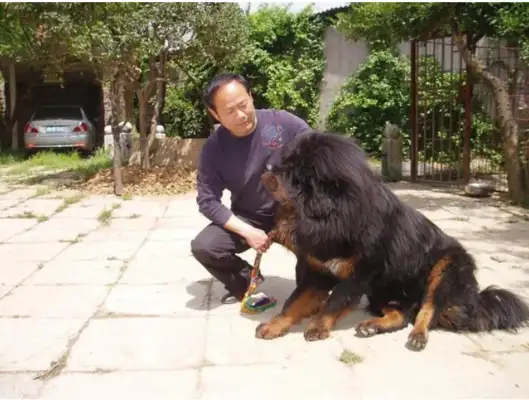
Behind the increase in the price of Tibetans is the involvement of a large amount of capital, initially a dog in our Tibet region. In 1969, the United States of America, Balibisop, brought back to the United States the treasures of the Tibetans, whose high and powerful image was rapidly recognized by the Americans, and whose prices rose. After the intervention of the star raised the heat of the Tibetan, Taiwan star Zhang Paiva bought a Tibetan at a building price.
The Tibetan economy in the Mainland is said to have been pioneered by a Henan man who runs a dog farm, and is, of course, at the height of the peak or by a celebrity. The celebrity behind it was the horse Jun-in, the leader of the “Ma's army”, who led his disciples to break the Western monopoly on the track and track, and then, owing to a number of negative news, he was forced to leave the field, leaving the old horse in the field and become the president of the China Tibetan Club.
Various books in reality, such as Wolf Totem, the Hidden Ground Code and so on, have created a fearless image of the Tibetans, and television reports of the Tibetans have contributed to the price increase.
Gold always glows, not as long as gold does not shine, but as if it fell down on the altar, because the loyalty of the hides was found to be only because of its low intelligence, which could not be remembered except by the first master. It is also the result of self-proclaiming by the people in the hide-and-seek that even the leopards may not be able to fight, and there are reports that some hide-and-seek can't even beat a yak. Moreover, the following collections are no longer cultivated under such harsh conditions as Tibet, are often grown in the greenhouses, have long lost their wildness, have no wildness as combat dogs, and have insufficient intelligence as domestic pet dogs.
Added to the growing number of negative news on the Internet about the hideaways, the most appalling of which was the bite of the owner, and in 2019, in the city of Anhui-Yang, the elderly, who had raised the hideout for six years, suddenly went mad, biting the master and then bit four more. In 2016, one of the Tibetans suffered from hunger and animal fever, biting the owner for 20 minutes, with the most severe wounds to the neck of 7 or 8 centimetres. A three and a half-year-old girl was killed in June 2013 by a hideout in Liaoning Dalian, and six cases were reported in Beijing, Liaoning and Sichuan on June 2013 in various locations. In 2012, in the Sun-yang district, there were only nine bites from a collection of “precedents”. There are countless instances of such hidden bites.
The purpose of capital is to make money, and the time has come to withdraw capital after the spread of negative news. The year 2011 was the craziest year for hidden capital, with the capital being sold out of its possessions ahead of time, and the unsure “Cyber-Man” thinking that he had taken advantage of it. The once-fired storage market has also cooled down, the price of the stash has fallen sharply, the price of the plant has dropped dramatically, and the storage and breeding centres have closed down for half, leaving only enough to sustain their daily expenses and lose their past.
The dog's final destination may not be eaten, even if sent to the dog's shop, which, according to the owner of the dog's shop, unlike other dogs such as the dog, Teddy and others, has a natural stench that can hardly be eliminated even if more spices are used. Dog traffickers are also not in a bad mood for hideaways, and normally they are not willing to buy hideaways because they are less profitable and more important, and only when dogs cannot collect them.
When the Tibetan economy collapsed, there were lots of them. In the area of vagrancy, according to statistics, at the peak there were 100,000-160,000 stray dogs in the Sanjiang region of the country, 97 per cent of them of Tibetan origin, and the extent of their activities was essentially within the community of 2 km. Although these stray dogs usually eat the leftovers of food that have been abandoned by the residents, since the amount of food they eat is mostly hungry, and when they are hungry, they bite. According to statistics from the Tibet Center for Disease Control, the number of stray dogs injured is high, at an average of 180 per month.
The “Tracking Economy” itself is a deformed economy, based on a fireworked economy whose value is not at its price, and the collapse of the Tibetan economy, which sooner or later will collapse, can be described as either the hideout itself, or as a reason to limit the excessive consumption of capital and the search for the next door. There's a lot of capital over the years. Orchids, winter worms, Rohansons, money turtles, Pummi teas, and even all kinds of famous white wine.