Designation: PET2638
National origin: China, Thailand, Indonesia, etc.
Vulnerability: respiratory, digestive and parasitic diseases
Life: 6-7 years profile of parrot species
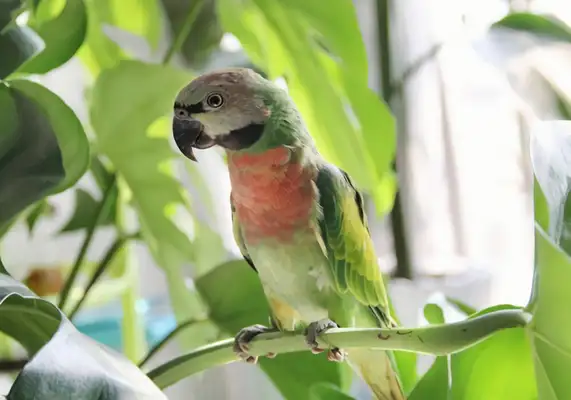
Little macaws are the more common parrots, because they speak very well, so many people choose to be pets. However, in order to get a little parrot to speak, the master will have to devote a lot of time and energy. In addition, it is possible that, with long training efforts, the pharaohs will not meet your requirements, and you will have to find out why and drug the problem.
And, of course, apart from speaking with the learned, beautiful feathers are another important factor that attracts the attention of bird lovers, as well as the difficulty of raising them, so that they are raised by a few.
At the domestic level, small macaws also have some fancy aliases, such as parrots and parrots, which are more common in the southwest. Outside, they are also concentrated in several countries in Asia, such as Thailand, Indonesia, India, Viet Nam, Cambodia and Myanmar.
Chinese literary name: Nautilus parrot
Two words: Psittaculaalexandri
Context: Animals
Gate: Pipeline gate
Programme: Birds
Look: Parakeet.
Section: parrots
Yes: Nautilus
Castes: morphological characteristics of parrots in the chest
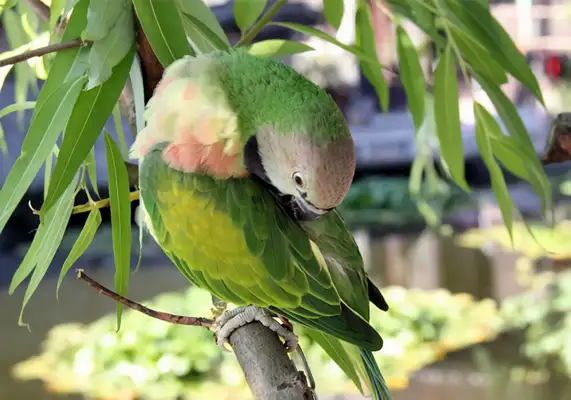
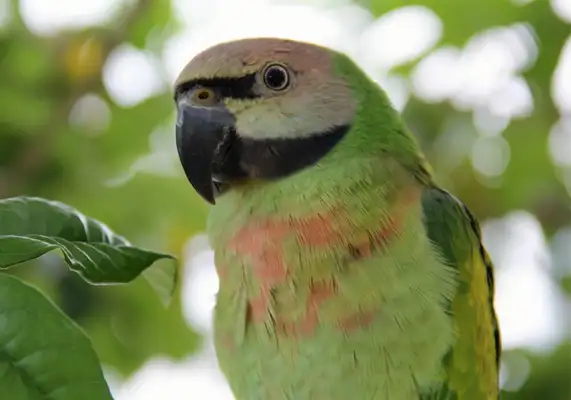
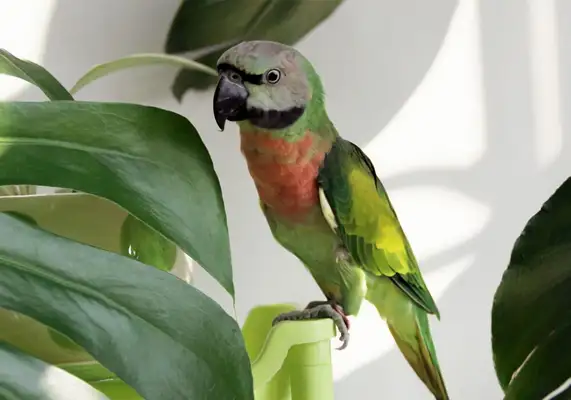
Small macaws have beautiful feathers, which are one of the key elements that people love, and can be distinguished from other birds through their feathers. The feathers of small macaws are predominantly green and far away, with half their bodies occupied by green. Apart from green, their throats and chest feathers are red or orange. The general larynx and chest are reded males, while the female is typically orange red. Of course, there's more than one way to distinguish the sex of a small macaw, and you can look at their mouths -- the female's upper and lower lips are black, while the male's upper and lower lips are brown. However, young birds are not fit to judge gender in this way.
Small macaws are not small in size, they can be larger than 30 cm, and if they are to be raised, the owner needs to prepare a larger cage.
The morphological description of the parrot.
Size: around 30 cm, usually above 22 cm, up to 36 cm.
Weight: There are also significant differences in body weight depending on the individual.
Mouth: The male has a red mouth, the lower one is brown, and the female is black and brown.
Throat: male red, female orange red.
Breasts: male bird red, female orange red.
Tail: Wedge. The parrots keep their knowledge.
The first thing you have to do is pick the bird. Some of the young parrots sold on the market have been captured from the wild, and they are less adaptable and have higher mortality rates, so it is important to ask for their origin before you buy them. If you're still worried about raising young birds, then you can buy a bird, which is more resilient and has lower mortality.
One of the more important concerns of the owner after bringing the small macaw home is whether he can train the birds to speak. In order for a parrot to learn to speak, the master must take note of the following:
1. Before training takes place, the master must be psychologically prepared, the training is not done in two days and the birds cannot learn to speak without patience.
Like humans, masters can teach parrots some simple words first, and then gradually teach them some more difficult words.
3. The training environment should be quiet and too noisy to allow small macaws to learn.
4. The proper use of food can lead to better training, which, according to experience, is the best time for early feeding.
A number of owners are also concerned about the breeding of pharaohs, whose breeders and experts have indicated that their reproduction is not easy. There are many elements of successful breeding in small macaws, such as whether the caged environment is adequate and whether the food contains all the nutrients required by the bird, so the master needs some theoretical knowledge of small macaw breeding. The parrot's environment.
Peasant parrots do not like too much altitude, and they generally live in low-lying mountain forests. They also fly to plains and even human settlements in search of food. They rarely act alone and usually appear in groups. In addition to living with their own kind, small macaws can accept living with other birds (e.g. octopus).
A small macaw will nest in a tree hole, and if you look carefully, you will find that on a tree there may be nests made by a few macaws, and of course you will see the presence of birds like the Eight.
Artificially raised parrots are divided into cages and racks. When they are raised, the master chooses a suitable cage for them. Because the size of the parrots is not small, the cages that feed them are not small. In addition, it is important not to forget that trees are set up in cages, which not only provide a place of rest for the parrots, but also enable their spouses to carry out their generational tasks. The nestbox can be made of wooden boxes, the rest of which must be closed except for a slightly upward entrance.
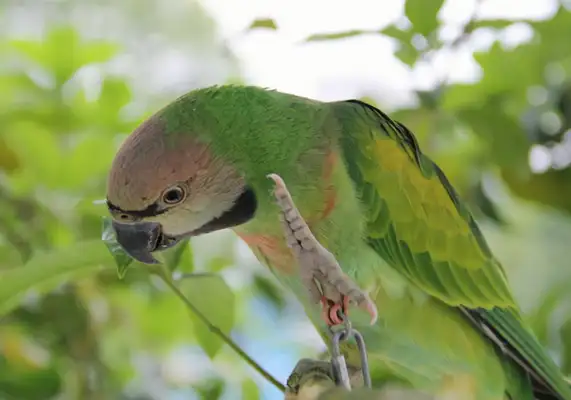
The masters of the parrots who had small breasts need to be careful that the parrots must be chained to their feet. Foot chains should not be too heavy, otherwise they may impose an excessive burden on small macaws. And if the parrots do not want to escape from the chains, the chains chosen by the master must be solid. Some masters thought it was natural for parrots to go up, but that was not the case, and they felt uncomfortable when they came up, and the master gave them time to adapt. I'll feed the parrot.
Artificial macaws cannot provide all the food they find in nature on a daily basis, but the master does not worry about the macaws because there are many parrot commodities on the market. In general, the owner buys for the parrots the feed they develop, and in the interests of the health of the bird, the owner is required to identify the feed at the time of purchase in order to avoid the purchase of bad feed. In addition to quality problems, the owner has to pay attention to the shelf life of the feed, and if the bird is unable to finish the feed during the maintenance period, you can choose to buy a smaller package of feed.
Feeding forage alone may not meet the needs of birds, and in the natural environment there is a great deal of food for small macaws, so that the master can prepare appropriate feeding for small macaws that are not fed. It is important to note that the owner must ensure the safety of the food he feeds. Sometimes the owner may find that the small parrots are particularly interested in one food, but it may not be good for them to feed the same food for long periods of time, and the master may consult bird experts or bird-rearing pets with great experience if he has such doubts.
Moreover, it is not said that the more food the better, the better the scientific diet will be in order to make the macaws healthier. It would therefore be preferable for the master to begin his work on bird food before raising a small macaw.
Other highlights of the porcelain parrot feeding:
1. Both feed and other food must be preserved by the owner in an appropriate way to prevent food deterioration.
2. If a bird cage contains food that the bird does not finish, the owner must clean it in time.