Designation: PET5775
English name: Yunnan box turtle
Origin: Yunnan, born only in Kunming and Toshikawa, Yunnan.
Vulnerability to disease: decomposition
Life: 50-60 Yunnan closed-hull turtle species profile
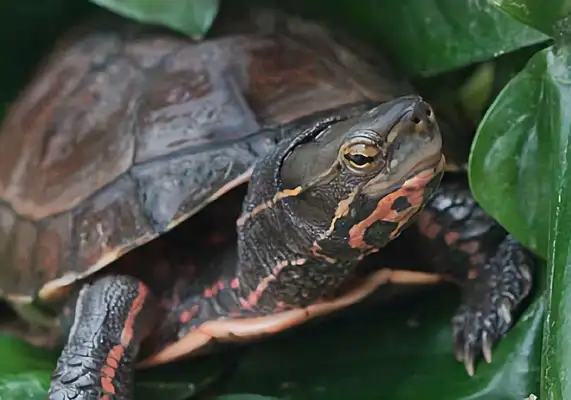
Yunnan closed-hull turtles, which were once thought to be extinct, are found in small quantities, desperately in need of protection and reproduction, are equally expensive, and the price of Yunnan closed-hull turtles is unacceptable, but the number of Yunnan closed-hull turtles is so small that they cannot be bought out of a state of embarrassment.
Chinese literary name: Yunnan closed-hull turtle
Chinese alias: Yunqing
English name: Yunnan box turtle
Two words: Cuora yunnanensis
Context: Animals
Gate: Pipeline gate
Amen: vertebrate Amen.
Programme: climb
ACQUA: ACQUIPMENT
Tortoises.
Asia: Aside the neck turtle
C: Turtles
Aako: Ako, Fresh Water Turtle
Groups: Freshwater turtles
Yes: Closed shell turtle
AIAN: CLOSED TERRORISM
Castes: Yunnan closed-hull turtles
Sub-species: Yunnan closed-hull turtle sub-species
Distribution: Yunnan, born only in Kunming and Toshikawa, Yunnan.
Appearance characteristic: shell length around 140 mm. Medium head, smooth back skin. The upper jaw doesn't match. It's low, it's ambiguous, it's spinal. Large abdomen, front circle, back edge dent. Two anal shields.
Reproduction: Eggs.
Lifestyle: Living in areas with higher water resources.
Eating: Most turtles are carnivorous, fed by worms, snails, shrimps and small fish, and also by the leaves of plants.
Prices: The amount is scarce, prices are heavily fired, and some even bid $500,000, which is not true. Yunnan closed-hull turtle morphological characteristics
Yunnan closed-hull turtle head is smooth and smooth. The shell is about 140 mm long. Medium head, brown-coloured back, no hooks. There are two yellow stripes on the top and bottom of the head-drum to the back of the neck and yellow clouds in the gills and throats. A narrow rectangular or triangle with a wider back edge than the front edge. The backslids are not visible, they are three-sided, and they are weak. The back and abdomen are several lengths long and linked to the ligature. Tortoises can be closed, but the abdomen are large, the front edge is round, the back edge is dented and cannot be completely covered by the gap between the backnails. Yunnan closed-hull turtle care knowledge
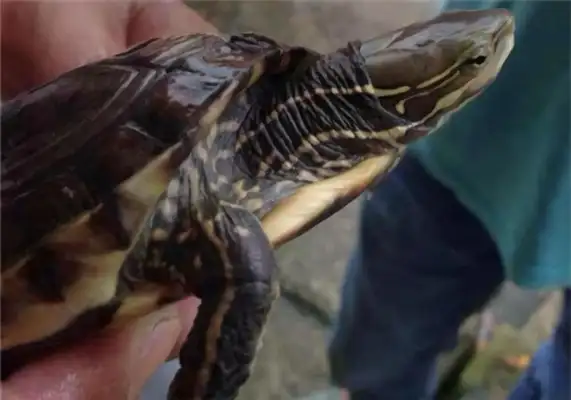
It is difficult to buy Yunnan closed-hull turtles, which are a rare species and have only been found in Yunnan, so to avoid being deceived, learn to identify them at the time of purchase. The seven closed-hull turtles are similar and very different.
I. Identification of closed-hull turtle species
Proper identification of closed-hull turtles is a prerequisite for breeding and a basis for ensuring the profitability of farmers. Because of the relatively small number of rare turtle species, such as gold, tri-line, and Zhou, some merchants take advantage of people's eagerness to buy goods for profit and the fact that many breeders have not yet seen some rare turtle species of living bodies or even photographs, using yellow box turtles, yellow box turtles, etc., to be used to fill them. It is common to use yellow box turtles as gold closed-hull turtles. Since yellow box turtles are named Golden Head Turtles, they are produced on the same basis as gold shell turtles in Anhui, which makes them easy to farm. Second, the three-line closed-hull turtle is impersonated by a yellow box turtle with three stripes on his back. Some of the individual backs were slightly brown, similar to the three-line closed-hull turtles.
II. Quality of closed-hull seedlings
The quality of seedlings is key to healthy breeding of closed-hull turtles. The selection of seedlings can begin with the appearance, weight and mental state of the turtle. Such as whether the skin is pulverized, whether the claws are intact, whether it feels light in the hands, whether eating and limbs are strong, etc. In addition, it is important to avoid pre-payment of a down payment to be defrauded by whether the turtle warms up, breeds itself for some time or just changes hands.
III. Clock turtle breeding
Closed-hull turtles are raised in the form of warmer or non-heated breeding during the winter season. Usually, seedlings are raised using warmer methods, which in the short term turn turtles into commodity turtles and make a profit. In turn, the turtles must be raised in a non-temperature manner, where they do not sleep in winter with no or no eggs. In order to make an early profit, some breeders reduce the hibernation period to three or four months (normal hibernation periods of five or six months) and allow turtles to lay eggs earlier. Yunnan closed-hull turtle living environment
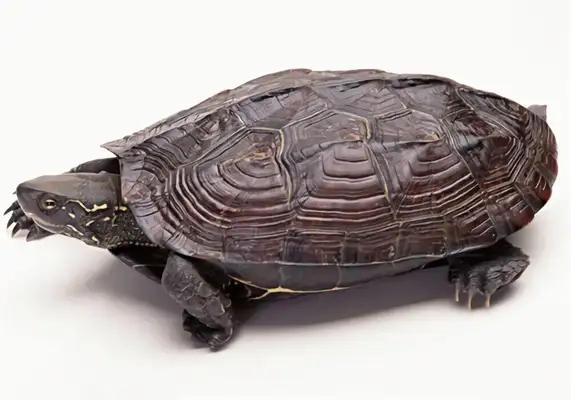
Yunnan closed-hull turtles have no record of being raised artificially, so people are not well aware of how they are raised and how they are placed in the environment, but Yunnan closed-hull turtles are similar to those living in yellow lobes, so it is suggested that an area suitable for Yunnan closed-hull turtles can be designed, depending on the living environment of yellow-hull turtles, at least to ensure that early breeding is not particularly difficult.
The distribution of yellow-hulled and gold-headed closed-hull turtles is currently limited to the mountain stream of the Anhui county dam, Tsai village and Lone Peak, with ranges from 30° 27 ' to 30° 52 ' N. Within the range of approximately 80 km2, there are 80-240 gold-headed closed-hull turtles. As a result of people ' s activities, the habitat is shrinking, leading to a sharp decline in the population. The yellow turtles are mostly found in tributary streams of the Green River, living in mountainous areas or hills, mostly on weedy hills with forest edges or thin bushes, where the area of activity is closer to the water source, where during the day they are hidden under the roots, where stones are relatively quiet and dark, where the patterns of day and night activity vary according to season from 16 to 8 August and are dominated by night activities; in April to May and 9 to October, where the temperature is lower, the temperature is much lower in the day and night, and the activity is much lower in the morning and evening, and around noon; and in the slopes below 10°C, most of the temperature is hidden in the grass and the rotten leaves. The key to Yunnan's closed-hull turtle breeding.
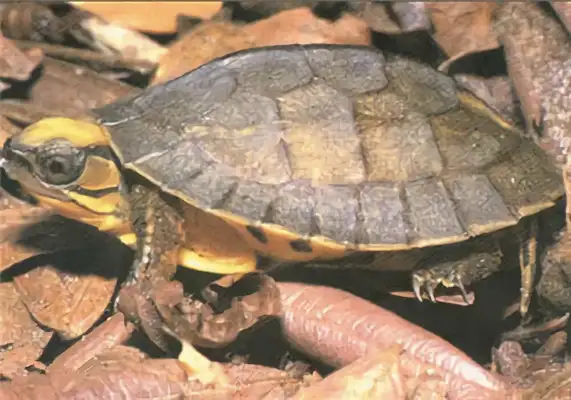
Yunnan closed-hull turtles are impregnable turtles, which generally feed some fish, but occasionally also eat some plants, with few suns and few people raising them, so it is recommended not to raise them in the absence of experience.
Rare Yunnan closed-hull turtles are currently hot spots in turtle farming, but they are just beginning to grow, and even some species do not have a precedent for artificial reproduction, and there is no established experience on breeding techniques, breeding techniques, etc. If blind farming is bound to lead to massive deaths, instead of saving the fate of closed-hull turtles, it accelerates their demise and harms investors.
Cultivation is one of the effective means of saving turtles and an important means of developing and protecting turtle resources. While it is worth promoting the breeding of Yunnan closed-hull turtles, farmers must also be reminded that: In 2001, all seven closed-hull turtles were listed in appendix II to the Convention on International Trade in Endangered Species of Wild Fauna and Flora (CITES), meaning that closed-hull turtles are prohibited species and must be allowed to be used only after breeding a certain size of breeding stock. At present, our legislation provides that the breeding of wild animals requires a licence to domesticate, so closed-hull turtles are no exception. Investors should consult with local forestry offices or agro-forestry authorities on policies before seeding them, so as to avoid violating national regulations.