No.: PET4006
English name: Philipin
Character: Sewage, Silence
National origin: China
Vulnerability to disease: decomposition
Life: 80-100 Felicia Tortoise Profile
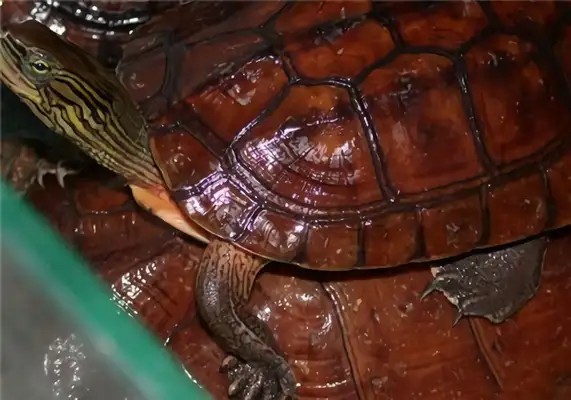
Fellow turtles are a unique species of our country, originating in Hainan, and have a slightly similar look to Chinese flower turtles, but the Fellow turtles have larger backs, which belong to large turtles, so it is easier to distinguish.
Phoebe turtles are sensitive to changes in temperature, are less difficult to raise and grow quickly, and are fed daily to small fish, shrimp and some fruits and green vegetables, which, because of the different acceptances of each individual, tend to be observed, adjusted in a timely manner, maintain food levels in a gradual manner, maintain regularity, over-feeding can lead to faster contamination of water quality and can lead to indigestion.
Chinese name: Fellow Turtle
Latin name: Ocadia philipeni
English name: Philipin's stripe-nicked turtle
Alias: Orange tortoise
Distribution: Domestic distribution in Hainan, not reported abroad
Lifestyle: under conditions of artificial breeding, living in water is desirable, and if living in a water-free environment for a long period of time, the back armored shield will rise and affect the appearance of the turtle. The water temperature of the Felicia turtles is 25°C; at 18°C, there is no food, no movement: However, they do not hibernate; water temperatures are up to 15°C and enter deep hibernation as water temperatures decrease.
(b) Eating: groceries, which are used to feed animals such as skinny pork, fish, shrimp and vegetables, such as leaves and tomatoes. Phoebe turtles are gentle, not afraid.
Female and male identification: The female has a short tail, the excavated cavity is closer to the rear edge of the back of the vest; the male has a long tail and has a thicker tail, and the excretion cavity is further away from the excretion edge of the back of the vest.
Reproductive practice: According to Oscar Shiu, Felicia turtles laid eggs in October, 10 at a time. An ellipse with an egg length of 38.7 ~ 41.6 mm.
Other: in 1992, McCord and Iverson were named on the basis of specimens found in China. Because of their small number and their similar appearance to Chinese flower turtles, they are often sold as Chinese flower turtles. Felony turtle morphology.
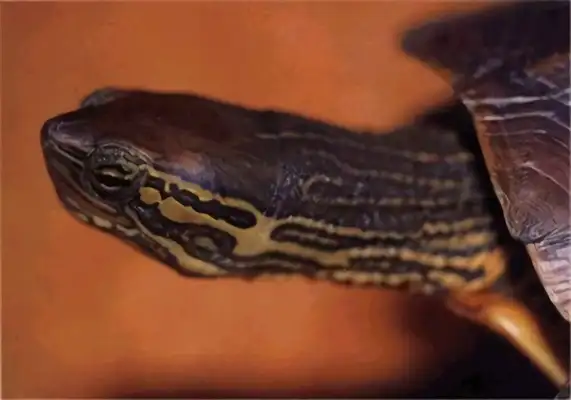
Pheixie turtle heads and necks have four black-side yellow cortexed stripes, with narrower brown corsets, as do abdominal nails and slightly pink oranges. Shorter and wider abdomen (up to 90 per cent of the length of the first half of the first part of the lower abdomen, shorter guilders and longer larynx (up to 120 per cent of the maximum length of the larynx)) knowledge of the conservation of the Fhifa turtle
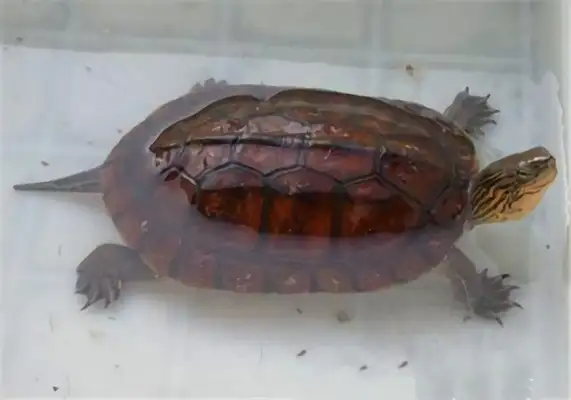
It is not difficult to raise a fish turtle, but it is a turtle that grows in the south of the country, so the environmental temperature requirements are special, and different forms of breeding are provided in seasons, so that the turtle can be more adapted to life.
I. Highlights of conservation in the spring
The first spring of each year is the key to turtle survival. At this time, the turtles are in a state of semi-hot sleep, which, combined with high day and night temperature changes, makes them highly susceptible to disease due to poor mastery. When the general temperature is 15 °C, artificial heating should be used to keep it above 22 °C. (The ambient temperature cannot be reduced after feeding). At 17°C, the turtles, although hungry, were unable to feed them in order to prevent them from eating properly and causing disease.
II. Highlights of summer conservation
In summer, when water temperature is around 34°C, turtles eat more, they should be fed more to accelerate their growth and, if they do not need to reproduce, can be fed 2-3 times a week. The day-to-day shift of water (which can take place before feeding) is not possible to use well water in order to avoid excessive temperature and adverse consequences.
III. Autumn conservation elements
Fall is the key to raising turtles. It is said that the success or failure of winter sleep is directly affected by the amount of nutrients stored in spring bones, autumn larvae and turtles. Therefore, in the autumn, higher feeding is needed, followed by the addition of vitamin C and composite vitamins to bait to improve turtle resistance. Daily attention should also be paid to changes in ambient temperatures, which are around 18°C at night, so as not to be counterproductive and cause disease.
IV. Elements for winter conservation
In autumn, good breeding, good hibernation for turtles, can be put on wet sand in winter, or in 10 cm deep water casks. Water temperature cannot be below 8°C. Otherwise, the hibernation safety of turtles would be threatened. Fellow turtle living environment
Artificial feeding of Felicia turtles generally has four types of environment, such as rearing ponds, glass tanks, aquariums and plastic basins, which can be selected according to family circumstances. Below is a description of the environmental setting and temperature control of the outdoor breeding ponds that feed the Felicia turtle.
Environment
It is generally better to plant a stockbreeding pool on the interior or on the ground in the yard, both in order to enhance the living environment and to facilitate the management of the stockbreeding. Indoor rearing ponds should be provided with ventilation towards the sun, with water vents at the bottom of the pool and water vents at the top of the pool for drainage and adjustment of water levels. The specifications of the rearing pool are typically 1 m x 1 m x 0.3 m, and the depth of the water in the pool is approximately 0.2 m, suitable for a little less than the manicure of the felch turtle, and not too deep, with a two-to-two density (i.e. 4 females and one male).
The environmental design of the rearing ponds is dominated by hydroponics (2.3 land surface ratio), which generally have a relatively large area of islands, which can be constructed from sunken wood, sandstone, vegetation (some wet-resistant grasses and small shrubs), etc., and should have a certain gradient around the base of the island, so as to allow the Philite turtle to climb up for rest, spawn and sun. There is also a need for sand on the island to allow it to dig and lay eggs. There are also a number of aquatic plants in the rearing ponds that can be used to purify water quality and to provide a summer shelter for Felicia turtles. The structure and functions of the above-mentioned rearing pools may be used for the purpose of raising ablaze, aquarium or plastic basins.
II. Temperature requirements
Felicia turtles are more sensitive to temperature changes and are prone to disease, especially for young turtles, with temperatures above 22°C throughout the day. At the beginning of each year, the key to the survival of the Philistines turtle is the semi-slept state of the turtle, which is very hot and prone to disease throughout the day and night. When the general temperature is reduced to 15°C, artificial warming measures should be taken to keep the ambient temperature above 22°C in order to be fed, and the ambient temperature cannot be reduced after feeding. At ambient temperature of 18°C, the Felicia turtles, while having an appetite for food, are unable to feed them in order to prevent disease from arising from ingestion. Felony turtles feed the food.
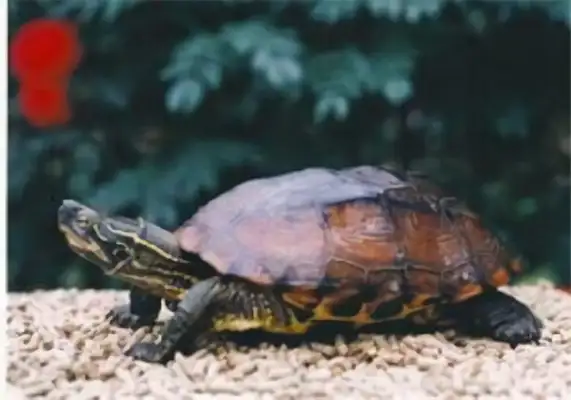
The adult Philistines are pure carnivores, but in the long run they are groceries, so when they are raised artificially, food is chosen according to its characteristics to avoid malnutrition.
Fellow turtles like to tan their backs and often spend most of the day in the sun. Long-term indoor feeding requires heating sticks and UVB. If they are in an outdoor pond, they can also withstand cold temperatures. It is recommended that they stay indoors for the winter, but not for hibernation. They're good water. They can be deeper. ♪ I've got a tatter to climb ♪
The larvae can feed insects, bloodworms, shrimp skins, turtle food and fish shrimp meat. It tends to be edible and fed to lettuce, water herbs, plumes and other aquatic plants, as well as to a variety of green leaves and vegetables, such as plum and plum. It is possible to keep green leaf vegetables and aquatic plants in the tanks and then feed turtles two to three times a week, in small quantities.
Fellow turtles are a more adaptable turtle species, but they are sensitive to temperature changes. In day-to-day rearing conditions, pork, fish, shrimp, etc. can be fed to a variety of aquatic plants at the same time, such as platinum and aqueous, plums, fruits and, above all, rice shrimp. Three meals a week, each with an appropriate increase of 5 per cent of the weight of the turtle, but without a sudden increase, should be gradually adapted to avoid indigestion.