Title: PET4126
English name: Chaetodon octofasciatus
Origin: Indian Western Pacific Region
Vulnerability to diseases: fish plague, white cloud disease, skin disease, rotting tail disease, etc.
Life: 3 to 5 years, overview of butterfly fish species
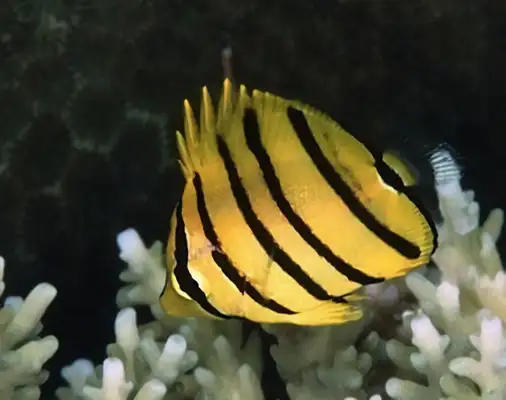
Butterflies in the octopus are not food-eating fish. Butterflies in the octopus are not easy to raise for a viewing fish. There are 11 fin thorns on the back fins of the eight bands of butterflies, the largest feature of the eight band of butterflies. The octopus is a warm, small coral reef fish.
Chinese name: Eight band butterflies
Distribution: Western Pacific region, India
Gate: Pipeline gate
I'm sorry.
For butterflies
Latin name: Chaetodon octofasciatus
Context: Animals
Platform: irradiated fin fisheries
C: Butterfly Fish Section
Species: Eight with butterfly fish, eight with butterfly fish.
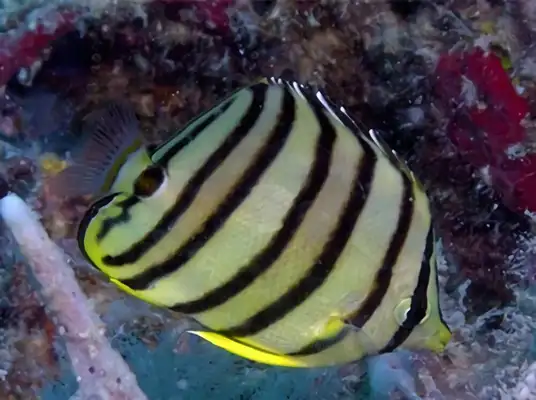
Eight-band butterflies are warm, small-scale coral reef fish, but it is more difficult to raise them as watch fish and cannot be used as food. The size of the eight-band butterflies is generally around 20-50 mm and is produced only in the South China Sea.
There are 11 back fin thorns in the eight bands of butterflies, the longest being the sixth. Three ass-fine thorns, second and third-fin thorns of approximately length. On the side there are eight narrow bands with approximately equal spacing. The sideline ends above the tail handle. Side flat, small kiss, prominent. The fish are yellow and eight black bands; the abdominal fins are yellow and the tails are transparent; and the juvenile fish tail handles have false eyes. In coral reef areas, where 3-20 metres of life is found, young fish swarms in the Acropola spp series, and fish in the form of fish are found in coral reef areas, with mildness. Accumulation, with corals and algae as the staple food.
The eight-banded butterflies are close droplets, colours ranging from yellow to yellow, and juvenile fish are the least coloured, increasing as they grow. It is named for its eight black stripes, the first of which begins in front of the throat and the last at the end of the back and hip. Skinny, round. Short kiss, three times longer head. 10-11 fin rough, 19-20 soft; 3 hip rough, 16-17 soft. It can be 12 cm long. Butterfly-breeding environment.
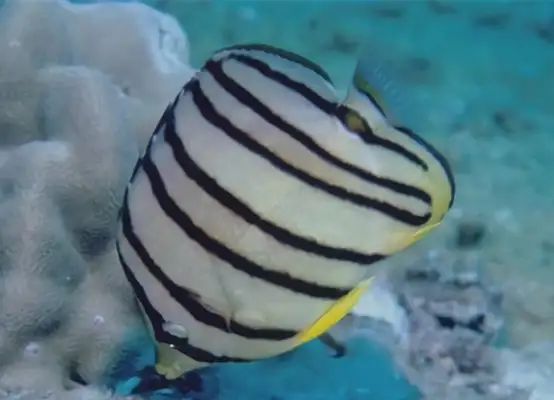
Small, warm coral reef fish in the eight bands of butterflies, so fish friends who want to watch the fish to be raised need to pay attention to the temperature of their breeding, and butterflies in the eight bands like to live in coral reef areas, so that they also need to be fed in such a way as to provide the most suitable environment for their survival.
Eight-banded butterflies prefer to live in coral reef areas of 3-20 metres, with small groups of juvenile fish swimming in axle-pore corals (Acropola spp), with little distance, and fish forming a habitat for coral reefs. The eight-band butterflies are located in the Indian Ocean and the western Pacific along the southern regression line and in the area between the northern regression line. We are born only in the South China Sea. I'll feed you some butterflies.
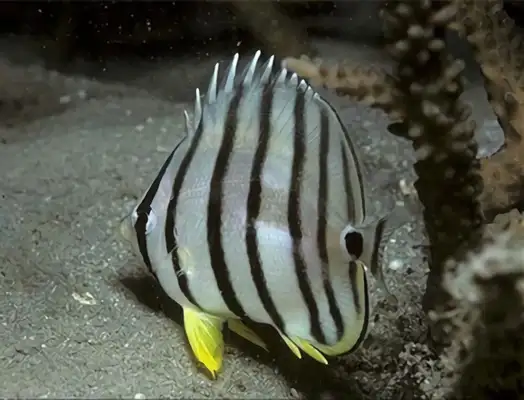
Butterflies in the eight bands, which prefer to live in coral reef areas of 3-20 metres, are one of the more difficult species to raise. Care is taken not only to provide them with a suitable breeding environment, but also some feeding concerns.
Butterflies in the octopus are non-foodable, and as the octopus is small and 20-50 mm long, the octopus is fed by corals and algae. Artificial butterfly fish must provide them with a coral reef view and give them a living environment comparable to nature.