Designation: PET2060
English name: Yellow-blotched Sawback
Origin: Mississippi, USA
Vulnerability to disease: decomposition
Life: About 50 years
Description of species of yellow-coloured turtles
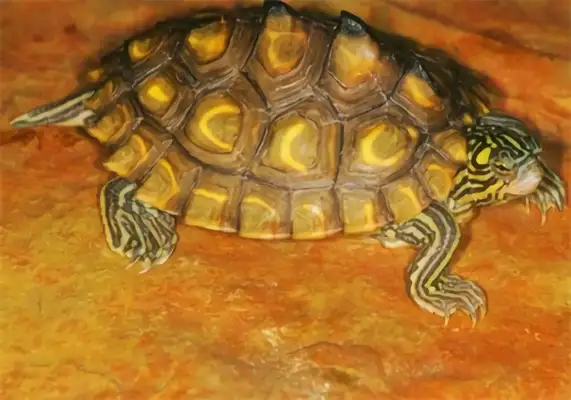
It is also normal for many turtles to love the beauty of the U.S.-specific tortoises, but not for domestic markets, because they are also protected animals in the U.S., so there is little natural inflow.
Chinese name: Yellow spots map turtle
English name: Yellow-blotched Sawback
School name: Graptemys flavimaculata
Context: Animals
Gate: Pipeline gate
Amen: vertebrate Amen.
Programme: climb
Tortoises.
AAA: Tortoises
C: Turtles
Geographical distribution: Pascagoula River, Mississippi, United States.
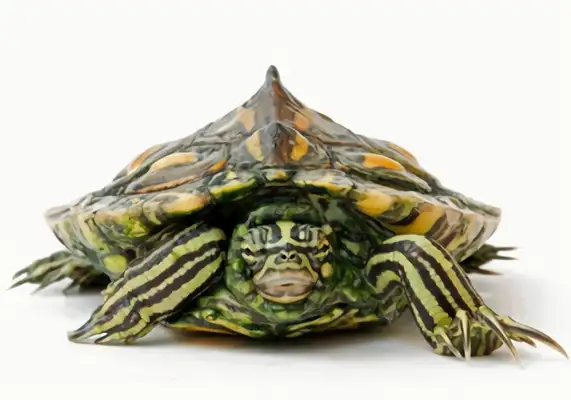
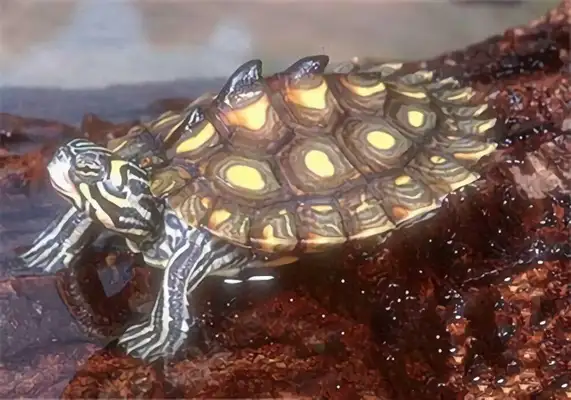
morphological characteristics: Male length 7.6-10.2 cm; female length 10.2-17.5 cm. Back-to-back olives to brown, with significant black punctures on the tripod; large shields with yellow spots. The abdominal butter is coloured and black patterns are found along the seams. The head tattoos are similar to the ringed map turtle. The male had long, long claws on his front foot.
Lifestyle: This is the dominant turtle species in the Pascagora River. They share this habitat with the Alabama map turtle, the red ear turtle, the donut turtle and the mackerel turtle. Sand and stones are laid at the bottom, and rivers flow slowly. In particular, the river is filled with leaves and trees.
Eatability: Insects and screws are the food they like.
Reproduction characteristics: eggs. The timing of spawning is uncertain. Men reach sexual maturity after 3-4 years and females later. The courtship is similar to the turtle.
Prices: Domestic markets are rare and prices are around $10,000. Yellow spots map turtle morphology
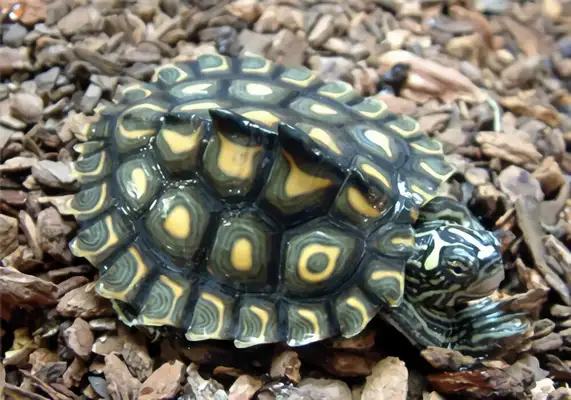
The yellow-coloured map turtle's backnail colour is arguably the most beautiful among the map turtles, so the yellow-coloured map turtles are also admired by many. Unfortunately, the yellow-coloured turtles have only wild individuals, and there are few successful cases of artificial breeding.
The yellow-coloured map turtles have the highest vertebrae in the map turtles, and there is a large yellow patch in each of the backs, and the larvae will have a more colourful shell. Yellow-marked map turtles are small and medium-sized tortoise species with an approximate length of 3.5 to 4.5 inches for males, with a larger female form of about 5 to 7.5 inches long, a back-clothed olive to brown, with significant black punctures on the back, and large shields with yellow spots. The abdominal butter is coloured and black patterns are found along the seams. The head tattoos are similar to the ringed map turtle. The male had long, long claws on his front foot.
Such map turtles belong to the narrower type of head inside the map turtle, which has the elastic characteristics of the central part of the typical map turtle, the more visible grafts on the head, and the more visible yellow pattern of the vests. There are five lines in the abdomen, and there are no complex bouquets. Like other map turtles, such turtles like to tan and live in sand currents or muddy rivers. Often, they live on branches falling in rivers. They spend a lot of time in the sun during the day. Yellow map turtle care knowledge
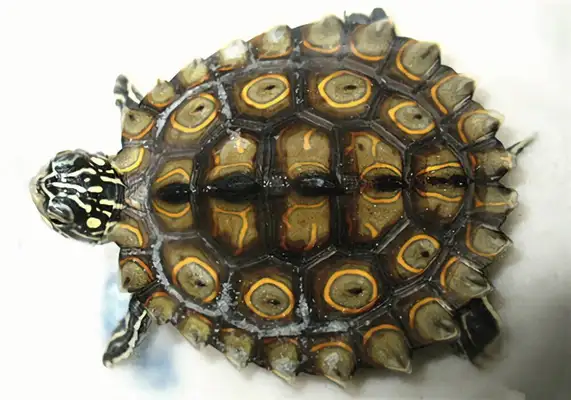
The number of yellow-stained map turtles is scarce in their original places of origin, so there is little chance of being exported or trafficked around the world. Only a small number of illegally exported wild individuals can be seen in spring and summer markets where yellow-stained map turtles are strictly protected locally in the United States.
I. Protection of the origin of yellow-stained map turtles
Yellow-plained map turtles are unique species in the United States and their main habitat is limited to the Pascagoula River in Mississippi and its tributaries (some of which overlap with Giard map turtles), but some habitats have been contaminated and water levels have changed as a result of agricultural development, affecting yellow-plained map turtles as sand beaches for nesting eggs. The average area of activity for males is 1.12 hectares, and the average length of activity is 1.8 kilometres, while the average area of activity for females is 5.75 hectares, which is 1.5 kilometres because females are required to nest at spawning.
II. Cultivation of map turtles
You can put it in storage or in a fish tank, you can put more water in it. You need something to land with a turtle. You better have sunlight. The turtle likes to tan. The cold needs to be heated, and if there is a 24-hour heating in the home, there is no heating, and attention is paid to the difference in water quality and temperature when changing water. A yellow map turtle living environment
Wild yellow-stained map turtles live on the Pascagoula River in Mississippi, United States, the only place where yellow-stained map turtles are found. It is a heavily contaminated river, and the harsh environment has brought severe survival tests to the coast and to the wildlife of the river.
The Pascagoula River is a river about 130 kilometres long, south-east of Mississippi, United States. The river area is about 23,000 km2 and the Mississippi river flows into the Gulf of Mexico. The Pascagoula Basin is managed by the Pat Harrison channel. It is the only significant and unaffected river, with emissions exceeding 10 cubic kilometres, flowing into the Gulf of Mexico each year from the United States, and in fact there is only one Cfa Koppen climate classification area anywhere in the world, and the most recent method is in the south-eastern part of Juquia ltaya of Brazil. As a result, Pascagoula, in modern times, has been heavily protected from dam construction.
Yellow spots are swimming in the waters of the Tennessee aquarium filled with plankton. In the wild environment, they only inhabit the Pascagoula River in the Mississippi River in the United States, especially in the southern part of the river. This population has not recovered since Hurricane Katrina caused a large number of deaths. Map turtles are usually killed by fast-paced speedboats. In the transport of riverways to clean up obstacles, there are few areas left for this animal to tan. Yellow-stained map turtle breeding point
The yellow-stained map turtles, which are predominantly carnivores, usually do not eat some plant food, bite some crust, provide them with favourable conditions for eating some shellfish, ensure as much nutritional balance as possible in the context of artificial breeding and add some nutrients.
I. What do wild yellow map turtles eat?
The yellow-coloured map turtles are food staples of aquatic aphids and snails, so their teeth are so hard that they can chew upon crust, and on the mix they must be careful to bite the tails or necks of other temperate turtles, which are more suitable to mix with the North American turtles, less resilient to the environment and less readily introduced. This is the dominant turtle species in the Pascagoura River. They share this habitat with the Alabama map turtle, the red ear turtle, the donut turtle and the mackerel turtle. Insects and screws are their favorite food.
ii. What does a yellow-stained map turtle eat?
Yellow-stained map turtles use egg yolk, red worms (twigs), pig livers, combined with feed, etc., and can be mixed with animal baits such as forage and pork liver. The rate of baiting for fresh live bait is 10 ~ 12 %, the rate of baiting for feed is 4 % ~ 6 %, and at the rate of 2 ~ 3 %, it is necessary to clear the food table and the water in a timely manner, and to be careful to clear the bottom of the pond once a day, fill new water and maintain water quality stability. Multivitamins, micro-ecological agents (e.g. EM microorganisms) are added to feed for health protection, and antibiotics are generally not used in order to prevent resistance and to disrupt the micro-ecological balance within the intestinal tract of the childish turtle.