No.: PET6515
English name: Salmon-crested Cockatoo, Molucan Cockatoo
Origin: Sicilian Island in and around the Moluccas Islands, Indonesia
Vulnerability: respiratory, digestive and parasitic diseases
Life: 60-year profile of parrot species in Moluccas
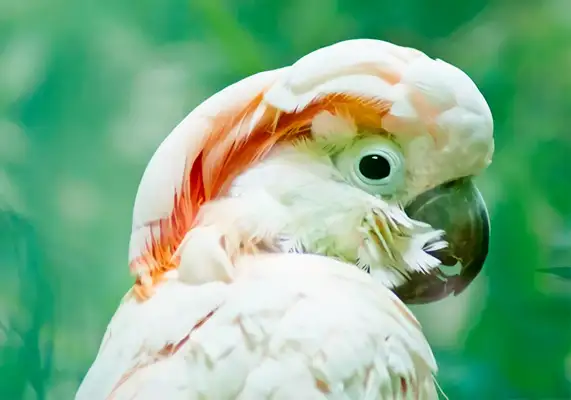
Seeing the name of a macaw, you might guess if such a parrot came from the Moluccas of Indonesia. Indeed, the wild moose and phoenix parrots are distributed only in the Moluccas, and elsewhere you can only see the macaws that are raised. However, with increasing human hunting and the destruction of the parrot habitat, the number of species has decreased dramatically. Currently, macaws in Moluccas are classified as vulnerable species.
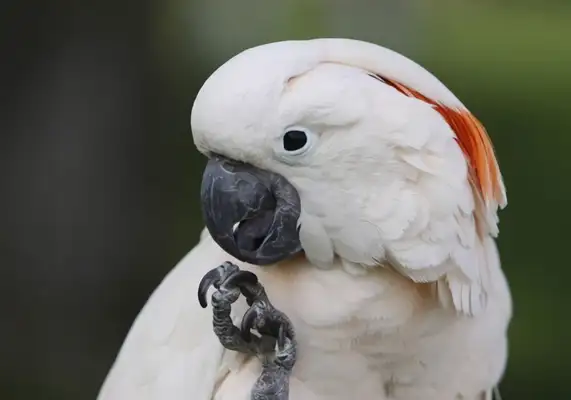
Moluccan parrots are large parrots, mainly white, with coronal feathers of salmon, which is in stark contrast to their color. Looks like there's not much difference between male and female moose and parrot, but if you look at it carefully, you can see that you want to distinguish male and female. The gender of the bird is still a little tricky - the male rainbow is black and the female has a little red.
The macaws in Moluccas live longer, and some individuals can survive 60 years of age.
Chinese literary name: Moluccan parrot
Two words: Cacatua molucensis
Context: Animals
Gate: Pipeline gate
Amen: vertebrate Amen.
Programme: Birds
APA: Today ' s APA
Look: Parakeet.
Section: parrot section
Family: parrots
Castes: Characteristics of parrot moose and parrot
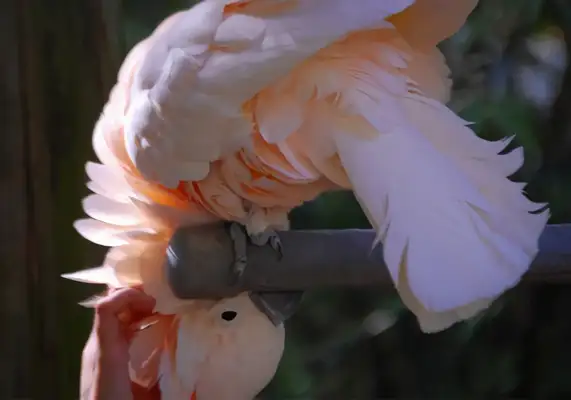
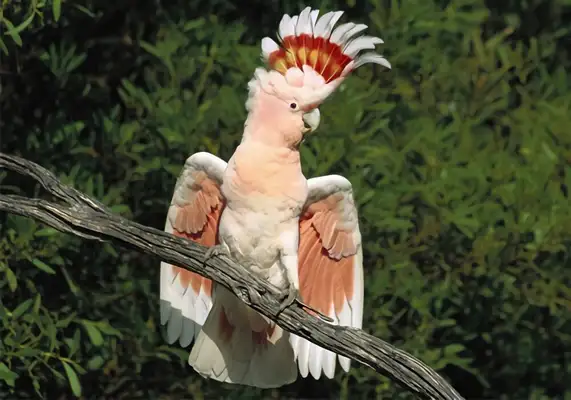
If the name Moluccan parrot tells us that this parrot is inhabited by the Moluccas, then their other name, the salmon parrot, shows one of their morphological features — their crown feathers are salmon. It is because of the distinctive crown feathers that the macaws have won many favors. The caps of the macaws of Moluccas can be raised and slightly bend back when they stand.
In addition to the salmon coronary plume, the main colour of the macaws' bodies is white, which is also pink. Besides, their wings and tails are usually yellow at the bottom. For Moluccan parrots, there are no huge patterns of gender differences. Usually one way to judge the sex of the macaws is to look at the colour of their iris, which is red in female birds, and black brown in male birds. In addition, females are larger than males.
The macaws in Moluccas are large parrots whose size can even exceed 50 cm, and it is difficult to raise them without larger space.
Moluccan parrot morphological description.
Size: 50 cm.
Weight: around 800g.
Head: Crown feathers are salmon.
Ion membrane: female with a little red, male black and brown.
Oxygen: Grey black.
Body: mainly white, pink mixed.
Wings: Yellow on the bottom.
End: The bottom is yellow.
Leg: Grey.
Foot: Grey. It's a point of care for a macaw.
Molucca parrots are of great concern because of their large size and beautiful feathers, but also because of their size, the breeding of Molucca parrots is not always easy. Large cages with sufficient space are naturally essential, and long-term living in small spaces does not contribute to the healthy growth of macaws. Especially for the owners of the macaws who want to breed the moose and phoenix, it is important to provide the birds with an open space.
Like many birds, the macaws of moose and phoenix have a strong bite, and they may cause much more damage than you can imagine, so the cage must be strong, or they may just bite the cage out of the cage. In order to ensure that the nesting boxes are not severely damaged, some people would use metal materials to go to the edge of the nesting boxes and feeders would be able to provide a reference.
Because the macaw's bite power is amazing, the master might as well prepare them some fresh branches for them to bite, and, apart from them, the right toys can be the object of their bites. In order to ensure a good environment in the cage, the owner also has to clean the cage regularly.
There are those who say that the sound of the caged macaws is very high, as can be seen from their state in the natural environment, and that they make a lot of noise when they leave and return to their habitat. If you have male birds, their loud voice may be more pronounced, and the masters will have to pay attention to the impact of birds on neighbours and their families. Moluccan parrot living environment
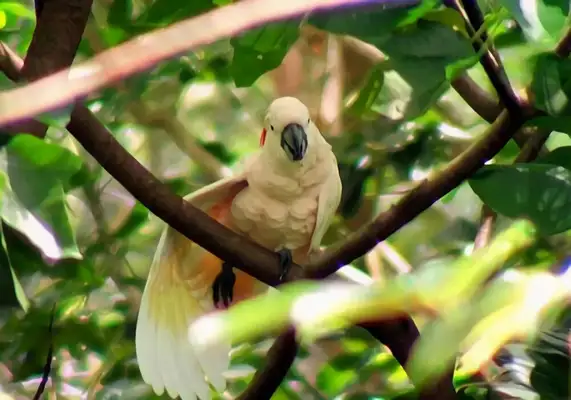
In the 1970s, when people did not begin to hunt in large numbers, and the habitat was not destroyed, the number of macaws in Moluccas was high, and it was common to see the emergence of dozens of moluccas. Now, however, it is very difficult for us to see that, as the number of macaws in Moluccas has declined dramatically and they have become members of vulnerable species.
At present, wild Moluccan parrots live in areas with low altitude (100 m-1200m), such as woodlands, marshes and mangroves, which are generally difficult to trace over a kilometer above sea level. Researchers, when studying macaws in Moluccas, found that they would scream when they left and returned to the tree, as if they were saying, "I'm out," "I'm back."
As a result of increasing hunting, the number of wild moose and phoenix parrots has gradually decreased, and it has even been suggested that the number of moose and phoenix parrots that are now caged may be larger than that of wild animals. But it's not easy to keep a moose and a phoenix. First, the macaws are big, usually grow up to about 50 cm or, if there is not enough space, don't raise them. Secondly, the macaws of Moluccas can live 60 years, which means that you have to take on the responsibility of caring for them during this period, and that any problems that arise must be resolved in a timely manner. If there is a condition to raise a moose-and-phoenix parrot, there is one thing that you need to be aware of. Moose-and-phoenix parrots are loud, and they are absolutely not happy for their families or neighbours, so think twice before raising them. Moose and phoenix parrots feed the points.
Wild mooses and parrots have a lot of food, such as insects, plant seeds, nuts, flowers, plant buds, etc. Although the macaws in Moluccas have been classified as near-exposed birds, they are being smuggled and trafficked as a result of interests. Because cage conditions differ significantly from the natural environment, most people who are still raising these birds are likely to buy special feed to feed them.
In addition to feeding, how to keep birds alive is probably another concern for those who are still raising macaws. Indeed, there have been cases of successful breeding of macaws by a number of seasoned birds, so masters do not think that the breeding of macaws is an unchallenged task.
Since macaws are large birds, it is important to provide sufficient space for activity during breeding. Moluccan parrots can reproduce four seasons a year, and in the course of the year they can produce up to four times, produce two eggs at a time and hatch for one month, so there are plenty of opportunities to breed molucca parrots.
During the breeding period, the master also has to be careful not to let the bird be frightened, otherwise a bird may cause panic and damage to young birds and even death.