Designation: PET3276
English name: Introduction to Red-breasted Parakeet parrot species
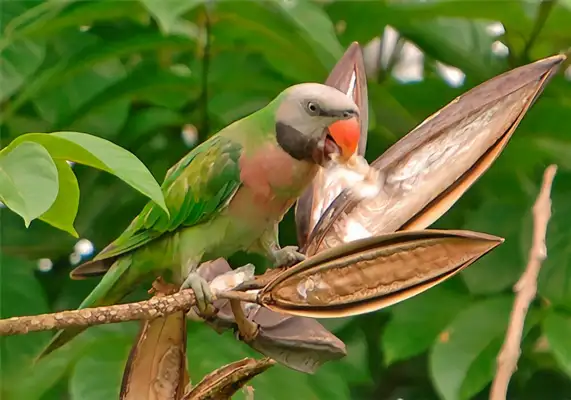
The macaws, which are medium-sized birds with a size of 26-36 cm, are typical climbers. There are eight subgenerous species of parrots, mainly located in the countries of the south-central peninsula to central Malaysia, including northern India, Nepal, Myanmar, Guangxi, Guangdong and Hainan Islands in China, Thailand, Viet Nam, Cambodia, southern Borneo and Java Islands in Indonesia.
Chinese literary name: parrots with breast
Latin name: Psittacula alexandri
Don't call it parrot.
Context: Animals
Gate: Pipeline gate
Programme: Birds
Look: Parakeet.
Section: parrots
Yes: Nautilus
A parrot with a breast
Named by Linnaeus, 1758
Name: Red-breasted Parakeet parrot
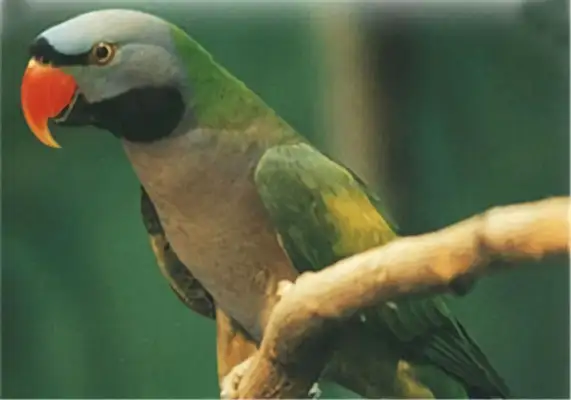
The macaws are typical of climbing birds, whose beaks are strong, their beak hooks, their upper beaks have active joints and their base parts have shuras. The macaws have short feet, but both toes are strong enough to hold and climb.
There is a black belt on the forehead of the male parrot, stretching backwards along both sides to the eye. On each side of the base of the lower mouth there is a black broadband spot tilting back to the neck, with green eyes and perforations, and purple grey on the rest. The back of the neck and its side are green, with the back, shoulder, internal overlay and internal wing flying in blue, with metallic green light, and the feathers with dark infestation. The outer side is green with large plume, and the plume is also stained with dark insect. The first one was dark brown and had a tan narrow edge, while the rest were black and brown, and the outer and plume were green and yellow, and the inner tan was dark and tanish. The tail feathers are narrow and sharp, the two central tail feathers are particularly narrow, blue, the base feathers are green, the tail feathers on both sides are shorter to the outside side, the outer gill is blue, the inner luminous is green to the golden, and the feathers are black and brown. It stains white, has purple gray on its throat and chest grapes. It's green on the back and under the wings, and it's purple blue on the abdomen. Big chest parrot breeding environment.
The macaws are the largest and more common species of parrots in China. However, as a result of the destruction of the environment and the excessive hunting of people, their number has declined significantly, and there has been an increase in the number of artificial parrots. The macaws are mainly located in open forest areas of various types in the lowlands and in areas about 2,000 metres of hilly hills; they also travel to mangrove areas, coconut forest areas, farming areas, parks, gardens and suburbs. A parrot with a big chest.
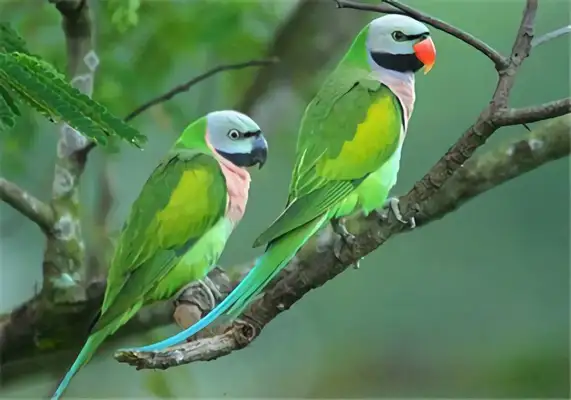
The large macaws are the largest and most common in the wild of Chinese parrots, so there is an increasing number of cases of macaws being raised. And what good is feeding a parrot to eat?
A parrot's feed can be made of rice, seed smelt, sunflower seed (or peanuts) combined at a ratio of 7.2:1, with fruits and vegetables as a by-product, and often leaves fresh green branches, grains and red clay to his choice. A slight increase in the proportion of fat feed in the winter, e.g. ricin seeds and sunflower seeds (or groundnuts) can account for 20 per cent, respectively, with complementary feeding of ripe eggs during childbearing. Fruits and vegetables are cut into blocks or fractions to be fed, disinfected, washed with potassium permanganate before being fed, the rest to be taken out in a timely manner and the parrots to be fastened, with light and strong feet to be kept under constant inspection. The parrots are not used to it at first. They have to adapt for a while. Give it the peanut rice, fruit and so on, and feed it with your hands, so that it can be tamed in a few days. Cages are raised and fine sand is laid to facilitate the movement of parrots on the ground and to facilitate cleaning. The rest of the food can be cleaned up twice a week. In early spring and late autumn, nesting boxes were cleaned and sand and disinfectant cages replaced once a year.