Designation: PET3543
English name: Introduction to the Red Eye Frog variety of Agalychnis callidryas
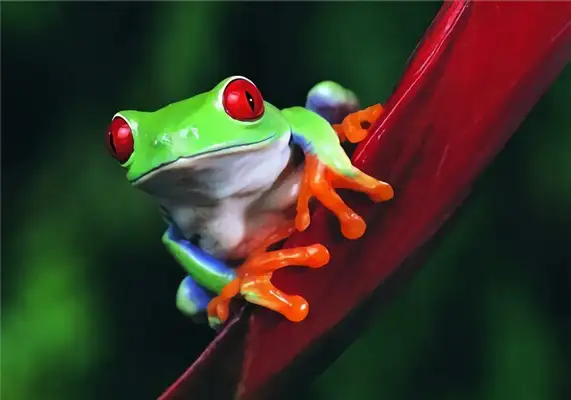
The red eye frog (Agalychnis callidryas) is one of the large tree frogs that eats as long as it can plug in imported animals and insects, including larvae. Only if they eat live. Because they're undetectable without moving food.
Eyefrogs are actually a kind of rainfrogs. The name “Red-Eyed Frog” was mistranslated. Red-eye frogs are found in tropical rainforests dominated by Costa Rica and Mexico in Central America, and in the northern part of South America, with slight variations in colour. Overall, because of the large number of ethnic groups, they are not protected by CITES. Red-eye frogs, like the vast majority of tree-dived frogs, are completely night-dived animals, and in size are also large-scale tree-deep frogs.
Chinese literary name: Red Eye Frog
Latin name: Agalychnis callidryas
Context: Animals
Gate: Trondata Gate
AAMEN: vertebrates
Programme: Amphibia
ANALYSIS: SLETTY ASPECTS
Objective: No tails Anura
Asia: Neobatrachia
Section: Rainfrog Section Hylidae
NACO: YET FROKEAKO
Yes: Red-Eye Frog belongs to Agalychnis
Crop: Red-Eyed Frog A. callidryas
Distribution: tropical rainforests in Costa Rica, Central America and South America
Red-eye tree frog morphology
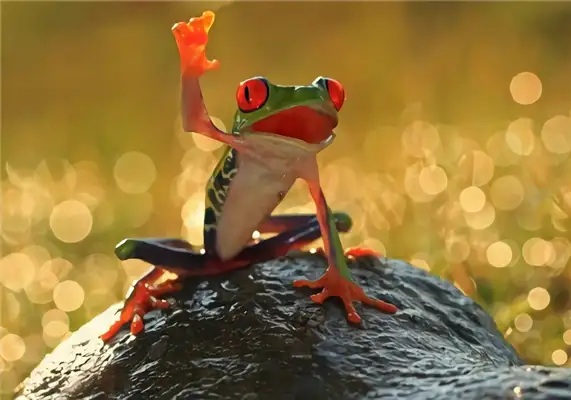
The Red-Eyed Frog is in fact not a tree frog, and the name is a misunderstanding. The red-eye frog is actually a medium-sized tree twig, and the red-eye frog's back is green, the color that protects them. It's the most special one. It's the big orange eyes. Red-eyed frogs are purple or blue and have white striped orange toes. This “consolidates” them in the rain forest and in the background of rocks and trees.
Red-eye frogs live in the Meso-American rainforest, which is often rained, hot and very wet. However, people there are increasingly cutting down forests in order to build houses and reclaim farms, and their settlements have been reduced in small measure. The Red-Eyed Frog has many characteristics that enable it to survive in the forest. Its ankles are large, shaped like water cups, which help it climb on trees to catch insects. Its skin will be darkened at night, so its natural enemy will not see it! When the sun rises, its skin shines green light, making it look like green leaves.
When a tree frog convulses on a leaf, its bright light becomes dim, its big red eyes hide in its head and its legs close beneath its body. If you push it softly, its big red eyes will stare round and round, and its beautiful, long legs will slowly reach under the soft body.
Why do red-eyed frogs have bright colors? There are many possibilities. Maybe those natural enemies who are about to eat it don't expect it to wake up so brightly! They'll freak out. That's when a tree frog can run safely. Red Eye Frog Living Environment
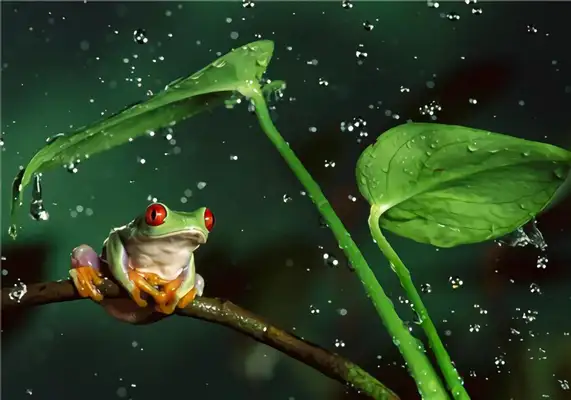
It's hard to say that it's easy to raise red-eye frogs. If you can set up a living environment like the red-eye frogs in nature, the success rate for raising red-eye frogs is high. Here's a description of the living conditions in which red-eye frogs are raised.
For adult frogs, it is recommended to use rearing boxes of about 70 cm (long) x 25 cm (wide) x 50 cm (high) at the top, which can contain the humidity in the boxes without being overspreaded. In the origin of red-eye frogs, the humidity during the rainy season is around 80 per cent (December-April) and in the dry season between 30 per cent and 50 per cent; you can use the above data to adjust the humidity of the changed rearing box appropriately.
Simple setup for red-eyed frog breeding box
The simplest rearing box can be set up with wet, thick paper towels as a cushion, which can allow tree frogs to enter and go into bubble water at will, and barks or plants that can allow tree frogs to climb and rest. Such a setup would require daily water spraying to maintain humidity, while paper towels and water in water basins would be better replaced daily, and rearing boxes could be cleaned every few days, so that the breeding environment would be kept clean and bacteria would not be allowed to breed death.
If you want the rearing box to be closer to nature, it is recommended to use fine gravel as a cushion, you can lay two to three centimetres of fine gravel at the bottom of the rearing box, spray it with water, then put a moss on it, then put it into a more earthly basin. For plants, species that are as high as possible and whose roots are not corrupted by excessive moisture are selected. Phirodendron scandens, or a mini turtle, are recommended. Plants must be washed completely before being put into plants; the leaves of plants may contain fertilizers or insecticides that are toxic to tree frogs.
Light
Red-eye frogs are night-gods, so they do not require full spectroscopy for breeding. However, the use of spectral lamps with smaller watts during the day is conducive to the photosynthesis and growth of the plant in the box and, of course, to the beauty of the rearing box. At night, when the frogs are active, you need to turn the sun off without affecting their biological habits. It is proposed to use low-watt-number red lamps at night so that night observation can be addressed.
Temperature
The daytime temperature suitable for the growth of red-eye frogs ranges from 24 to 30°C; at night it ranges from 18 to 24°C. The heating equipment usually used for red-eye frogs consists of white-weave lamps with low watts or heating pads placed at the bottom of rearing boxes. As frogs are relatively sensitive to temperature, ensuring that thermometers are installed in the breeding environment and that temperature is checked from time to time is a mandatory function. But the temperature continues to be too high and the red-eyed frog dies in a very short period of time. Red-Eyed Frog Feeder.
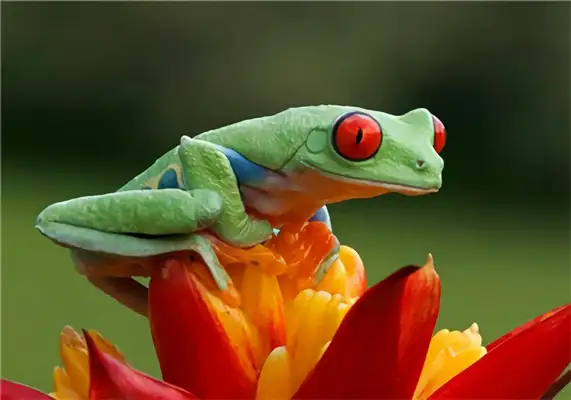
As long as they are living, as long as they can swallow food into their mouths, Red-Eyed Frogs will eat up all of them in the wild, mainly flies, moths, grasshoppers, crickets and other little frogs. So how do we feed when we feed?
You should feed the red-eyed frog at night. Usually, adult red-eye frogs feed only 3-5 medium-sized crickets 2-3 times a week; if young frogs, select as many smaller cricket individuals as possible; before feeding, as much as possible, crickets are fed more nutritious vegetables and cereals, such as carrots, which will help to keep the tree frog colours coloured; and 70 per cent of Rep-Cal vitamins and 30 per cent of Rap-Cal powder are recommended for use in calcium powder and vitamin powder, once a week. It is also possible to change the nutritional structure with proper feeding of fruit flies, if available. It is recalled that after each feeding, the rest of the food is removed so that the water quality in the breeding environment is not spoiled. Red-eyed frogs raising knowledge
It is difficult to distinguish males from females in their early years of age, usually by the size of the adult genre. Unlike pet dogs and cats, dogs and cats can be distinguished not only by their genitals, but also by sizes, usually large male, while red-eyed frogs are not.