Designation: PET1170
English name: chaines false-eyed turtle
Character: Fear of cowardice
Origin: On mainland China, in Hainan and elsewhere.
Vulnerability to disease: decomposition
Life: 50 or so years of eye-marking turtles
Eye-marked water turtles are a unique species in our country, and some researchers believe that they should not be a new species and that they are more specific, but they are not recognized by the academic community, so we consider them to be a special species. It prefers to live in waters with slow water flow, often sandstones and clear water quality. Occasionally, they enter farming areas and are found in rice fields and ponds in the summer. Eyeball turtles.
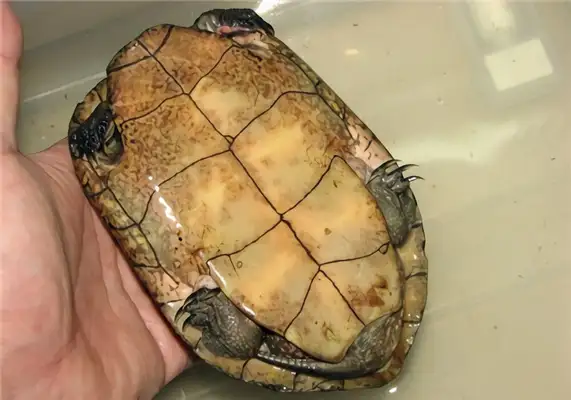
The eyes of the turtle are narrow, with no hooks and no chewing. On the back of the head there are longitudinal spots of yellow on the black side, which extend to the neck and form two visible funnel-like eye spots on the back of the head, but there are no black spots in the eye, which are clearly different from eye-marked and four-eyed turtles, with brown-to-black necks and orange and orange-coloured stripes, yellow on the cheek and the abdomen of the neck and vague spots. Eyeball turtles.
The breeding of eye-marked water turtles requires the selection of female and male individuals who are physically intact, unharmed, dynamic and responsive, based on gender characteristics. With the exception of Hainan Island, we usually mated to breed in April, with the highest spawning period from May to August. Small courtyards have 100 centimetres x 60 centimetres of mud ponds at an altitude of 20 centimetres between the pits and the walls to provide eggs to the turtles. Eyeball turtles.
The timid tortoises are timid and, in the event of disturbance, their heads, tails, limbs are crucified into the shell or move around without destination. It is generally desirable to dwell in the dark under water, such as under rocks and around ponds. The nostrils are exposed to the surface of the water three to five times in a row and can remain underwater for about 15 to 20 minutes. Between April and early May of each year, at 15°C, a small amount of activity is visible in the water, around 18°C. During the months of June and September, as temperatures rose, turtles expanded their range of activity, prowling around the shore at noon, stretching out their limbs and tanning, commonly known as “sunshells”. Eyeball turtles.
Dying turtles have a lot of food to eat, and in the wild, they seek food according to their own needs, but all sources of food and nutritional supplements come from the supply of humans at the time of adoption, so the diversity of food is needed to ensure nutrition and to pay attention to the freshness of food.
Eyed water turtles eat animal baits, such as skinny pork, small fish, liver, etc., under artificially raised conditions, with small amounts of carrots, cucumbers and mixed feed. There are no cabbage, potatoes, platinum; thin pork is immersed in water for longer and white is not. The four-eyed water turtles awakening from hibernation start feeding at temperatures above 18°C, at 26°C ~ 31°C, the period during which they feed and grow, and feed shredded small fish, shrimp, snail meat and slaughtering feet, with five grains of groceries, guacamole, vegetables, etc., with a feeding rate of 5%-15% of the total weight of the turtles and a seasonal increase or reduction of 15%, so that after one and a half hours of the feeding is overfed, the bait should be removed in a timely manner.
The summer can be fed twice at 9 a.m. and 5 p.m. and once a day in spring and autumn. The bait is required to be fresh, not to feed the fermented bait, and large pieces of it must be crushed or conched to facilitate its feeding, swallowing and easy to digest. The ratio of animal feed to plant feed is 7:3. When the temperature fell below 20°C in mid-October, the appetite of the four-eyed water turtles declined until they stopped eating and went to hibernation.