Designation: PET4594
English name: HawksbilTurtle
Character: Fragile
Origin: mainly from tropical and subtropical waters, particularly in Malaysia, Indonesia, the West Indies and Brazil, and Central and South America.
Life: An overview of the species of tungsten from around 50 to 80 years
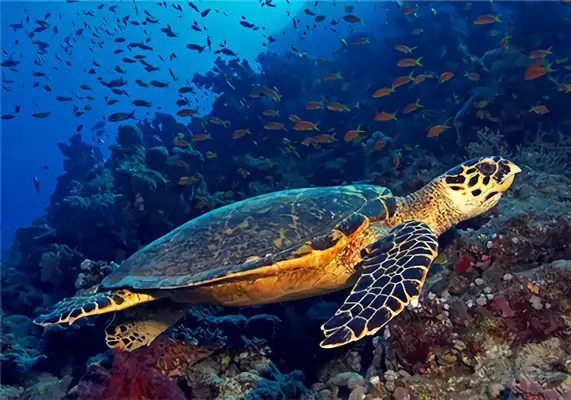
It represents a beautiful but fierce sea turtle, a turtle that has been hunted for a long time because his nails are of great use, not only as a luxury decoration, but also as a cure. For many years now, he has been on the brink of extinction as a result of endless killings, which have rarely been seen in the waters of our country.
The shape of the argon is broadly similar to that of other sea turtles, with flat bodies, protective backs, and rowed oar feet, the most visible of which is its eagle-like mouth, and serene backs. The raisins have beautiful and colourful raisins on their crust. They are precious stones that can be used as raw materials for jewellery, sculptures, and so forth. They are noble and a symbol of happiness and a long and healthy life.
Chinese aliases: 瑇瑁, 蝳蝐, 瑇玳, 鹰, 鹰, 鹰, 鹰, 龟, 龟, 龟, 龟, 龟, 龟, 龟
English name: HawksbilTurtle
Two words: Eretmochelysimbricata
Context: Animals
Gate: Chordata Gate
Amen: vertebrate Yaman
A: Reptilia
ACQUA: ACQUIPMENT
Tortoise Testudines
Subtitles: Criptodira
Section: Sea turtles Chelonidae
Yako: Yako the Sea Turtle
Family: Turtle
From: Eretmochelys Fitzinger, 1843
Asians: Asians
Castes: E.imbricata
Distribution: mainly from tropical and subtropical areas, particularly Malaysia, Indonesia, the West Indies and Brazil, and Central and South America. Capricorn Characteristics
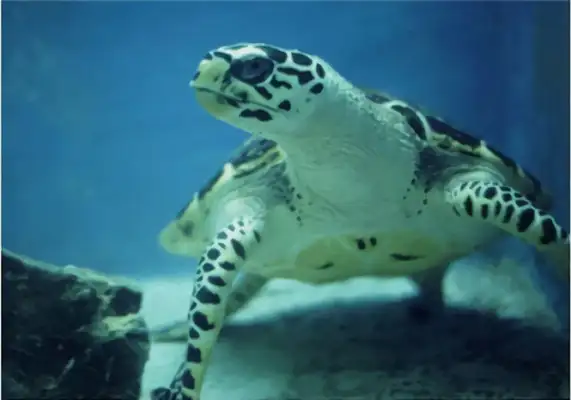
Since time immemorial, it has been regarded as a treasure, in particular an ornament made from a tortoise plate, a feature that has significantly reduced the number of wild animals, which is a matter of concern.
Like other sea turtles, they have typical sea turtle characteristics, with flat body sizes, protective backs, and rowing-like fin feet. The average female tortoise is 0.6-0.8 metres long, the male is similar, the larger one can be as much as 1 metre, and the largest one can even be up to 1.7 metres, with an average body weight of 45-80 kg and the most heavy thorium ever caught of 210 kg.
The most obvious feature of this is the fact that it has a curvature as sharp as a hawk, which is why one of its popular names, the “hawk-mouth turtle”, is known. The head is long, the forehead is two pairs of dark red brown or black nails, the nostrils are closer to the mouth, flattened in the kiss side, the front foot is two claws each, the back foot is one claw each, the front foot is large, the back foot is narrow, the back foot is small, the back foot is relatively short and swims like a bird.
The shield plate of the vest is unusually thick, and the back of the body, with the exception of the very old one, is in the form of sawn teeth. Their backs are smooth, their backs smooth, their abdomen are heart shapes, mature and long, their spines are obvious, their backs are three-and-a-half, they are generally amber colours, they have irregular, shallow cloud stripes, most of which are yellow or brown, and they are irradiated from the centre of their backs to the edges. Individual differences in the skin of juvenile turtles tend to become significant from the age of five months.
Another characteristic of this is its unique vest, its five vertebrae and its four pairs of ribs, which are coarse and flat. The combination of vertebrates and rib shields is 13 shields, forming the main body of the back armor, and the common names “13 turtles”, “13 turtles” and “13 turtles” are named on the basis of this feature. Two ass shields overlap, with a large gap at the end. The dichotomy shield is organized on both sides of the body of the back armour, and the back of the body tends to overlap and to show the edges of the sawn teeth.
The length of the crust can be approximately 1 m. The abdominal armour is white or yellow, sometimes with a brown and black spot, with two lines of elasticity, and consists of 13 coats of armour. The head, tail and four feet can be condensed into the ace, flat-footed, facing a black small block closely arranged in a twilight shape, white on the back, with a thin black spot in the line; the tail is short and often hidden in the ace. The differences between adult males and females are more pronounced, with males having more colours than females, males having larger tails and abdomen, with long claws, females having smaller tails and flat abdomen and short claws.
There is evidence to suggest that if the solid cortex cell (Malpighiancell) is not damaged and is released to the sea, it can be reborn after its back is stripped.
The back armor of the Pacific Ocean is more akin to the heart shape, with a complete line of prisms, with a black part on the head and on the front of the fin, and a black part on the head and on the back of the fin, which is light black, with the transatlantic shield organized close to the straight line, with only the tail shrunk, with the spinal cord only in the tail, and a black part on the back of the fin.
The footprints left on the beach are asymmetric, as they act simultaneously with the left front and right rear while walking on land, and with the right front and left back, which are completely different from the symmetrical steps of green turtles and leatherback turtles. Care literacy
It generally operates in waters above a depth of 18.3 metres and lives in several totally different habitats throughout its life cycle. Adults are mainly active in tropical coral reefs, where they enter and leave during the day in many caves and deep valleys, many of which provide them with rest. As often migratory turtles, their habitats range from vast seas to lakes to even mangrove swamps at sea mouths. Living environment
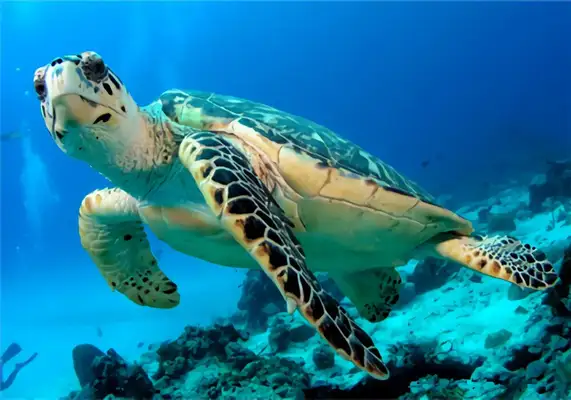
Although it is difficult to capture a man who lives in the deep sea, there are still a number of people who are moving towards him, which is difficult to protect.
Living in tropical and subtropical seas such as south-east Asia and the Indian Ocean. It is mainly inhabited by coastal coral reefs, bays, estuaries and clear lakes, with relatively shallow waters. nesting usually occurs in remote and isolated beaches.
It generally operates in waters above a depth of 18.3 metres and lives in several totally different habitats throughout its life cycle. Adults are mainly active in tropical coral reefs, where they enter and leave during the day in many caves and deep valleys, many of which provide them with rest. As often migratory turtles, their habitats range from vast seas to lakes to even mangrove swamps at sea mouths. Little is known so far about the preferred habitat of young adults in the early stages of life, but it is assumed that they live in the sea like other young sea turtles and do not leave their homes until they reach adulthood. It's about feeding.
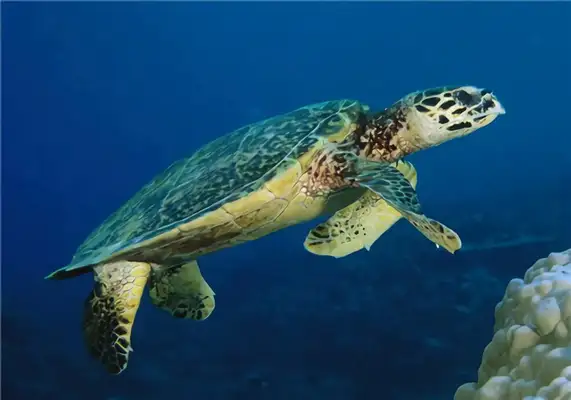
It's a very special choice of food, which also means that it's not easy to raise, but in the vast ocean, the food is still abundant. Do you know what strange creatures the catfish eat? I'll introduce you.
It prefers to feed on coral reefs, on the continental shelf, or on beaches full of brown algae. Although gills are groceries, their most important food remains sponges. The sponges account for 70-95 per cent of the total diet of the Carib population. Their diet is high, as in the Caribbean, where on average 544 kg of sponges are consumed annually. However, like other sponge-eating animals, the pelicans feed only a few specific sponge species, but other sponges do not become their food. The Caribbean is mainly looking for spongy spongy spongy, especially the skeletal spongy, spiraly spongy spongy, and resilient spongy spongy; the spongy spongy spongy species are known to be Geodia gibberosa (a sponge with many dents on its surface).
In addition to sponges, algae and stinglings such as jellyfish and sea anemones are also included in the food of the gills. They also prey on extremely dangerous aqueous animals. The gills close their unprotected eyes when they prey on the stingers, and the stingling cells of highly toxic animals such as the Monk jellyfish cannot be formed through the gills to the head, so that the gills are not threatened. Shrimp crabs and shellfish are sometimes hunted for, and their jaws are powerful enough to bite crab shells even very hard and thick, such as double shellfish. The mouths of the hyenas facilitate their feeding of shrimps and squid in coral cracks, and the mouths of the hyenas can easily hook them out.
They are highly resilient and resistant to their prey, and they feed on sponges such as Aaptosaaptos (dark red meat ball), chicken liver sponges, Tethyaactinia (green or brown green ball with occasional oranges), Speciospongia vesparium (dark red wine table) and host crab leather sponges that are highly toxic and often fatal to other organisms. In addition, the sponges containing silicon-rich bone needles, such as Ancorina, Geodia, Ecionemia and Placospongia, are selected for food.