Designation: PET1363
English name: Alexandre Parakeet
National origin: Myanmar, Thailand, Cambodia, Viet Nam
Vulnerability: respiratory, digestive and parasitic diseases
Life: Introduction to the Alexander parrot species 6-10 years
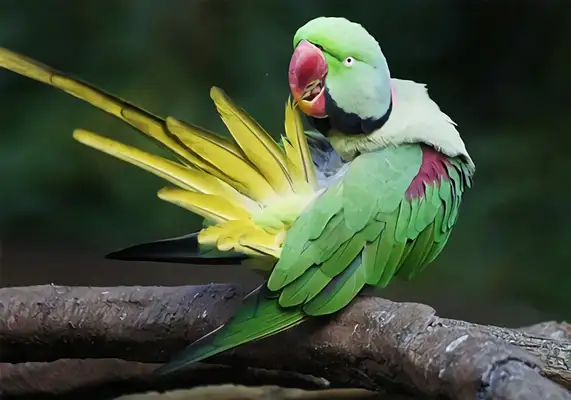
Alexander parrots are not the more common birds in the pet market, but they have many fans. One is that they have beautiful feathers; the other is that they learn to speak; and the third is that they have a good temper. Although Alexander parrots are distributed in many countries in Asia, their number is decreasing, and man-made hunting is one of the main reasons for their decline.
As for Alexander parrots, you may not know yet that they are the largest parrots in Asia, with a size of over 60 cm, and if you want to raise them, you might have to prepare a larger cage.
Compared to the wild Alexander parrots, artificially regenerated birds come to the home of the new master faster to adapt, and they are also more likely to breed the next generation.
Chinese literary name: Alexander parrot
Two words: Psittacula eupatria
Context: Animals
Gate: Pipeline gate
Programme: Birds
Look: Parakeet.
Section: parrots
Family: ring parrots
Cast: Alexander Parrot
Subspecies: 5 Alexander parrot morphological characteristics
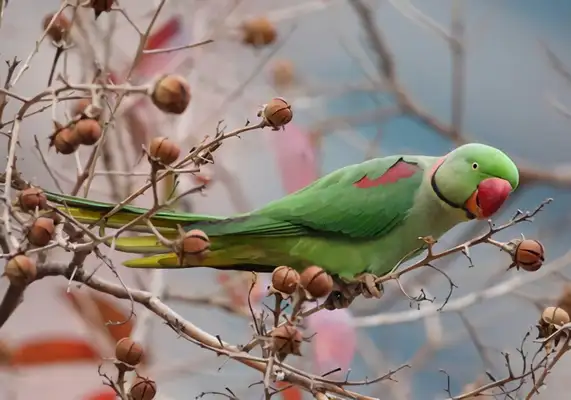
Alexander's parrots are large, not less than 55 cm in size and the longest individual can reach 62 cm. Because of their length, their weight is not too low, usually around 230 g for Alexander parrots. Looking far, you'll find this bird's colour is mostly green, and their beaks are visible red, but their beaks are not all red, and you'll see that the tip of their beaks is yellow.
Although Alexander's parrots are predominantly green, it does not mean that they will not have other colours of feathers on them, such as their cheeks and necks, which are not green, but grey blue; their outer wings, which carry a purple feather; their abdomen, which are yellow and green; and their tails, which are yellow at the end and inside, etc.
Like many birds, Alexander parrots of different sexes have different morphological characteristics, and female birds do not have black and pink ring feathers in their necks, which can be an important basis for identifying the sex of birds. It needs to be noted that young birds are more like females, but it takes at least 32 months to become fully birded.
Alexander parrot's morphological description
Size: 59cm or so.
Weight: around 230g.
Knees: Grey blue.
Pelican: Red, point yellow.
Iris: Yellow white.
neck: Grey blue.
Abdominal: Yellow green.
End: Yellow inside. Alexander parrot nursing knowledge
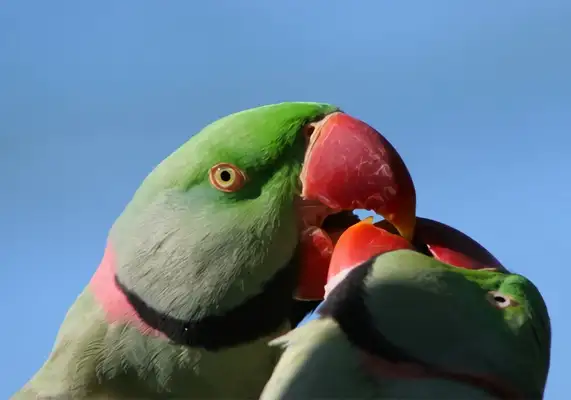
The parrots of Alexander prefer to communicate with their masters, and if the masters are not home for a long time or with the birds at home, they can easily be pecked and, in serious cases, their feathers may be completely pecked out. To avoid birds pecking, the master must interact with them. In fact, not only can interaction with birds avoid pecking feathers, but it also fosters feelings between you and the birds.
Of course, the cause of pecking is more than just the "lonely and empty cold" that can cause macaws to peck. As long as the plumb pecking occurs, the master must immediately find out the reasons and address them in a timely manner in order to avoid a more serious situation that you do not want to see.
In addition to the question of pecking feathers, another concern of the masters is the possibility of artificially breeding Alexander parrots. If you want to breed the Alexander parrots, then when you buy them, you have to choose the artificial birds, which adapt more quickly to the environment that humans provide, and therefore are not particularly difficult to breed.
The months of November to April of the second year of each year are the breeding season of the Alexander parrot, and if this is missed, the next cycle will have to wait. In order to provide a better living environment, the master needs to pay attention to the laying of the Parrot's nest. The nesting boxes of the parrots of Alexander may be somewhat different from those of some birds whose nesting boxes can be placed in higher places and cannot be too shallow. Since pro-bird care for young birds, it is essential that the master provide the pro-bird with adequate and nutritious food.
Alexander parrots, who breed themselves, can be better trained, and you can be astonished by their language skills as long as they can be properly guided. Alexander's Parrot Living Environment
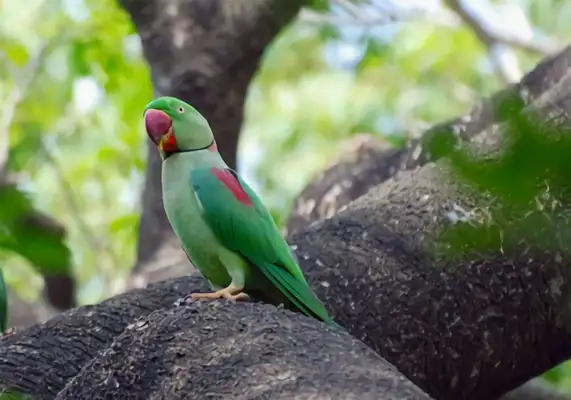
Perhaps in China, you don't see Alexander parrots very easily, but in countries like Thailand, Vietnam, Myanmar, you're probably much more likely to see Alexander parrots, because Alexander parrots are mainly located in these countries. And, of course, you don't see them anywhere. You need to know where they like to be.
As a rule, you do not have to look for them at high altitudes, because they live below a kilometer. Where there is more food, they are most frequent, like forests. In some places, however, Alexander parrots are farmers' “eye nails” because they feed on crops, so farmers may not see them as an impulse for pets.
In fact, Alexander parrots also appear in cities, such as less populated suburbs, more trees, and others have seen them. Although we rarely see a very large number of Alexander parrots gathering together, they usually do not appear alone, and if you see an Alexander parrot, there must be other Alexander parrots around.
When they are raised artificially, the master needs to prepare a larger cage for them, because Alexander's parrots are not small in size; secondly, Alexander's parrots may have more bite power than you can imagine, so you cannot mix them with other species; and thirdly, fresh branches for the birds not only allow them to bite as much as they like, but also as a toymaker. Alexander's parrot.
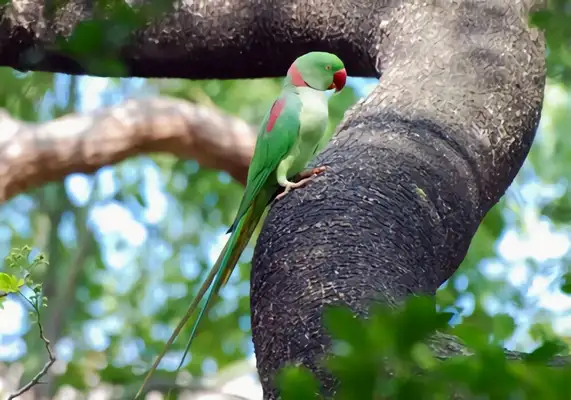
Alexander parrots who are not tamed by humans need to find food on their own and usually eat two meals a day — breakfast and dinner. In fact, for the macaws of Alexandria, feeding is not a very difficult task because the seeds, fruits and even flowers of plants are their favorite food. In some areas, Alexander parrots go to the farmer ' s crop areas to find food, which also gives farmers a headache.
Even when fed, Alexander parrots are not hard-to-breed birds, and they have a lot to eat, and Alexander parrots can grow healthy if fed properly. Alexander's parrot's staple food should be five grains, etc., while food like a melon may be a bird's favorite food, but it should not be provided as a staple food, but you can give them some during training.
In addition to the staple food, some fruits and vegetables can also be provided to the Alexander parrot as by-catch. However, some birds are very wasteful to eat, and they may simply bite and not continue to eat. The master needs to clean up the food that the parrot Alexander no longer eats.
In breeding, the owner can also see what the parrot Alexander likes and what he doesn't like. For birds, the food they like to eat can be supplied in an appropriate quantity, but it needs to be noted that some birds may like to eat it for a certain period of time, but after a period of time they may not like to eat, and the owner can adapt to the situation.