No.: PET6599
English name: Cyclura lewisi
Vulnerability: cartilage, parasites
Life: Overview of blue rock iguana species, 69
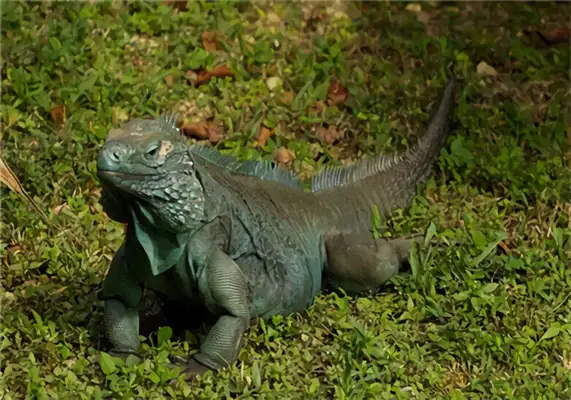
The blue iguana (Cyclura lewisi) is an endangered lizard from Grand Cayman, a typical reptile that survives in a hot environment. The blue iguana survives longer under artificially raised conditions, with a lifetime of about 69 years.
Chinese literary name Blue Rock Iguana
Two words:
Area: Animal
Gate: Spinal animal door
Amen: Vertebrata
It's called "Climbing".
Platform: Diapsida
FEEL: Squamata.
Lacertilia
Iguanidae
Iguana from Rock
C. lewisi
Distribution: Grand Cayman blue rock iguana morphological characteristics
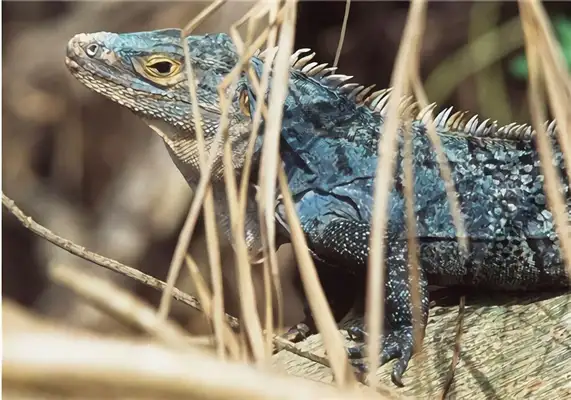
Blue rock iguanas are a magical animal with a light-sensitive organ on top of their heads, called a skull eye. The cranial eye is limited to basic retinas and crystals, does not generate images, is sensitive to light and is used to detect motion.
Blue rock iguanas reach full age of 2 metres and weigh 14 kg. 51-76 centimetres long and tails similar to body size. Toes are tight with each other. They help dig holes and climb trees. The male is one third larger than the female. The adult iguanas have dark gray to blue green skin, while the female iguanas have green to light blue olives. The young iguanas are either dark brown or green and have some deeper marks. On the back of the first-born child lizards, eight dark mountain stripes were found on the crowns from the neck to the hip.
The stripes gradually recede at the age of 1 year, turning grey and milk white and eventually blue. Adult blue rock iguanas tend to be dark gray, matching the rock colour of the surrounding Caster terrain. They turn blue when they're warning protection. Iguana's blue is more obvious. Their feet are black, compared to the color of their bodies. Iguanas have knots on their thighs that can release Feromon. The female has no knots and her back is not visible.
Blue rock iguanas have golden pupils and red filaments. It has an excellent vision to detect long-range shapes and movements. Since the blue rock iguanas have only a small number of sight rod cells, their vision is very poor in the dark. There are double cone cells, which are very sensitive to colour and can even see ultraviolet light. This capability is important for their sun-burning to absorb ultraviolet light for vitamin D production. Blue rock iguana living environment
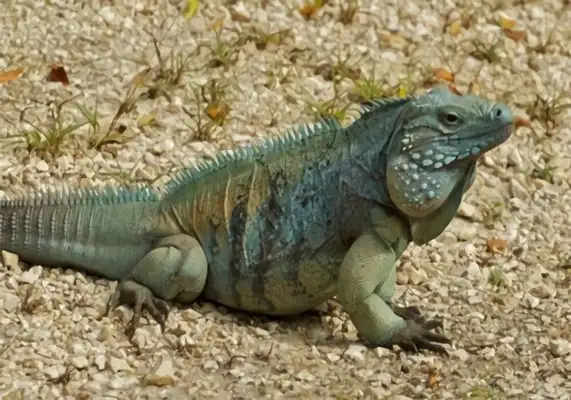
Because of the proximity of the blue rock iguanas to the equator, the sunlight there has been strong, so that they can meet their demands for UV and so that the blue rock iguanas are highly adaptable to temperature. So how do we create a similar living environment?
It takes long periods of sunlight to grow healthy when artificially raised, and it is best to raise them outdoors in order to provide them with sufficient natural direct sunlight. If blue rock iguana is raised indoors, sufficient UVB light must be installed in the rearing box.
Although blue rock iguanas are a very rare species, blue rock iguanas are not a difficult species to care for. On the contrary, the large iguana species, which can reach 150 cm, are strong enough to take good care of them in the way green iguana are raised. The only difference that needs to be made is that all iguana species are terrestrial and do not need trunks that are designed to climb like green iguana breeding environments. Blue rock iguanas are more moderate than other species of iguanas, which, because of their slow growth, can reach a life of 40 to 50 years if they are properly raised and, if their rareness is taken into account (and price-blind), are a type of iguana pet that is well suited to artificially rearing and collection. Blue rock iguana breeding knowledge
Blue rock iguanas are typical vegetarians, but at an early age they occasionally feed animals such as insects. But with age, it can gradually turn into a vegan lizard. Except during mating seasons, blue rock iguanas live independently. The mating is generally polygamy but may also be abusive or monogamy. During the reproductive season, one male dominates the range of activities of one or more females. Throughout the breeding season, the blue iguana skin was blue. In spring, male blue rock iguana hormones surged and decreased weight, and females usually avoided males. Until they start mating in May.