Designation: PET1039
English name: North American (Common)
Character: Fragile. It's aggressive.
Origin: Born mainly in Southern and Eastern Canada and extended to Florida Peninsula in Eastern United States of America to Texas.
Vulnerability: oral inflammation, aqueous disease
Life: 45-50 years
Price: Summary of species of North American crocodiles 500-800
There are four types of crocodiles, the best of the four, and the cheapest, producing a wide range of products, mainly from southern and eastern Canada, and extending to the eastern Florida Peninsula to Texas. Sales are made in many parts of the country, but are mostly wild because of unsuccessful cases of artificial reproduction. North American morphological characteristics of crocodiles
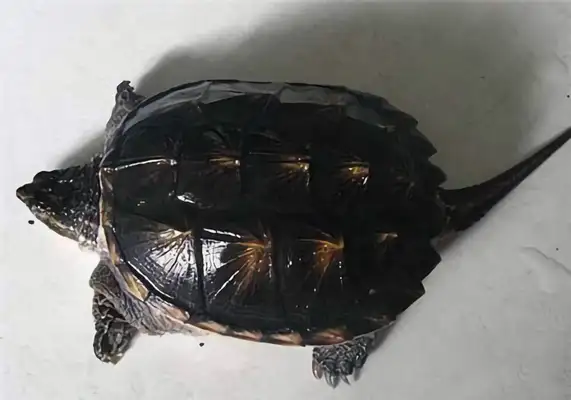
It's called a snake turtle and it's called a turtle. There are four sub-generic species, the most common one in North America, and the largest of the four sub-generic species that can grow to the top, which is very closely related to the blood of the mackerel in South America, and one of the most unstable genes in the four sub-generic species and most susceptible to mutation. North America's alligator-like, violent, aggressive, and a lot of turtles like it.
North American agure turtles can be broadly classified into three main variants, namely, white yellow, orange red and red eye.
I. Diversion of the white yellow system
The white yellow variant is what players call white and high yellow, whereas white and high yellow are part of the same mutation system. White to North America is characterized by corroded white, some with dark vests, some with white meat and others with white. Looking closely at the characteristics of white change, you can see that it's exactly the same as high yellow, some high yellow-backed dark, some yellow, and others all yellow, and it can be concluded that high yellow-temperature North America is the evolution of very dark white changes. While the two vary according to the same broad category, there are also differences in prices because of the wide variation in colour.
II. Orange mutations
Orange-red variants are what players call gold oranges and chili reds, which are actually the same variants, and are distinguished by the great differences in color. Most orange reds have radiation-like trajectories on the back of North America, which is very beautiful, orange North America with dark or orange yellow and red North America with chili red. Apart from the difference between the two, the rest of the characteristics are exactly the same, saying the most understandable thing, that chili is actually a very dark orange, and looking closely at both, you can see that there are many red scales in the orange mutated North America, and some oranges are relatively much more red. Although the same broad category of variation is the result of wide differences in colour and price.
III. Red-eye albinos
Albino red eye variation is extremely rare in North America, with full snow white, red eyeballs and no other colours. In fact, it's North America with albinism, where white animals are scarce in any species, like white tigers, white lions, white crocodiles and so on. So the price of albinos is quite high. North American knowledge of crocodile care
North American crocodile turtles mate in April-September, spawn in May-November, and in June, during the boom season. There are 11-83 eggs per nest, usually 20-30, white, ball-shaped, slightly rough, 23-33 mm in diameter and 7-15 g in diameter. After 55-125 days of hatching the shells, the conditions of hatching vary, and the number of days of hatching varies. When the incubation temperature is above 30°C, the incubation temperature is less than 20°C for females, and when the incubation temperature is 22°C ~ 28°C for males. The turtle weighs 9.5 to 12 grams, the back armor is 24 to 30 mm long, the back armor is round, black, and there is a bump on every shield. North American crocodile living environment
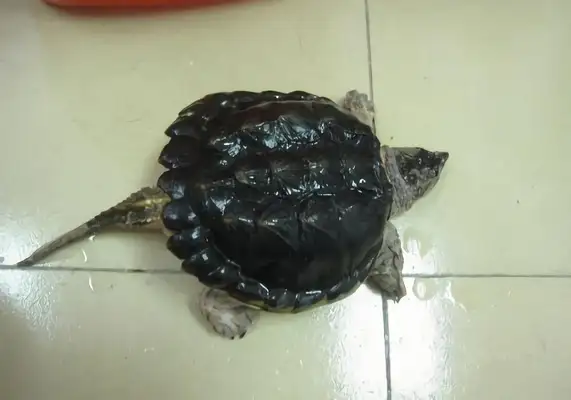
New tortoise fields in North America should be selected where water sources are good, the environment is quiet and transport convenient. The main species of turtle ponds are: turtle ponds themselves, table, land, drainage systems, water spills, among others, where land is mainly used to rest with turtles to build spawning grounds in the land section of the tortoise ponds.
The tortoise ponds are brick-laying cement structures, and the inside of the pool is polished with cement so that the turtle's skin is not bruised. A rectangular shape, typically east-west, north-south wide, can also be built. Size by location, 50-80 cm depth, not more than 120 cm deep. Ji Zhou's 8-10 cm escape back, also known as delay. The bottom of the rectangular pool is set to a high and low slope and the bottom of the round pool is set to a bottom of the pan, which allows for discharge.
One third of the table is watered, two thirds of the table is surfaced and is tilted to the surface at 30°, which is actually referred to as a slope in the underwater part, part of the water as a table, and, in the case of a tortoise pool, part of the water on the table is also able to guide the turtle to the spawning grounds. It is reasonable to set the table southwards on the north side of the turtle pond, with a width of about 2 m and a length of 80 per cent of the length of the pond. The spawning field is 2-3 m wide and is long enough to match the table with 20-30 cm deep sand. The laying of eggs above the spawning grounds in a rain-proof shed has facilitated the laying of eggs by turtles.
At least 10 cm in diameter into the drain pipe in order to speed up the discharge, while facilitating the discharge of sewage, bearing in mind that the drain must be under or near the table, where the most sewage is found and where turtles like to excrete. Water spills are located at the highest level above the walls of the turtle ponds, allowing for the discharge of organic suspensions and flash floods during the rainy season. Turtle ponds are constructed with repeated water-purification impregnation for at least one week to remove alkalinity. It is then sterilized with 150 ppm of lime and replaced with fresh water. North America's crocling point.
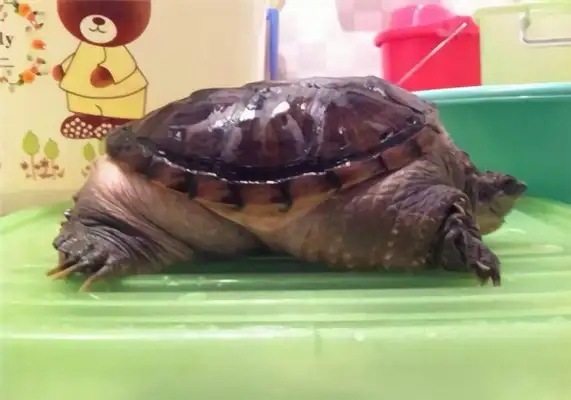
North American crocodiles are at least above their backs to feed in deep water, where their floating backs are flat, where they feed tortoises, red wire worms, when they're bigger, where they feed fish, shrimp, meat, and often sunbathe, which helps it absorb calcium.
North America's crocodile turtles are meat-eating animals. Of course it's fish shrimp. Eat less and absorb it. Do not feed seafood, seafood, because it is too salty and can cause part of the entrail function of freshwater turtles to fail. You can normally feed feed fish, muddock. Forage shrimp (small, largely transparent shrimp) is mainly supplemented by calcium and can also be used to improve meals.
North America's alligator is good. The principle of diet is conducive to its absorption. Too fat or bad unless you're ready to kill. The flesh grows too fast, the bones are slow to develop, the flesh is internally oppressed and creates an internal burden.
North America is highly adaptable, living at 3 ~45 °C water temperature, with 20 ~ 30 °C most active, 28 ~ 31 °C growing fastest, hibernation below 15 °C, and freezing to death under ice at 5 °C water, and safe winters at more than 1 °C. Croc turtles prefer to live in a quiet environment, with a mixed appetite for small animals and watergrass in water, and even decomposition of small animals on shore, as well as fresh leaves and guacamole. Feeds are fed by fresh fish shrimps, snails, sorghums, insects, earthworms, scallops, yellow powder worms, various animals, etc.