Designation: PET2715
English
Origin: United States, Mexico
Vulnerability to disease: decomposition
Life: Overview of turtle species over 100 years of age
There are six sub-species for each of the Carolina turtles, with different differences between the sub-species, and in recent years, due to the small number of tortoises and the multiplicity of tortoises among the different sub-species, the identification of species has become more difficult. Carolina turtles are distributed from eastern America to Canada and Mexico, and their most typical feature is its “box” shell. Caroline's turtles are mostly land-based, edible and extremely long. As a result of the destruction caused by human activities, their numbers are declining. It's also a state reptile in three states of the United States. Carolina turtle morphological characteristics
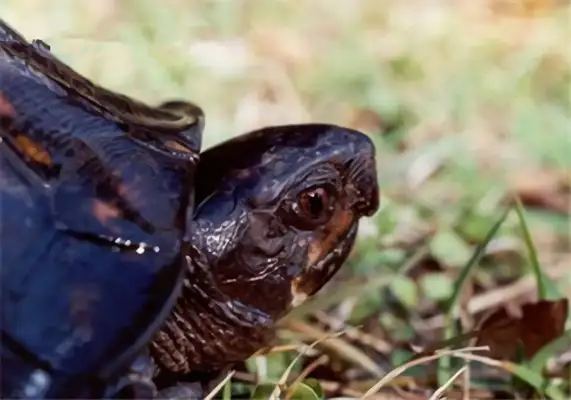
The whole of the Carolina turtle looks like a box, with six sub-species, with a difference between the backs of each sub-species, but the overall structure is unchanged and distributed across Mexico and the United States.
The most widely distributed box turtles in the United States are the eastern ones, with light yellow heads, black eyeballs and orange iris. Mouth tops. The backslids are high, the centre is elastic, the backslid colours consist mainly of black-coloured stripes and threads, and the edges of the backslids are reversed. There are large variations in the colours of individuals, i.e., the yellow abdominal, and black spots on each shield. The fragrance is connected to the chest shield, which is completely closed, with four limbs of yellow and brown, five fingers of the front limb, four toes of the back limb, yellow plaster and a short tail.
The male turtle crust is thinner, has a slightly longer shape, has a thick and long tail; the female has a tall back armour, has a more round shape, has a thin and short tail. There are six sub-species, and they vary greatly. Two of them are only from Terrapeine Mexicana and Terrapenecarolina Yucatana. The other four have a lot of breeding. Carolina Turtle Care Knowledge
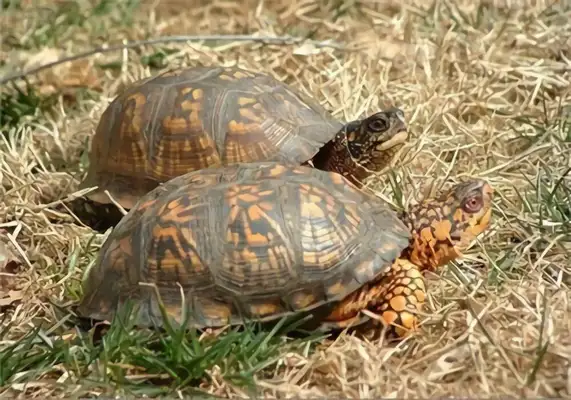
Carolina turtles are easy to feed at prices and tend to produce more, with eastern turtles most common. The provision of a good environment and reasonable food when raising the Carolina turtle will allow him to grow up healthy.
I. Cultivation of Carolina turtles
Carolina turtles are impregnable, with berries, larvae, earthworms, snails and insects as staples. In the case of animal proteins, which are generally fed 50 per cent by hand, such as cricket, breadworms, fish, etc., 40 per cent of green vegetables and fruit, 10 per cent of weeds, such as sorghum or platinum, have a large amount of food, and wild individuals can live 30 to 40 years and were selected as state turtles in North Carolina in 1979. Included in CITES Level II protection.
II. COLORINE TORTURE HOLDING
Carolina turtles sleep from the first year of life. Tortoises in the east and tortoises prepare themselves for hibernation. We can also choose to sleep in an outdoor cold house, in a refrigerator or in a dark room. In general, hibernation lasts between two and three months, depending on the place of birth. The temperature of 4-8 degrees requires attention to the need to keep the base very wet. Too cold a breeding environment can easily result in an acupupuncture of the ears of the turtles, which can be examined by crushing both sides of the head. And too cold and dry environments can cause eye inflammation. Carolina Tortoise Living Environment
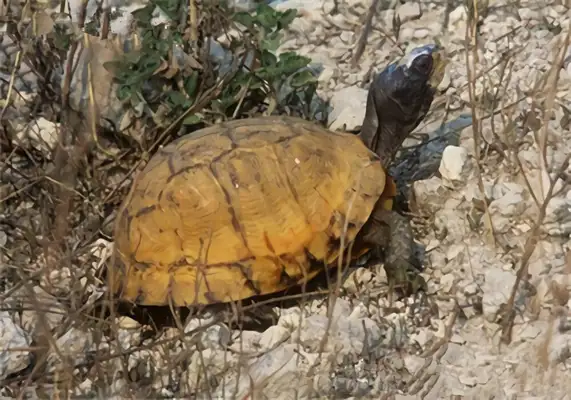
The environmental configuration of the Carolina turtle can be divided into two parts, one during hibernation and the other into a long-term environment, where the life of the Carolina turtle is tenacious and a reasonable environment can make it more adapted to artificial farming.
I. The setting of the Carolina turtle environment
What Carolena turtles need is a high-moisture and warm environment, so-called high-moisture, which does not mean that bottoms require water, but if bottoms are able to use straw or dirt, Carolina turtles will be very happy. The demand for water from Carolina turtles is quite high, drinking and bubbles, and therefore clean shallow dishes are always available to them in the environment. Their excreta smell is not good or easy to kill because of their culinary nature, and, worse still, they like to deal with the urine problem in the water.
II. Conservation of hibernation of the Carolina turtle
With regard to the winter environment, it is recommended that, if the temperature is not increased, it should be provided with a basin of soil, which would probably be more than twice as deep as the turtle's back armour, which must be water-rich, which would be okay to wet, and a place where turtles would be buried. You'll find that turtles love to hide in the earth, not necessarily hibernation, because sometimes when the weather is better, they find out. The earth basin is primarily a shelter for turtles to rest and maintain their physical functioning, and Carolina turtles are vulnerable to eye problems if they continue to be exposed in a dry environment, and if winter is wet and cold, turtles need a dark, wet place to rest. It is therefore necessary to provide such a basin in winter. The point of the Carolina turtle.
Caroline ' s turtles live mainly on land, with nightfalls and easier to trace after rain. They are groceries that feed near the leaves, logs and nests of some mammals, and sometimes eat animal rotting bodies. In the warm summer, Carolina turtles appear on the edge of the marshland, probably for the sake of summer cooling. When the body temperature is too high (approximately 32°C), saliva is sprayed on the body and head and cooled by evaporation. For unreachable limbs, they achieve the same end by urinating.