No.: PET5003
English name: Pitta Brachyura
Vulnerability: respiratory, digestive and parasitic diseases
Life: Overview of blue-wing eight-coloured species 6-10
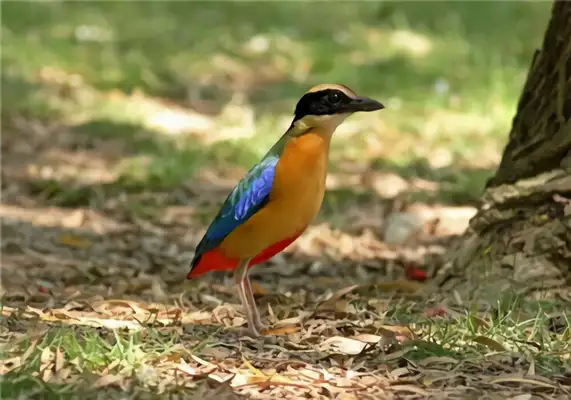
By name, Pitta Brachyura's feathers are made up of eight colours: red, green, blue, white, black, yellow, brown, chestnut, and so on.
The sound of blue wings and eight colours is simple moaning. The main locations are south-west China, south-east Asia, and winter in Malay Peninsula, Sumatra and Borneo.
Chinese literary name: Blue wing, eight colors
English name: Pitta Brachyura
Two words: Pitta brachyura
Area: Animal
Gate: Spinal animal door
Aves
"Passerformes"
Section: Eight-coloured piptidae
From eight colours to Pitta
Speculation: Blue wing eight colored P. Brachyura
Distribution: The characteristics of the blue wings of Japan, North Korea, Viet Nam, Kalimantan, Taiwan and mainland China in Henan, Anhui, Guangdong, Fujian, Shanghai, Chongming Island, Jiangsu, Hebei, Guangxi, Guangdong and Hainan
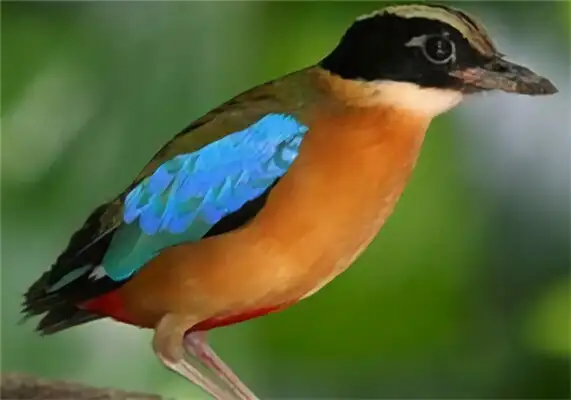
The blue-winged eight-coloured larvae, which is small, is about 18 cm in size after adulthood and should ideally weigh between 48 and 70 g. He's small, he's round, short legs long. It's a valuable bird.
The blue-winged eight-coloured body is famous for its colours, such as red, green, blue, white, black, yellow, brown, and chestnuts, which in fact have more than eight colours, with its forehead to its pillows covered with dark, brown hair, coloured colours, browsed with tea yellow, black eyes, cheeks, ear feathers and necks, and is linked to the back of the neck, forming a collar. The back is green, the wings, the waist and the tail feathers are pink blue. The lower body is light tea yellow and the centre of the abdomen to the end of the plume is red. In the jungle, these patches of feathers are combined with the colours of nature such as sunlight, green leaves, velvet flowers and prism, thus becoming a special protective colour.
The blue-winged eight-coloured larvae is a small bird with strong mouths, long and flat sides, short necks, and an inner bicep pair to the central part of the bronchial half-ring. The tail feather is short, the legs are long and strong, and the surface is smooth.
Ion membrane is dark or brown, eye-skin blue, mouth-blank or black, tan or pink. Blue wing, eight colored environment.
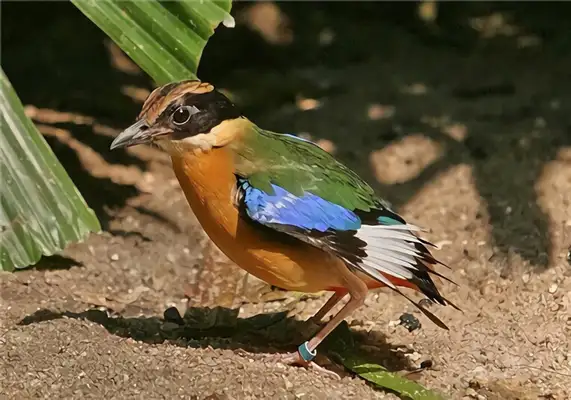
The small blue-winged eight-coloured bird is very attractive because of its shape, not only as a valuable bird viewer, but also as a pet bird of the breeder ' s choice, and the family breeds the bird ' s advice in setting up the breeding environment according to their habits in the wild.
They are also found in various types of forests in the wild, mainly in flat dams and hilly leaves below 200 metres above sea level, in bushes and small trees along the stream of forest, in plumes and small trees on the edge of the village, and in environments such as bamboo forests.
Blue-winged eight-coloured larvae would be best raised with a pickled cage, which is not suitable for other bird cages. Blue-winged eight-coloured larvae do not require a daily bath when raising a baby, once in two, three days in the summer and once in the winter week or so. Cages and cages are often cleaned and the birds kept clean so that their colourful feathers can be fully displayed. The toes of blue wings and eight colours are prone to corrosion and frost and are carefully protected. At winter and early spring festivals, care is taken to maintain temperature so that birds are not frozen. Blue-winged eight-coloured larvae.
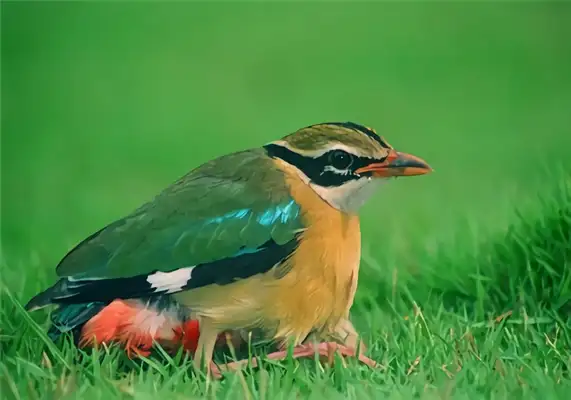
Blue-winged eight-coloured larvae belong to groceries, which usually feed animals without eating. In the wild, they are fed mainly by small animals such as beetles, termites, fins, insects and earthworms, and thorium, where home-grown feed can begin to feed worms such as earthworms, snails and shrimp, and then gradually replace them with powder. The powder is mixed with peas and corn powder with two meats. In addition to the powder, the worm or earthworm must be fed the following day. Not less than a third of the powder.
Blue-winged twigs tend to move in pairs during the reproductive period, and when the wedding rings continue, the breasts, necks and tails move up and down and play with each other, sometimes standing on branches and jumping to the ground to eat with their feet to the ground, cutting down the leaves, moving quickly, being very sharp, and occasionally sounding, the male and female move quickly. At the end of the exchange, the female stood on a tree about 2 metres above the ground, and the male flew quickly to the female's back, the female was not moving, the female was crouching down, the male fanned his wings, kept his balance and turned his tails, at which point the two birds stopped ringing. The female remained standing in place after the turn, and the male flew to the other branch, to prepare each other's feathers and then to the ground for food.
In late May, the camp was nested in the high natural broad leaf forest and a small number was selected in the artificial forest. The nesting is shared between the male and the female, and one of the pro-birds removes the ground weeds and leaves from the nest with two claws, forming a pit, while the other is searching for nesting material on the ground within a distance of 30 metres around the nest. First, the dead branches of the trees, such as the maple and the chestnuts, are built into a platform base on the pits on the ground in order to maintain the stability of the nests, which do not roll along the slopes of the nests erected above, but are also protected against the tide, and then a spherical ground nest is built around 20 centimetres in diameter, approximately 7 centimetres in diameter, 15-19 centimetres in depth, with thinner weeds, leaf handles, pine needles and leaves on the front of the nest, with small shrubs or basalms.
Each nest lays 5-7 eggs, which are milk white, mixed with a patterned spot in the dark and dark of purple brown, with relatively few sharp ends, thicker blunt ends, 26 x 23 mm in size and 5-6 g egg weight. When the eggs are not fully laid, the bird does not sit on or move around the nest and does not hatch until the last egg is laid. Incubation is shared between male and female, and they are both highly nesting. When one of the pro-birds hatches, the other is on a tree near the nest or on the ground, screaming and warning. When a pro-bird hatches, it starts with an alternation, then the nesting pro-bird comes out of the nest, and the other one goes into the nest several minutes apart.
The incubation period is 15 days, after which the male and the female are expected to grow together for about 13 days. When they come back for food, they do not go directly to the nest, but rather stand on a tree four metres away from the nest and see if there is no danger around them before quickly entering the nest and putting food into the mouth of the chick. When the chicks first came out of the shell, they were only 5 grams, 46 mm long, hairless, closed eyes, yellow lips, fleshed feet, visible plumes and naked areas. By the time of flight, the body weight of the chicks had increased to over 50 g and the length to over 90 mm.