Among snakes, there are some 3,000 or so snakes around the world, many kinds of snakes are harmless to humans, about 15 per cent of snakes are toxic to humans, and some of them are deadly.
In the home of a resident of South Africa, the Rovina dog that they raised was a little off-the-shelf, always barking at the couch, and when someone wanted to sit on the couch, the pet dog always came to push the master away from the couch, and the master saw it, feeling that there was something behind the couch that kept the Rovina dog vigilant and afraid.
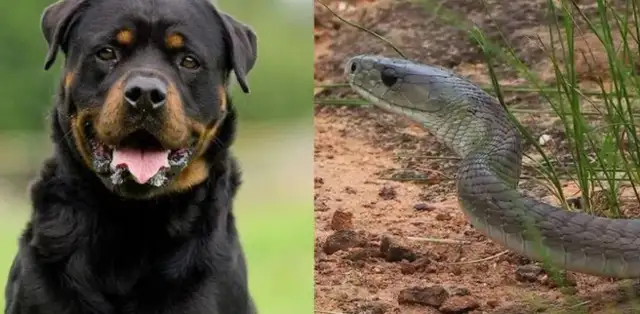
When the master slowly moved the couch, it was no wonder the dog barked, and there was a snake almost two metres away, the mouth of which was completely black, where the Black Manba Viper and other viper were clearly different. When the snake was seen, the man was afraid to come near, the Rovina dog was moving a bit, constantly provoking the snake, and the owner was quick to pull the dog out of the door and notify the catcher to catch the snake.

The Black Manba Viper is the fastest climber in the category of snakes at a rate of 16-20 km/h, or 4.5 m-55 m/s, and it is dangerous to look at humans ' own speeds and face them. But the Black Manba viper has no advantage in the face of the snake hunter, who is experienced in controlling the snake and taking it away.
Dogs are also very alert in animals, even pet dogs, whose sense of smell is much higher than that of humans, and who are warned by the intrusion of unknown organisms, as in May 2022, in a sub-district of the Zhuang Guangjiang River region, there were no signs of an anomaly at the beginning of the building, and it was a pet dog who kept barking at the building that drew attention. It took a closer look to find out why the pet dog was so upset, that there was a big guy in the building — the king cobra — and the fireman arrived to control the three-metre-long cobra.
The Black Mamba, which belongs to Cobra, Mamba, is the next of four types of snakes: Hemamba, Green Mamba, Jane Mamba, and Green Mamba in the east. They are tree-dwelling, highly virulent snakes, of which Hemamba is the most toxic, temperate, and of which the world is known to be the largest, with hemambas having an advantage in Africa if it is not faced with immunovenging beads, foxes, etc.
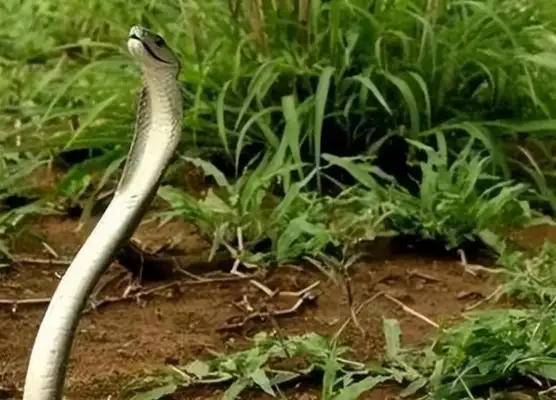
One of them, known as the fierce battle of snakes from the Black Manba Viper, was the war between the African Namibia Nature Reserve, the lion and the Black Manba Snake, which had just begun with an adult female lion challenging the snake as if it were a “cat to win the snake”, but the black manba body was more than 3 metres long and its response was slow, and the lion had unfortunately been bitten by a snake to the left front, and the lion had subsequently been paralysed in pain, for about an hour, and the lion had been completely poisoned.
The venom of the Black Mamba snake is composed of neurotoxins with a detoxification of between 100 and 120 mg, most of which are injected under LD50, is 0.28 mg/kg, but it is inevitable that only one or two of the more false ones (the lower the value of LD50, the higher the toxicity), i.e. the Blackmamba snake usually has 20 drops of venom in his tox, but only two drops of it are needed to cause death, and it is possible to die within 30 to 60 minutes if a person is bitten without a cure.
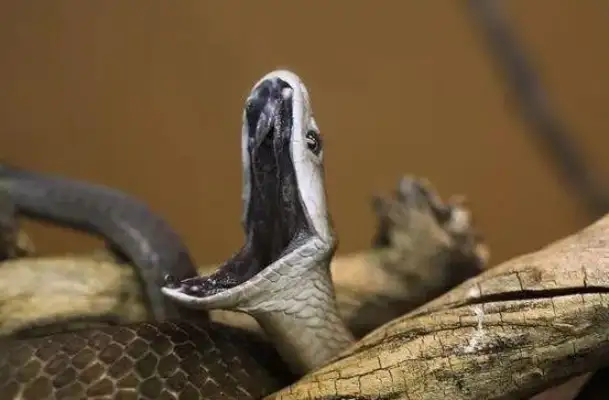
The Black Manba snake is considered to be one of Africa’s most dangerous and notoriously coloured snakes, but the Black Manba viper is not the most murderous viper. In a study of Africa’s Viper, the drums hurt the most, but the Black Manba viper has the highest mortality rate, with 11 deaths, at 5.2 per cent, and seven cases of Black Manba bites recorded, all of which appear to be fatal.
As for the data that emerges, on the one hand, the widest distribution of the drums, the largest number of them, and their ability to disguise, the fact that they do not run directly from people, and on the other hand that they are caught on one foot, that the Blackmamba snakes bite immediately, and that the narrow distribution of them, usually hide in trees and sometimes flee at speed, make it less frequent for the Blackmamba snakes to attack people, that the base number of bites is smaller and that the fatality rate is high, but it is also important to note that the snakes are not provoked and are promptly taken to a nearby hospital.