No.: PET3820
English name: Spotband butterfish
Origin: Central to Western Pacific
Vulnerability to diseases: albino disease, rotting tail disease
Life: 4-5-year overview of butterfly species
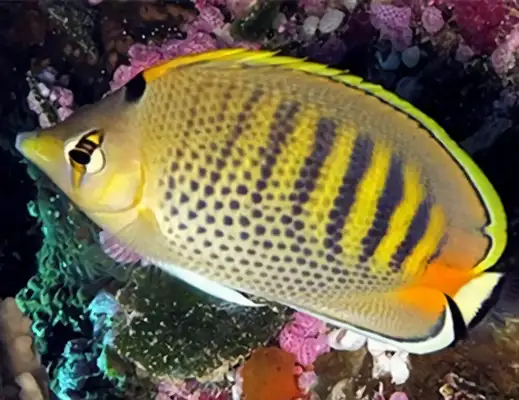
Butterflies are mild and groceries, and they are easy to raise, so they are suitable for some new fish friends. It is important to note that laced butterflies are not fed in coral casks because they can eat a lot of coral worms.
It's commonly called "Tigers."
Name: Banded Butterfly Fish
English name: Spotband butterfish
School name: Chaetodon punctatofasciatus
Distribution: Central to Western Pacific
Water temperature: 24-27
PH: 8.1-8.4
Proportion: 1.020 - 1.025
Compatibility: danger
Emotion: Moderate
Minimum aquarium size: 190 litres
Food: commotion
Length: up to 12 cm
Difficulty: Easy
The species are: seawater fish, irradiated fins, tusks, and the shape of butterflies.
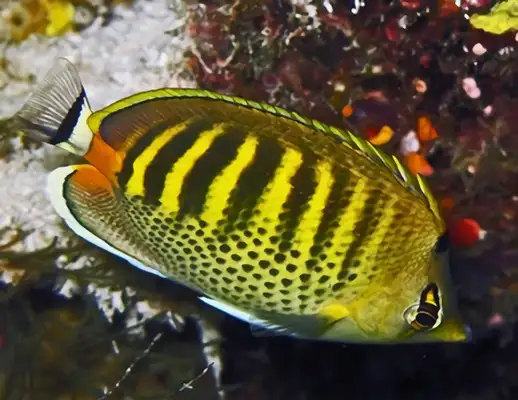
The size of the banded butterflies can be about 12 cm, so the smallest aquatic tank size for the banded butterflies is 190 litres. The banded butterflies are gentle enough to mix with other fish. Since laced butterflies prefer to live in clean waters rich in corals, since they like to eat coral worms, they require watergrass to provide shelter.
The banded butterflies are flat on their sides, with a black spot on their backs, yellow on their heads, a golden ribbon on their eyes, the dark strips on their sides disappear midway, with dark spots in their sides and abdomen, and when it becomes a fish, the back becomes yellower, with the tails darker to yellow. They live in the clean waters of corals. Banded Butterfly Fisheries Environment
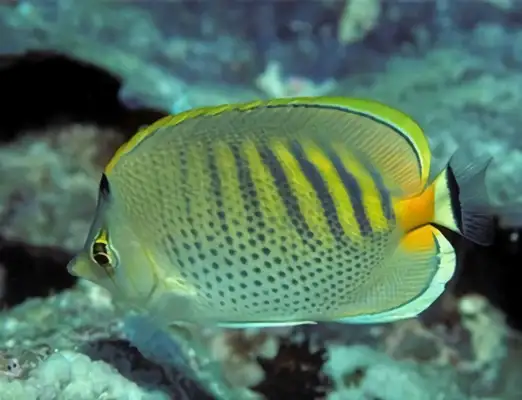
Banded butterflies belong to the visual species and are not used as food. It is easy to mix and not easy to breed because of the temperate nature of the banded butterflies. Scabber butterflies originate in clear, coral-rich areas of 1-45 metres, so they need to be raised in a suitable environment for their survival.
The water temperature suitable for survival in laced butterflies is 24-27°C, the PH values are appropriate at 8.1-8.4 and the water weight is optimal at 1.020-1.025. Banded butterflies tend to live in clean coral-rich waters, often in coral reef areas and occasionally in subtidal coral reef platforms. However, since the banded butterflies eat a large number of coral worms, it is not possible to raise them in coral casks when they are planted. Banded butterflies are impregnable, and a wide variety of foods include varnished invertebrates, coral worms, algae fragments, etc. Battery butterflies.
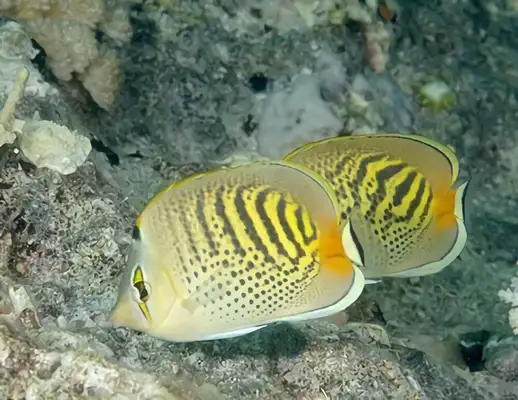
Banded butterflies, which survive in the wild, eat almost everything, are a variety of groceries, but in an artificially raised environment, what to eat for banded butterflies requires the fish friends to think about.
Since the banded butterflies like and can eat most of the atolls, they are not fed in coral casks if they are raised manually. The range of food available for laced butterflies that survive in their origin is very high and depends mainly on coral worms, small benthic invertebrates and algae. In the case of artificial breeding, it is possible to feed laced butterflies with algae, as well as cybernetics to train laced butterflies to eat vegetables, which ensures digestive intestinal tracts. In fact, good recipes can help the banded butterflies to color and grow healthy.