Designation: PET1218
English name: Overview of iguana species
Sea iguana, alias Galapagos, or a blunt iguana, prefers to live in the sea, often in marshes and mangrove areas where they can feed. The main distribution is currently in the Galapagos. On the coast of the Galapagos Islands of Ecuador, sea iguanas inhabit a reptile that looks like prehistoric animals, which at first glance is frightening. Some call them dragons, not dragons, but sea iguanas. Sea iguanas are the only iguanas in the world that can adapt to the sea. Like fish, they can swim freely in the sea. They drink seawater and eat seaweed and other aquatic plants. Sea iguana morphological characteristics
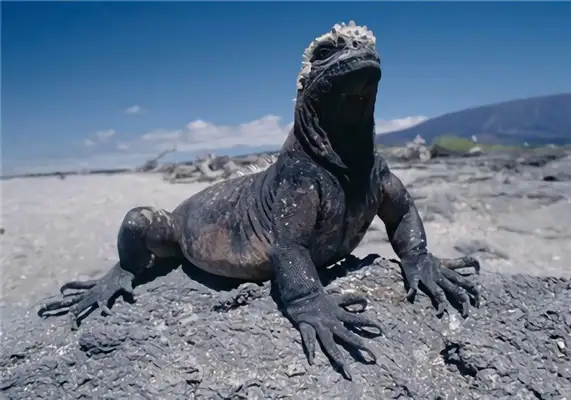
The shape of the sea iguanas is very similar to that of the dinosaurs, with their adult size between 2 and 3 feet, and the appearance of lazy oceanic appearances, which often appear on rock beaches with black skin colours and a salt-covered sea iguana on their heads.
In fact, sea iguanas are not necessarily black. The back fins of the juvenile lizards are lighter. Males also have different colours in different seasons. In the southern islands, males during their reproductive period are relatively bright and can be red and green; in Santa Cruz they can be red and black; and in Fernandina they can be dark and red.
Sea iguanas vary in size from island to island. Fernandina and Isabella are the largest, while Genovesa is the smallest. Adult males are approximately 1.3 m and up to 1.5 kg, while females are 0.6 m.
On land, sea iguanas are clumsy, but they are flexible in the water and swim with strong tails.
The mean length of adult males is about 1.3 m and the mean length of adult females is about 0.6 m; the weight is about 1.5-5 kg.
There are seven species of sea iguana in the Galapagos Islands. The reptile has a longer body, the longest being 150 cm or more. The island of Spain, in the south-east of the Islands, has a significant difference from the other six species of iguana in the Islands, where male iguanas have red, yellow and black marks of three colours, with dark green legs, feet and crowns, while other islands of the Islands have no bouquets and are green or yellow.
The claws of sea iguanas are long and sharp, so that not only are they able to climb firmly on the rocks on the shore, not to be swept away by waves, but they are also able to crawl locally and search for food in a sea-flowed sea floor.
The length of the iguana tail is almost twice the length of the body. Long tails provide enough power to swim.
Sea iguanas are seen dragging dirty snots, which are unhygienic. Actually, it's salt from the sea iguana. Sea iguanas.
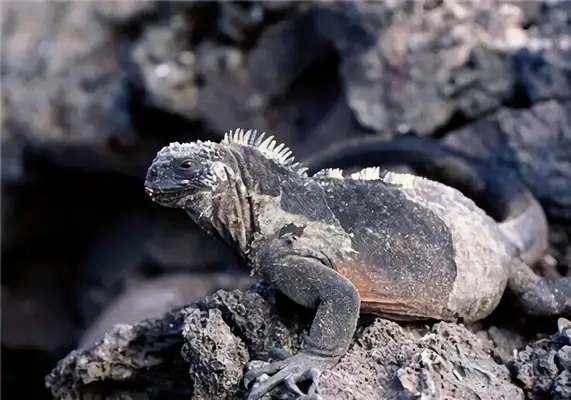
Because sea iguanas are often found in seawater, living in long water leads to a high dependence on sunlight, and it is good that the skin of the iguana is black and helps to absorb heat. In order to address this weakness, there is often a bluff as a result of the slow movement on land and the consequent greater risk.
Volcanic rock areas on the coast are the most suitable lizards for living in the sea. Because of the cold-tide zone surrounding the Galapagos Islands, the species must be able to dive into the sea for food within a short period of time after sunbathing to achieve higher body temperature. After landing, the body temperature still needs to be raised by sun bathing. The female will fight to take the right spawning land. 2-3 eggs per fetus.
Guuana lives only in the Galapagos Islands. The adult sea iguana can grow up to 1.5 metres long. The iguanas have a flat tail, which is almost twice the length of the body. The long tail gives the iguana enough power to swim. Sea iguanas often search for seagrass and crustaceans washed up by sea water along the coastline of the islands. The molluscs attached to the reefs on the coast are also delicious for sea iguanas. The sea iguanas also go to sea often to hunt. Sea iguanas consume excess salt when eating seaweeds, although sea iguanas can remove excess salt in a special way. A special part of the iguana's nose is called the salt gland, which, in chewing, separates the excess salt from the food in its mouth and excretes it. So sometimes people see sea iguana sneezing, and white crystals are sprayed out, actually in the genus.
In order to adapt to the need for diving, the body of the sea iguanas evolved into features different from those of other lizards. For example, in order to reduce the spread of heat during diving, they can reduce the speed of blood circulation. (The temperature of the sea water is typically 20°C below the temperature of the iguana.)
Sea iguanas are a magical animal, especially when confronted with enemy objects, which are slow because of their large size. Interestingly, the iguana automatically regulates the heart rate, which slows when it dives; when it rises to the surface, it accelerates. In anticipation of the imminent arrival of sharks, it is possible to stop immediately the beating of the heart and make it difficult for enemies to detect them. The sea iguanas are all gray. However, the colour of the body of the sea iguana, which is in love, will change from grey to black and will grow red spots.