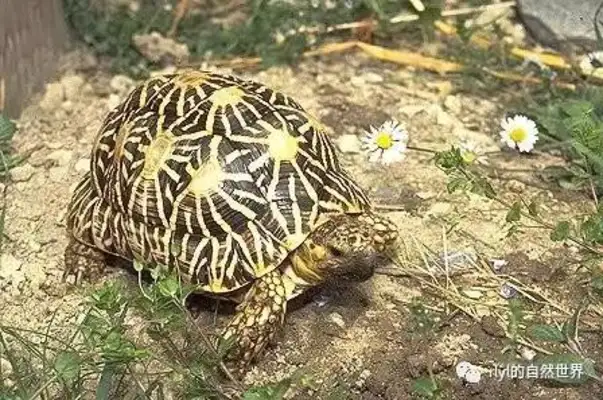
The Indian star turtle (Geochelone elegans) is a medium-sized turtle originating from the Indian subcontinent, Sri Lanka and Bangladesh. This turtle is named after its beautiful star pattern. The pattern of stars usually shows a beautiful line between yellow and black, like stars in the night sky. Indian sea turtles are terrestrial animals that usually live on dry, tropical grasslands or forest margins.
Adult Indian turtles are about 25-30 cm in size and typically weigh between 4 and 5 kg. The hard and arched shape of their shells not only helps them to defend themselves against external abuses, but also allows them to retreat into the shell when threatened. Character characteristics
Indian turtles have a soft internality. They are not as active and quiet as other turtles, prefer to stay in the cold and occasionally come out for sun. Like other turtles, Indian turtles are more conservative and avoid conflict with other animals.
In the field, their main activity time is morning and evening, where they come out for food and activities. They have a strong sense of territory, and once a foreign similar or other animal approaches, they reach out and slowly climb to warn each other.
While their character is relatively moderate, care should be taken to maintain sufficient space for breeding with the same turtle or other reptile in order to avoid struggles caused by narrow space or competition for food. Livestock skills environment settings
Indian star turtles are tropical species that like warm weather. There is a need to ensure that the temperature of the turtle house is appropriate when raising it. The temperature in the day should preferably be between 28 °C and 32 °C and not less than 20 °C at night. In order to provide sufficient warmth, heat lamps or hot mats can be placed in turtle houses. Tortoises need adequate shaded areas for their rest and summers to avoid excessive sunlight. Humidity management
Indian sea turtles are drought-resistant reptiles, but their need for moisture cannot be ignored. Maintaining moderate humidity is essential for their health. Generally, humidity is desirable between 50 and 70 per cent. Humidity can be maintained by regular fog spraying, but it is necessary to avoid over-humidity to avoid turtle shells decomposition or fungus growth. Tortoise area
Indian turtles need enough space to move and find food. A suitable turtle house should be sufficient to avoid being confined to too small a space for long periods of time. If conditions permit, the outdoor natural environment is the ideal option. Outdoor habitats can provide natural sunlight and grasslands to help them better carry out their daily activities. Catering
Indian sea turtles are herbivores, which feed mainly herbs, fruits and vegetables. Their staple foods should include high-fibrous plants such as grass, platinum, platinum and platinum leaves, or occasional provision of calcium-rich vegetables such as cabbage and broccoli. You can add a proper amount of fruit, like apples and oranges, but you should avoid overdose. There is a need for regular replenishment of calcium powder, especially for juvenile turtles. Complementation of calcium contributes to the development of their bones and shells.
It should be noted that Indian sea turtles are not suitable for high starch foods (e.g. potatoes, carrots, etc.). Too much protein can also affect their health. Water management
Although Indian sea turtles live in dry environments, they still need adequate drinking water. The provision of clean drinking water is important to ensure that water sources are not contaminated. You can set up a shallow water basin for drinking water and cleaning the shell, but regularly clean the basin to avoid bacteria breeding in the water. Health screening
There is a need to periodically check the health of Indian star turtles, especially if the shells are damaged or decayed. If the shells are split or softened, they may be caused by a high level of environmental wetness or food imbalance. Regular cleaning of turtles, sludge and residues in clean shells can effectively prevent breeding of parasites. Hair care
Although Indian sea turtles do not have hair, the maintenance and cleaning of shells is also important. The shell surface covers the angular layer and protects its soft tissue from external harm. Regular cleaning of turtle shells is necessary during the breeding process. Light and clean turtle crust surfaces with soft brushes to remove accumulated dirt and algae. Be careful not to use any corrosive cleaning agent to damage turtle shells.
If there are signs of minor cracks or softening in turtle shells, some mineral oil or special turtle shells may be appropriately used for their maintenance. This not only helps to keep the shells bright, but also effectively prevents them from cracking. Summary
Indian sea turtles are a mild, beautiful and relatively easy-to-breed reptile that suits experienced pet owners. They can live a healthy and happy life at home through the provision of an appropriate environment, a reasonable diet and periodic health checks. In breeding, careful management and care can give this mysterious little animal the most beautiful face.