No.: PET1540
English name: Green iguana
Vulnerability: cartilage
Life: Overview of species of green iguana 5-6 years
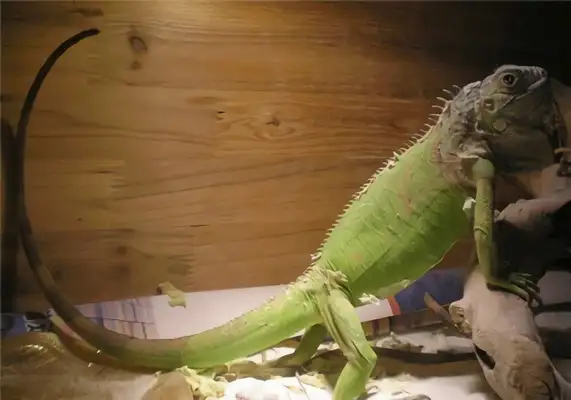
Green iguana, born in countries such as Central and South America, Mexico and Paraguay, is one of the most popular reptiles in the United States, and can be seen in most pet stores in the United States. Artificial green iguanas live for more than 20 years.
Chinese literary name: Green iguana
English name: Green iguana
Latin name: Iguana iguan
Area: Animal
Door: vertebrate door.
Amen.
The reptile.
I've got eyes.
Iguana!
A green iguana.
Distribution: Origin: Characteristics of green iguana patterns in Mexico-Paraguay, Central and South America
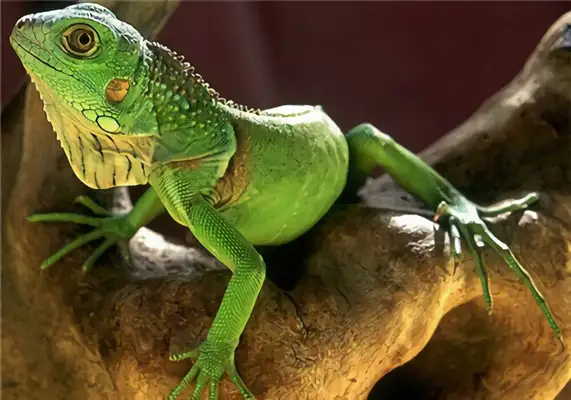
Green iguanas are typical tree-dwelling lizards and have been one of the most popular pets in the United States, growing up to about two metres in size and weighing about eight kilograms. They also have different colours at different ages.
The bodies of young green iguanas are generally green, which they use to escape from the eyes of the predators; as age grows, the green fades, replacing them with light yellow, light blue or brown. The main physical characteristics of the green iguana include corsets on the back, black ring stripes on the tail and large, downslided throats of adult males. In the field, the lifetime of the green iguana is generally between 10 and 15 years, and individually longer; the life of the artificial iguana can be over 20 years. Green iguana living environment
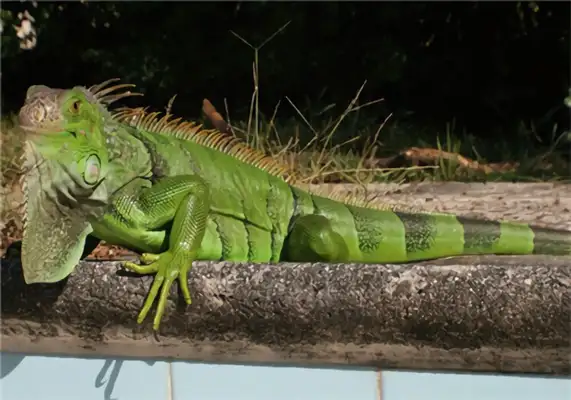
Green iguanas are heat-resistant reptiles that grow faster, with larger post-adult shapes, and need enough room for family breeding. The setting up of a living environment for green iguanas is particularly important.
Typically, most people use fish tanks as breeding tanks for green iguanas, which are the most readily available and readily available. An iron cage can also be used as a rearing box, as well as wood and glass windows. If you use the fish tank, the ventilation will be bad. It's not cool to use iron cages.
I. Size of rearing boxes
If you have enough space, you should be able to provide large rearing boxes as much as possible. Green iguanas are tree-dwelling animals and spend most of their time in the wild on trees. When they were still young, they were relatively active on the ground, so that as they grew, they were increasingly climbing. As a result, rearing boxes should be higher rather than longer. The following is the minimum size of the rearing box: the height is equal to its length (with tail) and the length is 1.5 times its length and the width is 2/3 of its length. The green iguana can then climb, walk and turn more freely. If it's too small, it'll get a mental atrophy.
II. Ventilation
Ventilation is often neglected. If it's a feeder box made of barbed wire, ventilation is certainly not a problem. Even a glass tank with a glass lid could be used, but not a fish tank with a full seal. If you want to use the tank, you should use the one with the vents next to it, so that there is good ventilation.
III. Humidity
Green iguanas are lizards that survive in the hot and wet regions of Central and South America. Higher humidity benefits their skin, but it is difficult to maintain high humidity in an artificially raised environment, not only because of the complexity of the equipment to maintain high humidity, but also because it is difficult to maintain hygiene in this high temperature and humidity environment. Because of the high temperature and humidity, as well as food, excreta and so on, bacteria are easily grown.
Humidity is maintained: a water basin, large and small, can be placed in a rearing box, or can be wetted, etc.
Temperature
During the day, sun dots of 32 ~ 35°C and 32°C are more appropriate, with a maximum of 35°C, temperatures of about 28°C at other locations in the box and 25 - 28°C at night, up to 30°C; humidity: over 60 ~ 80%.
V. Climbing
To provide branches in boxes, green iguanas can climb. A branch better be thicker than a green iguana. Put the branch inside the box along the diagonal line.
vi. Lamps (UVA heaters, UVB lamps, night lights or ceramic lamps)
1. Heating and lighting (UVA heating lamps)
Many address both heating and lighting. Incandescent lamps are heating and lighting. Placing a light on an corner of the box can create an environment with a temperature gradient. Under the lamp is a place of sunbath so that i-green i-guanas can warm themselves here in the morning. It would be useful to have thermometers at different points in the rearing box so that the temperature of the whole box is known. In general, the coldest location in the box is around 80 degrees Fahrenheit. In general, green iguanas require an internal temperature of at least 10 hours per day at 88 degrees Fahrenheit to ensure that they perform normal digestive functions. It would be preferable not to put the light directly in the box, because it would be easy for green iguanas to climb on the light, causing burns. Green iguanas are digested by bacteria in the body, which require a higher temperature to function, and it is therefore necessary to ensure sufficient temperature, otherwise the green iguanas will lead to malnutrition due to indigestion.
2. UVB lamps (UV)
It's very important that green iguanas get tanned into UV. They need to synthesize vitamin D3 in their skin through exposure to ultraviolet light, while D3 promotes calcium absorption. Sunshine is the best option, and UV lamps (especially UVB lamps) must be prepared for them if sunlight is not possible. It is important to note that the UV is not exposed to the green iguanas from the glass or the organic glass, because these substances are very low on the UV and a thin glass can remove 95% of the UV. Don't look at UV lights with your eyes, because too strong UV light is harmful to people.
The UVB lamps are used during the day and are irradiated for 6-8 hours per day, with UVB options 5.0 and 10.0.
3. Night lights
The night light is a model of the moon light, which is soft, does not affect sleep and is suitable for all night feeding environments. Basic heat for reptile life and digestion is provided and can therefore be used to heat up the green iguana at night.
4. Ceramic lamps
Ceramic lamps, which do not glow, can also be used for heating at night, but since they reduce environmental humidity, care must be taken to ensure humidity.
5. Photocycle
The light cycle simply means how long a green iguana takes to shine a light every day. It is generally recommended that they be exposed to 14 hours of light and ultraviolet each day. However, it must be ensured that the night is dark and lightless, and that the long-term lights make the green iguana nervous.
6. Advances
The principles for the selection of mats are easy to clean and dry. Many people like to use newspapers to make mats because they can throw them away when they're done. In any case, other materials, such as wood shredding and sand, which can easily be swallowed wrongly, are not used.
Reference to gaskets: floor + PVC waterproof cloths; points of tile reverse green iguana feeding
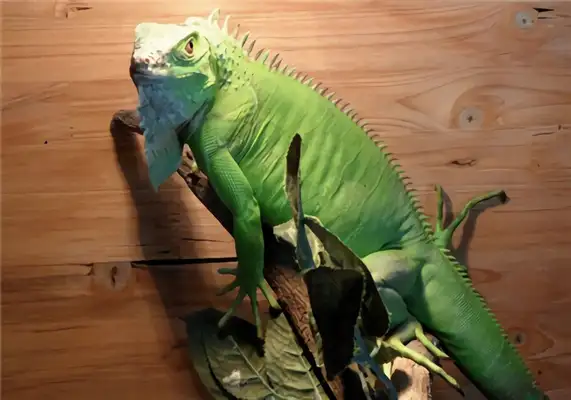
Green iguanas are typical herbivores, which eat only plants in the wild and are mainly made of leaves, flowers and fruits. So it's a problem for the family to feed the diet. We'll give you a detailed description of how we feed the green iguana.
Food diversity
Unfortunately, the green iguanas have no access to food they eat in nature under conditions of artificial breeding. So we must provide them with sufficient and correct food to ensure that they grow healthy and do not get sick. In providing food, attention must be paid to the diversity of food, so that the green iguanas receive balanced nutrition. Green iguanas are prone to illness due to nutritional disorders, such as calcium deficiency, if they feed a single food over a long period of time. So it's important to provide the right food in breeding.
How to feed
The size of your green iguanas should be determined by how small the food is. Food should also be fully blended, as the green iguanas have a selection behaviour, and if they are not mixed, they choose to prefer food, which leads to malnutrition.
Time of feeding
Green iguanas should be fed every day, at the best time between 9 and 11 o'clock, because the green iguanas need to warm their bodies in the morning (natural or artificial) and then start eating. In nature, however, green iguanas are fed after noon, but there is no harm in having food ready in the morning so that the iguanas can eat at any time.
IV. Calcium powder
Calcium powder is the best source of calcium for all reptiles and amphibious pets, consisting of D3 without phosphorus and D3 without D3, and is recommended for use. Gravity of calcium into powder and food mix.
V. The food basin
It is used to place the food that the green iguana needs every day.