“The more urban human beings become, the further away from nature, the greater the importance of pets in human life.” As the zoologist and Nobel Prize laureate Conrad Lawrence once said.
The recent boom in capital markets has also been a fitting one. In Hong Kong, the cloud group in the transformational pet track has grown by 14 per cent over the past two days, and the shares of A Zen dollar pets and Ei-Ji shares have continued to grow, and the pet economy index has increased by more than 20 per cent in 11 trading days, becoming a beautiful landscape in the stock market.
Behind this phenomenon is the shift in China's pet economy from “small consumption” to “hundreds of blue sea”. According to the 2025 White Paper on the Chinese pet industry, the domestic pet market grew at an average of 13.3 per cent per annum between 2015 and 2024, significantly above the average rate of GDP growth over the same period.
When “downing” becomes a social normal, when “pets are humanized” reshapes the logic of consumption, this emotional economic wave is quietly rewriting the dual rules of capital and consumer markets.
From survival to emotional consumption, the economy is raging.
At this moment, “cat-sucking dogs” have long been an integral part of many people's daily lives, and many cats and dogs “eat and eat” and make a lot of Internet friends wonder about the “good days” of their pets.
According to White Paper data, the urban pet (dog and cat) consumption market grew by nearly 7.5 per cent in 2024, surpassing the $300 billion mark and reaching $30.2 billion, with a small 4.6 per cent increase in the dog market and $15.57 billion in size, and a 10.7 per cent increase in the cat market and $144.5 billion in size.
With the growing maturity of the concept of pets, the number and consumption of pets in the country has begun to grow rapidly, and the role of pets has begun to shift accordingly, moving away from the orientation of “home-care homes” in the family, towards role attributes such as “children, loved ones” and becoming emotional attachments to foster care.
Moreover, the two major structural transformations that contemporary society is experiencing are also clearly driving. The first is the acceleration of the emergence of single society, which, by the first half of 2024, had a single population of more than 240 million, including more than 90 million adults living alone.
Second is the advent of a moderately ageing society. In 2024, the population aged 60 and over accounted for 310 million people, or 22.0 per cent of the population, of whom 220 million were aged 65 and over, or 15.6 per cent.
These two groups are the main people who fill the emotional gap through “humanization”. After 90 per cent, the average monthly consumption of pets is concentrated in mid-class $100-500 and above $500, and the number of people holding birthday parties for pets is not small; the silver hairy are more willing to pay for scientific pets, and the refined whole chain demand is growing significantly.
That is why pet consumption has also begun to shift from “survival” to “enjoy”. The average annual consumption of a single pet jumped from $2,500 in 2015 to $5,800 in 2024, of which the share of food fell from 68 per cent to 52 per cent, while the share of non-essential consumption, such as medical (22 per cent) and services (18 per cent), continued to rise.
This trend is highly consistent with Japan's transition from a “second consumer society” to a “third consumer society” in the 1990s: When per capita GDP breaks down a certain threshold, the pet economy begins to enter the Quality Phase, and the break-in of sub-routines such as smart equipment and high-end medicine begins.
At the same time, local governments have been active in the development of pet-friendly cities. Shenzhen launched a pet-friendly bus H239 line, and Shanghai piloted a high iron pet shipping service. Chengdu built a “bright carnival” park.
Overall, the outbreak of the pet economy was no accident, behind which there was a triple resonance between the rapid demographic changes, the wave of consumption escalation and the changing societal emotional needs. The single population of 240 million and the single economy of 310 million silver hairs promotes the evolution of pets from “functional animals” to “emotional families”, while pet-friendly urban construction and the penetration of smart technologies allow industries to break through traditional boundaries.
So where is the “New Continent” in the hundreds of billions of blue seas when pets begin to refine?
Where is the New World in the hundreds of billions of blue seas?
From a revolution in the network of smart cat sandbasins to a medical upgrade in pet oncology, from a functional breakthrough in geriatric feeding to end-of-life care services for pet burials, an industrial division around a subdivision of scenes is accelerating the restructuring of market patterns.
On the one hand, the continued expansion of the plentiful market has made the “it economy” more powerful. According to the White Paper, by 2027 the size of the urban pet (dog and cat) consumer market will be over $400 billion, reaching $404.2 billion, with a compound growth rate of 12.6 per cent for 2015-2027.
On the other hand, in terms of breakdown, pet foods and pets have taken the lead in health care, constituting the two core pillars of the “economic” sector.
In 2024, the pet food market was 15,851 million yuan, representing 52.8 per cent of the total size of the pet economy, and the pet health market was 84,060 million yuan, or 28 per cent. Between 2018 and 2024, the health-care complex growth rate for pet foods and pets averaged 10.06 per cent and 16.39 per cent, showing strong consumption dynamism.
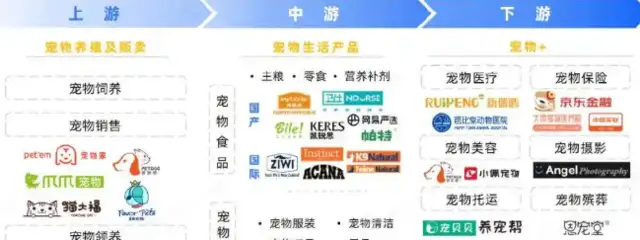
Among them, the mid-range pet food track is in the process of a two-nuclearly driven high end. In the main food and functional foods market, the international brand Royalty (Mart) is responsible for the scientific formulation of foods (e.g. calves, urinary foods), which currently account for 20 per cent of the total and continue to dominate high-end markets.
In contrast, the rise of local brand-based national production is also strong, with a middle-end share through a “functional formulation” of “price-for-money” and an online channel that outpaces foreign brands across the board.
For example, McFuldy, a good pet, has been at the top of the list for the fourth year in a row, with the city's share rising to 7 per cent; the new brands, such as Sui Lan and Blue, have increased their GMVs by over 100 per cent, and Frigate has been in fourth place with a 190 per cent increase in sales.
The downstream pet medicine is moving towards specialization and standardization. Data show that in first-line cities, new-line cities and second-line cities, more than 60 per cent of pet cats visit.
In the field of biomedicine, pet cancer vaccine, genetic detection techniques are commercialized; 16 health indicators can be monitored in real time by the Internet collar for intelligent manufacturing. For example, green bamboo organisms have entered into strategic cooperation with Tianjin Ripp, and will cooperate in the area of pet monodrugs and genetic engineering vaccines.
And downstream pets and service boards are also moving towards intellectualization and personalization. For example, products such as smart feeding devices, automatic cat sandbasins, smart environmental monitoring systems, and pet robots are precisely addressing the complex needs of modern-day pets. By contrast, traditional deodorant has increased by 35 per cent over the same period, while the increase in intelligent deodorant has been as high as 1246 per cent.
Today, high-end and national production alternatives are the main melody in the food and health industries. The main food market has been upgraded from “saturation” to “functionalization” and the health sector has increased the service premium through specialization and chainization. At the same time, innovations in smart equipment and services have become new growth poles. The high growth narrative of the pet economy has shifted from “wild expansion” to “structural fragmentation”.
How does the market behave when the “New Continent” surfaces?
When markets move from “incremental competition” to “precise positioning”, how does an enterprise build a moat in a high-air track? The strategic layout of companies listed in the capital market may reveal the logic of future industry.
As pet consumption moves from “functional satisfaction” to “emotional interaction”, two core groups drive demand fission. On the one hand, the Z generation's "precision pet" has created a wave of intelligence.
The data show that after 90-00 the percentage of pets is over 60 per cent, the average annual consumption of first-line cities alone is $3,200 and the penetration rate of smarts is over 25 per cent. The emergence of AI, on the other hand, furthered the early warning of diseases and facilitated the evolution of smart hardware from “passive response” to “active health management”.
Many brands are beginning to focus and try to integrate into AI technology in the context of the trend towards the intellectualization of products and services. For example, the branded Petkit ' s smart feeder supports AI voice interactions, with users viewing pet feeding on a real-time basis through App, with single sales exceeding millions in 2025.
And the cross-border giant, millet, beauty, through the middle- and low-end markets of the supply chain niche, pet pets, Hogman technology, and hardware innovation, rapid pupil technology, which provides algorithms plus data solutions, build the pet universe.
The second is that the silver-haired “accompaniment economy” activates low-line markets. Second-line urban consumption increased at a rate of 22 per cent, with older groups contributing over 18 per cent of the medical consumption of pets. For example, the “silver foster care package” launched by the Yellowpool pet shop in Shanghai continues to be available at a 50 per cent increase in holiday prices.
Moreover, the demand for elderly pet consumers is directed towards the quality, quality, nutritional health of pets and the high demand for safe sex. In 2022, 78.7 per cent of pet owners considered the nutritional balance to be important when feeding, and 65.4 per cent considered the need for regular intake of health products to prevent diseases.
Corresponding to the medium-sized shareholding, which focuses on the positioning of “food for peace”, follows the technical route of “food for baked and fresh meat” and actively builds its own IP system and leads to brand break-ups. By 2024, 4,465 million yuan had been earned, representing an increase of 19.2 per cent over the same period. The net profit of the mother was now $394 million, an increase of 68.9 per cent over the same period.
The Ai nutrition feeding system, introduced by a good pet, customizes the diet to pet genetics, not only in terms of technicality but also in terms of dietary well-being, moving out of its path of differentiation, with a 60 per cent increase in the unit price of the counterpart.
In addition, industry competition is shifting from “product competition” to “situation monopoly”. For example, the Shenzhen Joint Pets Hospital's “Pet+medicine” complex is growing at an annual rate of more than 50 per cent, and the “Pet+Tourism” service (the “Pet+Purple Room” for the South) now covers 20 cities.
The range of radiation on industrial chain connections is also increasing. Upstream raw material enterprises (e.g., the petrochemical degradable cat sand project) worked with branders to promote an increase in the share of environmental supplies from 15 per cent in 2025 to 30 per cent in 2030.
Driven by a hierarchy of demand, firms are building barriers to competition through technological differentiation and landscape monopolies, while industrial chain linkages drive industries to green and eco-upgrade.
When emotional consumption becomes the core battleground, how can enterprises balance technological investment with business returns? From the algorithmic revolution of smart hardware to the precision development of ageing products, from the pet universe scenario experiment to the re-engineering of global supply chains, the industrial transformation around “precision” is testing the strategic stability and innovation of participants.