Designation: PET6408
English name: Humphead Cichlid
Origin: Deep water zone along the coast of Zaire, north of Lake Tanganyek, Africa, now known as Congo
Vulnerability to diseases: albino disease, rotting tail disease
Life: Overview of six Saïlan species, 4-5
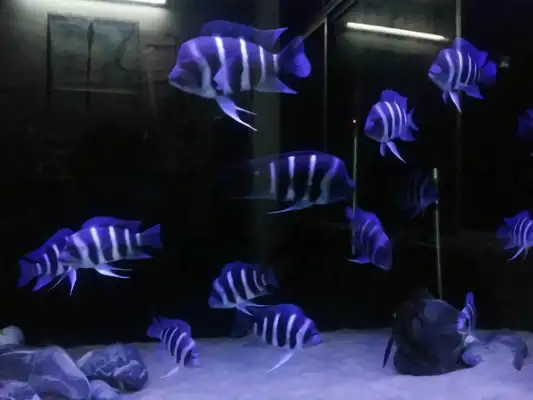
The six Sai Blue fish are one of the world's most prestigious fish viewers and one of the most famous of the 10 or so species of Lake Tan. They were first introduced by Taiwan, and Zaire was translated into Say due to different translation habits.
Chinese: Six Saylan
English name: Humphead Cichlid
School name: Cyphotilapia Frontosa
Origin: The six fish exteriors of the deep-water area of Saïlan on the coast of Zaire, northern Lake Tanganique, Africa (now known as Congo)
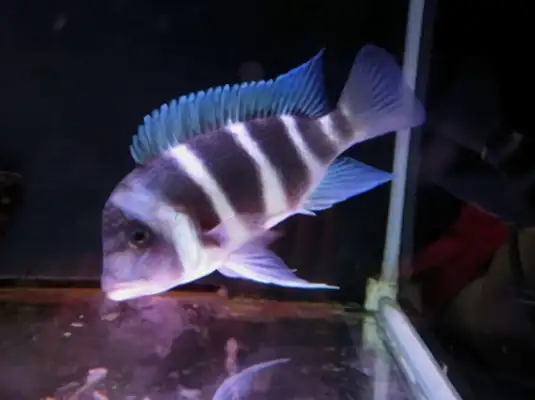
Of the six species, six are undoubtedly the most beautiful, and therefore the price is naturally very good. Many traders would sell six of the six Manpos and six of the six Burundis for the six of the Say Blues, so how should we distinguish between them?
The blue, black and white colours of the Saï blue six juvenile fish age are already quite obvious, the blue and bright, the first black line in the head is a standard triangle, the tip is just beyond the lower edge of the eye, and when it's in good shape, the gill is very bright blue; the black line in the manpo six juvenile fish is not so dark, it's a little brown, especially the first line in the head, it's not a full triangle, and the bottom line is above the eye, and the most striking feature of the manbo six is a black line between the eyes, not a standard triangle like the six of Say Blue.
Six of Saï Blue in good shape, black, white, blue, bright on the body, the edge of the black line should be neat, clear, relative to the arc, and the distribution of the six lines on both sides should not be too different, if it is fully symmetrical. The wild Saïlans will be more popular, not only in colour, but also in black bars, which can reach even one third of the back fin. There are sometimes small variations in six individuals, such as white spots on the black line, curves on the line, and, very rarely, six on one side and seven on the other. Six fish breeding environments in Sayland
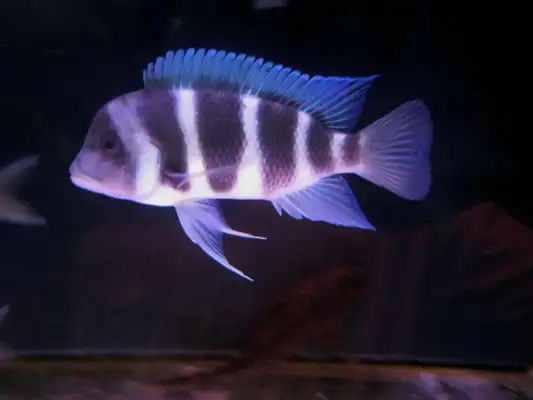
The six Say Blue fish are a valuable species, but they are beautiful in colour and appearance, and only scientific breeding can make the six Say Blue fish show their beauty. So what should be done to make the six Saïlan fish look better in terms of raising the environment?
The six houses in Say Blue are large, strong, disease-resistant and generally healthy in aquariums with good water quality adjustments. Six homes — Lake Tanganyek — are known as alkalin lakes, with a PH value of 8.0-9.0 and a hardness of 8-15. For northern China, especially its friends who use groundwater as a source of water, raising six units has become a relatively easy task, so that running water can be easily adapted to this appropriate range.
Also of note is the need for salt to be added to the six Saïlans. Because most of the geological formations around Lake Tan are limestone, and through the brushing of rivers, a great deal of calcium and salines are dissolved in the lake ' s waters. As fish evolve year by year, their body organs are fully adapted to this high-hardness and salty water environment, which is virtually non-existent in the lake ' s water. As a result, 10-15 grams of salt should be added to every 100 litres of water in the environment. With the right water quality, the six of Say Blues will certainly show an amazing beauty. Six fish feeding points for Sayland.
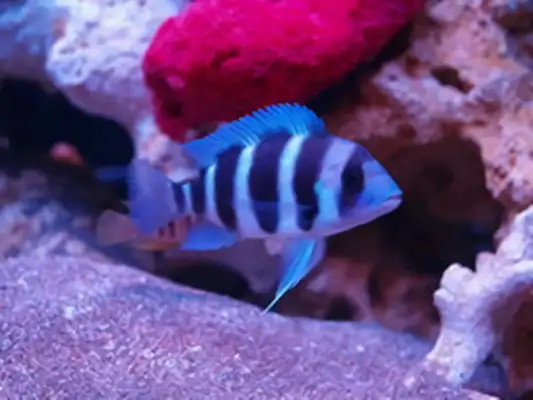
The use of transparent aquariums to feed the six Saï blue fish is not pleasant, but it is important to note that the six Saï blue fish do not try to mix with any mackerel fish. How, then, should the scientific feeding of the six Say Blues be done?
There's a diversity in the feed that feeds six Saïlan fish, and shrimp is the most recommended here. In addition, care must be taken to ensure the hygiene of meat feed, and during the three years that we've been feeding Say, we find that red bugs and shrimps are far from as terrible as we thought, as long as you can guarantee the hygiene of meat feed, without feeding artificial feed.