Designation: PET2722
English name: Amy duraaustralis
Nature: Moderate non-aggressive
Origin: Australia ' s largest sea turtle
Epidemic: white eye disease, calcium deficiency
Life: More than 50 years
Price: Overview of the size of Australia ' s head curvy turtle species 2000-18,000
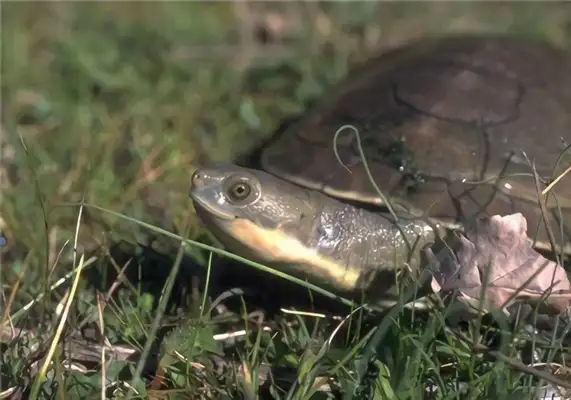
Australia's giant crotch turtles feed on animals. Living in shallow water, occasionally climbing over land. By the dry season, they sleep in the pond mud until the rainy season. Wild Australian curvatures eat large amounts of mosquito larvae and are therefore very useful animals for people. The scarcity of quantities and the tight control over capture and trade in their products.
At the time of breeding, a water tank of at least 100 gallons is required for the smaller males, while for the larger females 160 gallons are required. They're good at swimming, so it's better to have large sites like ponds and ponds. The water needs to be as deep as possible as the turtle can get out.
Latin name: Amy duraaustralis
Length: 14-16 cm
Weight: 50 kg
Body characteristics: The distinction between females and males can be distinguished by the tail. The male has bigger tails than the female.
Practice: Australia ' s largest water turtles require a relatively long period of maturity, with male turtles taking at least five years and female turtles growing for about eight years. The female has 5-10 eggs, which can be produced 2-3 times a year.
Food: meat.
Care: In an artificial environment, live baits such as water turtles and shrimp, bread worms and crickets are very much in love and growing very quickly, and they are also very fond of sunbaths, requiring stronger lights for indoor feeding. They are also more appropriate to the herds and less likely to attack each other. Precious turtles can freeze red bugs and water turtle feed as staple foods, which is less difficult and suitable for starters.
Purchase instructions: Owing to the ban on all wildlife exports from Australia, most of the turtles that can be seen are captured by the New Guinea wild communities in Indonesia.
Reproduction: morphological characteristics of the cobblehead of Australia
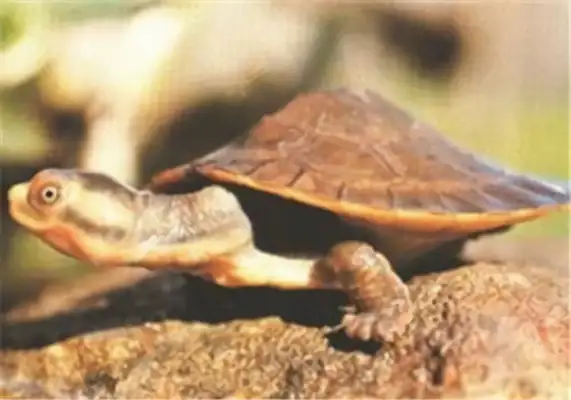
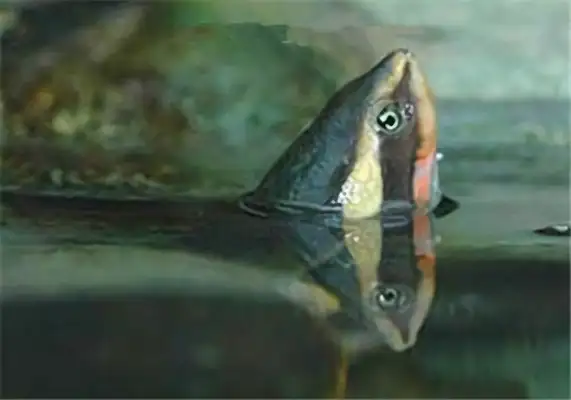
Australia ' s large head curvature turtles are found in Australia (the combined name of Australia, New Zealand and the nearby South Pacific islands), with fissure-free mid-to-carbon grays. The abdomen of the abdomen, the bridge and the abdomen of the arctic edge are marked by bright grey and pink. The head is dark gray, yellow stripes behind the eyes and bright coral red patterns at the bottom of the jaw.
The larvae of Australia ' s larvae are colorful and degenerative. The size of turtles usually does not exceed 8-9 inches.
Australia's large-headed crotchback turtles have a smooth, flat rectangular back armor, 2-4 guilders are dimmed inside, and the cones are wide as adults. The first cone is the longest and the smallest one is still the fifth. The fifth cone is the fifth one, and the fifth cone is slightly taller than all the coated tails, with brown to black, large abdominal armour behind them, covering almost all the backs.
Australia's large crotch-capture tortoise throat shield is very large, separates the larynx shield from the other, and separates the two-brand part of the bridge wide, covering one third of the abdominal armour, the abdominal acetal ale, the bridge, and the edge of the shield is black, the head is short and the jaw is flat with no hole in the skin of the head rough, and a pair of the chins have a lot of cones bursting around the neck, with the front of the front leg covering the large piece, which is thicker than the female tail. Australia's Big Head Crawl Turtle Care Knowledge
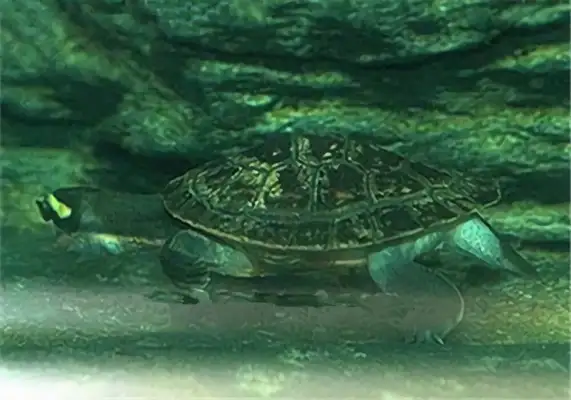
Australia ' s large crotch turtles grow faster, with 50G larvae growing more than three times the length of six months. And a grown Australian crotch turtle is much less beautiful than a larvae. The color fades, and the head stripes decrease. It is therefore appropriate to control the feeding when it is done for the purpose of viewing.
It is best to make it natural to hibernate in winter. Australasia has high water quality and sensitivity. Feeding with piped water is prone to decomposition, so it is appropriate to use old water. It is also necessary to keep the sun on a regular basis and to keep the UVB for permanent indoor feeding.
Australia ' s large crotch turtles lay between 7 and 14 eggs at once, with an incubation period of between 42 and 49 days. Their nesting behaviour differs significantly from other turtles originating in Australia. The turtles climbed to the land early on and patrolled between the grass for two weeks until they found a suitable spawning site. In contrast, Australia's crotch turtles crawled on land once or twice -- usually at night or in the morning. A shallow nest was then quickly dug, often between the grass, making it difficult to find the eggs.
Female turtles bury their nests in a very rough manner and do not press the soil with their abdomen. The nests are usually found by the mud that was excavated during nesting without being filled back. Female neck turtles take four hours to lay their eggs and bury their nests until they are satisfied, while Australia ' s large curvatures are only about an hour from the beginning to the end. Their nests are readily known compared to snake-neck turtles, whose nests are almost undetectable because they are so good at disguise. Australia's Big Head Crawl Turtle Living Environment
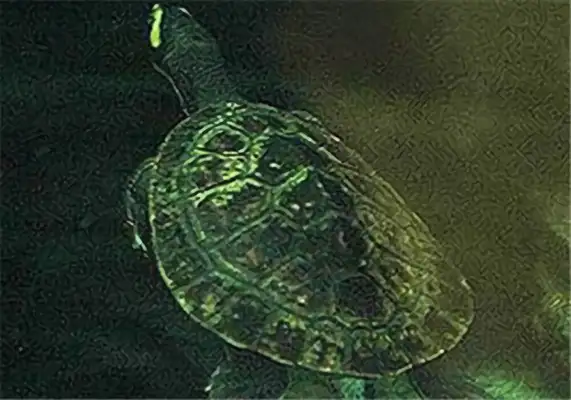
Australia's head-cap turtles are highly aquatic and rarely leave the pond except for sunbath and nesting. They are mundane sunbathers who stay in the sun for hours or under heat lights. Outside, they were the first to come out in the morning and the last to return to the water at dusk.
I. LIGHT REQUESTS
In the interior, they take sunlight under the light of a 75-watt spotlight, but natural sunlight (unglassed) is better for them. In the absence of natural light, UV lamps (for wide spectrum light) and incandescent light bulbs should be used that can hang above water tanks. Softwood bark, plastics or other forms of slope should also be provided so that turtles can climb out of the water or support them during night sleep.
II. SIDES, SIDES
Green land is best built by the pool, with a 15- to 25-degree slope between the pool and the green ground, and cobblestones in the slope. Faces, which prevent the wear and tear of turtles' abdomen, also allow turtles to climb. The landscape of green land is supposed to be quite important, so that it can respond well to the pool, so that some grassland plants and short shrubs can be planted, so that the proper emplacement of fake mountains can be pretty good for the landscape, and little animals like earthworms and snails can feed turtles themselves. Food basins can be operational, and individuals find it more appropriate to place them between green ground and reservoirs, thus facilitating daily clean-up.
III. Sand pool view
The sand tank is designed to be simple and simple, but it is not easy to put it in place at least four square metres in a sand tank, which should be 20-30 centimetres thick, and where turtles lay their eggs in about 10 centimetres of sand, sometimes deeper, reaching 15 centimetres, so laying 20 centimetres thick in the sand tank is the minimum; and setting up 4-6 poles at the four corners and centre of the sand tank to support the temperature insulation membrane and the wetting sponge at a later stage, with two hooks placed on the edge of the sand tank to hold the temperature and humidity meters. Of course, the sand tank must be covered with asbestos tiles or shades in order to prevent the sand tank from tanning in the summer. The other two can be fitted with temporary shades. Tortoise nests can be built directly by the sand tank, where turtles can rest. Overall, it would be better to have about 10 to 15 square metres in the whole turtle pool, so that the three areas can be located quite reasonably. Australasia's Big Head Crawl Turtle Feeding Point
The curvial turtle is a sub-argument of turtles, also known as navigable turtles, hidden navigable turtles, which are widely distributed across land, freshwater and oceans, and encompass most of the turtle species, most of which live in freshwater. The difference between the curvial tortoises and the side tortoises is that the curvial tortoises are condensed directly into the shell when they are convulsed by the S-shaped concussion of the neck, while the curvial tortoises are convulsed back into the shell.
Australia's big crotch turtles are warm and cold. The temperature of water is about 16°C, it is about 5°C, it is about three months, it is about 23°C, and it is about 25-30°C. The diet is dominated by meat, aquatic crustaceans and insects are better foods.
Almost any food is eaten in an artificially raised environment: worms, thin beef, chicken liver, chicken heart, fish, and, incidentally, banana chips (bananas will soon pollute the water), green vegetables like pickles, daisies and pumpkin bars. Calcium blocks made of heavy building mud mixed with water and drier should also be regularly placed in water.
Australia ' s large crotch turtles are mild, smart, mobile, peaceful with other species of water turtles, and do not proactively attack others. It's beautiful, it's like a fire in the water and it's so cute to swim.